Categories
Blog Safe Design

Good Work Design

Good work design can help us achieve safe outcomes by designing safety into work processes and the design of products. Adding safety as an afterthought is almost always less effective and costs more over the lifecycle of the process or product.

Introduction

The Australian Work Health and Safety Strategy 2012-2022 is underpinned by the principle that well-designed healthy and safe work will allow workers to have more productive lives. This can be more efficiently achieved if hazards and risks are eliminated through good design.

Work is currently underway by Safe Work Australia to update the WHS Strategy for 2022-2032.

Top Tip

The Ten Principles of Good Work Design

This handbook contains ten principles that demonstrate how to achieve the good design of work and work processes. Each is general in nature so they can be successfully applied to any workplace, business, or industry.

The ten principles for good work design are structured into three sections:

  1. Why good work design is important;
  2. What should be considered in good work design; and
  3. How good work is designed.

These principles are shown in the diagram in Figure 1.

An image of good work design principles
Figure 1. Good work design principles.

This handbook complements a range of existing resources available to businesses and work health and safety professionals including guidance for the safe design of plant and structures see the Safe Work Australia Website.

Scope of the Handbook

This handbook provides information on how to apply good work design principles to work and work processes to protect workers and others who may be affected by the work. 

It describes how design can be used to set up the workplace, working environment, and work tasks to protect the health and safety of workers, taking into account their range of abilities and vulnerabilities, so far as reasonably practicable.

The handbook does not aim to provide advice on managing situations where individual workers may have special requirements such as those with a disability or on a return to work program following an injury or illness.

Who Should Use this Handbook?

This handbook should be used by those with a role in designing work and work processes, including:

  • Persons conducting a business or undertaking (PCBUs) with a primary duty of care under the model Work Health and Safety (WHS) laws.
  • PCBUs who have specific design duties relating to the design of plant, substances, and structures including the buildings in which people work.
  • People responsible for designing organizational structures, staffing rosters, and systems of work.
  • Professionals who provide expert advice to organizations on work health and safety matters.

Good work design optimizes work health and safety, human performance, job satisfaction, and business success.

Information: Experts who provide advice on the design of work may include: engineers, architects, ergonomists, information, and computer technology professionals, occupational hygienists, organizational psychologists, human resource professionals, occupational therapists, and physiotherapists.

What is ‘Good Work’?

‘Good work’ is healthy and safe work where the hazards and risks are eliminated or minimized so far as is reasonably practicable. Good work is also where the work design optimizes human performance, job satisfaction, and productivity.

Good work contains positive work elements that can:

  • protect workers from harm to their health, safety, and welfare;
  • improve worker health and wellbeing; and
  • improve business success through higher worker productivity.

What is Good Work Design?

The most effective design process begins at the earliest opportunity during the conceptual and planning phases. At this early stage there is the greatest chance of finding ways to design-out hazards, incorporate effective risk control measures, and design-in efficiencies.

Effective design of good work considers:

The work:

  • how work is performed, including the physical, mental and emotional demands of the tasks and activities
  • the task duration, frequency, complexity, and
  • the context and systems of work.

The physical working environment:

  • the plant, equipment, materials, and substances used, and
  • the vehicles, buildings, and structures that are workplaces.

The workers:

  • physical, emotional, and mental capacities and needs.

Effective design of good work can radically transform the workplace in ways that benefit the business, workers, clients, and others in the supply chain.

Failure to consider how work is designed can result in poor risk management and lost opportunities to innovate and improve the effectiveness and efficiency of work.

I suspect that many of us have seen badly-designed work, which results in workarounds or waste, or both. A little fore-thought can prevent this.

Top Tip

The principles for good work design support duty holders to meet their obligations under the WHS laws and also help them to achieve better business practice generally.

For the purposes of this handbook, a work designer is anyone who makes decisions about the design or redesign of work. This may be driven by the desire to improve productivity as well as the health and safety of people who will be doing the work

The WHY Principles

Why is good work design important?

Principle 1: Good work design gives the highest level of protection so far as is reasonably practicable

  • All workers have a right to the highest practicable level of protection against harm to their health, safety, and welfare.
  • The primary purpose of the WHS laws is to protect persons from work-related harm so far as is reasonably practicable.
  • Harm relates to the possibility that death, injury, illness, or disease may result from exposure to a hazard in the short or long term.
  • Eliminating or minimizing hazards at the source before risks are introduced in the workplace is a very effective way of providing the highest level of protection.

Principle 1 refers to the legal duties under the WHS laws. These laws provide the framework to protect the health, safety, and welfare of workers and others who might be affected by the work. During the work design, process workers and others should be given the highest level of protection against harm that is reasonably practicable.

Prevention of workplace injury and illness

Well-designed work can prevent work-related deaths, injuries, and illnesses. The potential risk of harm from hazards in a workplace should be eliminated through good work design.

Only if that is not reasonably practicable, then the design process should minimize hazards and risks through the selection and use of appropriate control measures.

New hazards may inadvertently be created when changing work processes. If the good work design principles are systematically applied, potential hazards and risks arising from these changes can be eliminated or minimized.

Information: Reducing the speed of an inappropriately fast process line will not only reduce production errors, but can also diminish the likelihood of a musculoskeletal injury and mental stress.

Principle 2: Good work design enhances health and wellbeing

  • Health is a “state of complete physical, mental, and social wellbeing, not merely the absence of disease or infirmity” (World Health Organisation).
  • Designing good work can help improve health over the longer term by improving workers’ musculoskeletal condition, cardiovascular functioning, and mental health.
  • Good work design optimizes worker function and improves participation enabling workers to have more productive working lives.

Health benefits

An effective design aims to prevent harm, but it can also positively enhance the health and wellbeing of workers, for example, satisfying work and positive social interactions can help improve people’s physical and mental health.

As a general guide, the healthiest workers have been found to be three times more productive than the least healthy. It, therefore, makes good business sense for work design to support people’s health and wellbeing.

Information: Recent research has shown long periods of sitting (regardless of exercise regime) can lead to an increased risk of preventable musculoskeletal disorders and chronic diseases such as diabetes. In an office environment, prolonged sitting can be reduced by allowing people to alternate between sitting or standing whilst working.

Principle 3: Good work design enhances business success and productivity

  • Good work design prevents deaths, injuries, and illnesses and their associated costs, improves worker motivation and engagement, and in the long-term improves business productivity.
  • Well-designed work fosters innovation, quality, and efficiencies through effective and continuous improvement.
  • Well-designed work helps manage risks to business sustainability and profitability by making work processes more efficient and effective and by improving product and service quality.

Cost savings and productivity improvements

Designing-out problems before they arise is generally cheaper than making changes after the resulting event, for example by avoiding expensive retrofitting of workplace controls.

Good work design can have direct and tangible cost savings by decreasing disruption to work processes and the costs from workplace injuries and illnesses.

Good work design can also lead to productivity improvements and business sustainability by:

  • allowing organizations to adjust to changing business needs and streamline work processes by reducing wastage, training, and supervision costs
  • improving opportunities for creativity and innovation to solve production issues, reduce errors and improve service and product quality, and
  • making better use of workers’ skills resulting in more engaged and motivated staff willing to contribute greater additional effort.
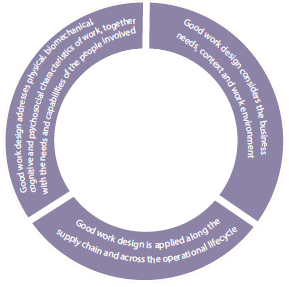
Figure 1, The WHY Principles

The WHAT Principles

What should be considered by those with design responsibilities?

Principle 4: Good work design addresses physical, biomechanical, cognitive, and psychosocial characteristics of work, together with the needs and capabilities of the people involved

  • Good work design addresses the different hazards associated with work e.g. chemical, biological, and plant hazards, hazardous manual tasks, and aspects of work that can impact mental health.
  • Work characteristics should be systematically considered when work is designed, redesigned or the hazards and risks are assessed.
  • These work characteristics should be considered in combination and one characteristic should not be considered in isolation.
  • Good work design creates jobs and tasks that accommodate the abilities and vulnerabilities of workers so far as reasonably practicable.

All tasks have key characteristics with associated hazards and risks, as shown in Figure 2 below:


Figure 2 – Key characteristics of work.

Hazards and risks associated with tasks are identified and controlled during good work design processes and they should be considered in combination with all hazards and risks in the workplace. This highlights that it is the combination that is important for good work design.

Workers can also be exposed to a number of different hazards from a single task. For example, meat boning is a common task in a meat-processing workplace. This task has a range of potential hazards and risks that need to be managed, e.g. physical, chemical, biological, biomechanical, and psychosocial. Good work design means the hazards and risks arising from this task are considered both individually and collectively to ensure the best control solutions are identified and applied.

Good work design can prevent unintended consequences which might arise if task control measures are implemented in isolation from other job considerations. For example, automation of a process may improve production speed and reduce musculoskeletal injuries but increase the risk of hearing loss if effective noise control measures are not also considered.

Workers have different needs and capabilities; good work design takes these into account. This includes designing to accommodate them given the normal range of human cognitive, biomechanical and psychological characteristics of the work.

Information: The Australian workforce is changing. It is typically older with higher educational levels, more inclusive of people with disabilities, and more socially and ethnically diverse. Good work design accommodates and embraces worker diversity. It will also help a business become an employer of choice, able to attract and retain an experienced workforce.

Principle 5: Good work design considers the business needs, context, and work environment.

  • Good work design is ‘fit for purpose’ and should reflect the needs of the organization including owners, managers, workers, and clients.
  • Every workplace is different so approaches need to be context-specific. What is good for one situation cannot be assumed to be good for another, so off-the-shelf solutions may not always suit every situation.
  • The work environment is broad and includes: the physical structures, plant and technology, work layout, organizational design and culture, human resource systems, work health and safety processes, and information/control systems.

The business organizational structure and culture, decision-making processes, work environment, and how resources and people are allocated to the work will, directly and indirectly, impact on work design and how well and safely the work is done.

The work environment includes the physical structures, plant, and technology. Planning for relocations, refurbishments, or when introducing new engineering systems are ideal opportunities for businesses to improve their work designs and avoid foreseeable risks.

These are amongst the most common work changes a business undertakes yet good design during these processes is often quite poorly considered and implemented. An effective design following the processes described in this handbook can yield significant business benefits.

Information: Off-the-shelf solutions can be explored for some common tasks, however usually design solutions need to be tailored to suit a particular workplace.

Good work design is most effective when it addresses the specific business needs of the individual workplace or business. Typically work design solutions will differ between small and large businesses.

However, all businesses must eliminate or minimize their work health and safety risks so far as reasonably practicable. The specific strategies and controls will vary depending on the circumstances.

The table on the next page demonstrates how to step through the good work design process for small and large businesses.

Good design steps In a large business that is downsizing In a small business that is undergoing a refit
Management commitment Senior management make their commitment to good work design explicit ahead of downsizing and may hire external expertise.   The owner tells workers about their commitment to designing-out hazards during the upcoming refit of the store layout to help improve safety and efficiency.  
Consult The consequences of downsizing and how these can be managed are discussed in senior management and WHS committee meetings with appropriate representation from affected work areas.   The owner holds meetings with their workers to identify possible issues ahead of the refit.  
Identify A comprehensive workload audit is undertaken to clarify opportunities for improvements.   The owner discusses the proposed refit with the architect and builder and gets ideas for dealing with issues raised by workers.  
Assess A cost-benefit analysis is undertaken to assess the work design options to manage the downsizing.   The owner, architect, and builder jointly discuss the proposed refit and any worker issues directly with workers.   
Control A change management plan is developed and implemented to appropriately structure teams and improve systems of work. Training is provided to support the new work arrangements.   The building refit occurs. Workers are given training and supervision to become familiar with a new layout and safe equipment use.  
Review The work redesign process is reviewed against the project aims by senior managers.   The owner checks with the workers that the refit has improved working conditions and efficiency and there are no new issues.  
Improve Following consultation, refinement of the redesign is undertaken if required.   Minor adjustments to the fit-out are made if required.  
Table 1 – steps in good work design for large and small businesses

Principle 6: Good work design is applied along the supply chain and across the operational lifecycle.

  • Good work design should be applied along the supply chain in the design, manufacture, distribution, use and disposal of goods and the supply of services.
  • Work design is relevant at all stages of the operational life cycle, from start-up, routine operations, maintenance, downsizing and cessation of business operations.
  • New initiatives, technologies, and changes in organizations have implications for work design and should be considered.

Information: Supply chains are often made up of complex commercial or business relationships and contracts designed to provide goods or services. These are often designed to provide goods or services to a large, dominant business in a supply chain. The human and operational costs of poor design by a business can be passed up or down the supply chain.

Businesses in the supply chain can have significant influence over their supply chain partners’ work health and safety through the way they design the work.

Businesses may create risks and so they need to be active in working with their supply chains and networks to solve work health and safety problems and share practical solutions for example, for common design and manufacturing problems.

Health and safety risks can be created at any point along the supply chain, for example, loading and unloading causing time pressure for the transport business.

There can be a flow-on effect where the health and safety and business ‘costs’ of poor design may be passed down the supply chain. These can be prevented if businesses work with their supply chain partners to understand how contractual arrangements affect health and safety.

Procurement and contract officers can also positively influence their own organization and others’ work health and safety throughout the supply chain through the good design of contracts. 

When designing contractual arrangements businesses could consider ways to support good work design safety outcomes by:

  • setting clear health and safety expectations for their supply chain partners, for example through the use of codes of conduct or quality standards
  • conducting walk-through inspections, monitoring, and comprehensive auditing of supply chain partners to check adherence to these codes and standards
  • building the capability of their own procurement staff to understand the impacts of contractual arrangements on their suppliers, and
  • consulting with their supply chain partners on the design of good work practices.

Information: The road transport industry is an example of the application of how this principle can help improve drivers’ health and safety and address issues arising from supply chain arrangements. For example, the National Heavy Vehicle Laws ‘chain of responsibility’ requires all participants in the road transport supply chain to take responsibility for driver work health and safety. Contracts must be designed to allow drivers to work reasonable hours, take sufficient breaks from driving and not have to speed to meet deadlines.

The design of products will strongly impact both health and safety and business productivity throughout their lifecycles. At every stage, there are opportunities to eliminate or minimize risks through good work design. The common product lifecycle stages are illustrated in Figure 3 below.

A diagram of common product lifecycle
Figure 3 – common product lifecycle

Information: For more information on the design of structures and plant see ‘Safe design of structures’ and Managing the risks of plant in the workplace and other design guidance on the Safe Work Australia website.

The good work design principles are also relevant at all stages of the business life cycle. Some of these stages present particularly serious and complex work health and safety challenges such as during the rapid expansion or contraction of businesses. Systematic application of good work design principles during these times can achieve positive work health and safety outcomes.

New technology is often a key driver of change in work design. It has the potential to improve the quality of outputs, efficiency, and safety of workers, however introducing new technology could also introduce new hazards and unforeseen risks. Good work design considers the impact of the new initiatives and technologies before they are introduced into the workplace and monitors their impact over time.

Information: When designing a machine for safe use, how the maintenance will be undertaken in the future should be considered.

In most workplaces, information and communication technology (ICT) systems are an integral part of all business operations. In practice, these are often the main drivers of work changes but are commonly overlooked as sources of workplace risks. Opportunities to improve health and safety should always be considered when new ICT systems are planned and introduced.
A diagram of the WHAT principles
Figure 4, The ICT Triad

The HOW Principles

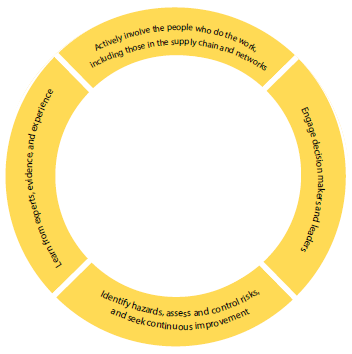
Principle 7: Engage decision-makers and leaders

  • Work design or redesign is most effective when there is a high level of visible commitment, practical support, and engagement by decision-makers.
  • Demonstrating the long-term benefits of investing in good work design helps engage decision-makers and leaders.
  • Practical support for good work design includes the allocation of appropriate time and resources to undertake effective work design or redesign processes.

Information: Leaders are the key decision-makers or those who influence the key decision-makers. Leaders can be the owners of a business, directors of boards, and senior executives.

Leaders can support good work design by ensuring the principles are appropriately included or applied, for example in:

  • key organizational policies and procedures
  • proposals and contracts for workplace change or design
  • managers’ responsibilities and as key performance indicators
  • business management systems and audit reports
  • organizational communications such as a standing item on leadership meeting agendas, and
  • the provision of sufficient human and financial resources.

Good work design, especially for complex issues will require adequate time and resources to consider and appropriately manage organizational and/or technological change. Like all business changes, research shows that leader commitment to upfront planning helps ensure better outcomes.

Managers and work health and safety advisors can help this process by providing their leaders with appropriate and timely information. This could include for example:

  • identifying design options that support both business outcomes and work health and safety objectives
  • assessing the risks and providing short and long term cost-benefit analysis of the recommended controls to manage these risks, and
  • identifying what decisions need to be taken, when and by whom to effectively design and implement the agreed changes.

Principle 8: Actively involve the people who do the work, including those in the supply chain and networks

  • Persons conducting a business or undertaking (PCBUs) must consult with their workers and others likely to be affected by work in accordance with the work health and safety laws.
  • Supply chain stakeholders should be consulted as they have local expertise about the work and can help improve work design for upstream and downstream participants.
  • Consultation should promote the sharing of relevant information and provide opportunities for workers to express their views, raise issues, and contribute to decision-making where possible.

Effective consultation and cooperation of all involved with open lines of communication will ultimately give the best outcomes. Consulting with those who do the work not only makes good sense, it is required under the WHS laws.

Information: Under the model WHS laws (s47), a business owner must, so far as is reasonably practicable, consult with ‘workers who carry out work for the business or undertaking who are, or are likely to be, directly affected by a matter relating to work health or safety.’ This can include a work design issue.

If more than one person has a duty in relation to the same matter, ‘each person with the duty must, so far as is reasonably practicable, consult, co-operate and co-ordinate activities with all other persons who have a duty in relation to the same matter’ (model WHS laws s46).

Workers have knowledge about their own job and often have suggestions on how to solve a specific problem. Discussing design options with them will help promote their ownership of the changes. See Code of practice on consultation.

Businesses that operate as part of a supply chain should consider whether the work design and changes to the work design might negatively impact on upstream or downstream businesses. The supply chain partners will often have solutions to logistics problems that can benefit all parties.

Principle 9: Identify hazards, assess and control risks, and seek continuous improvement

  • A systematic risk management approach should be applied in every workplace.
  • Designing good work is part of the business process and not a one-off event.
  • Sustainability in the long-term requires that designs or redesigns are continually monitored and adjusted to adapt to changes in the workplace so as to ensure feedback is provided and that new information is used to improve the design.

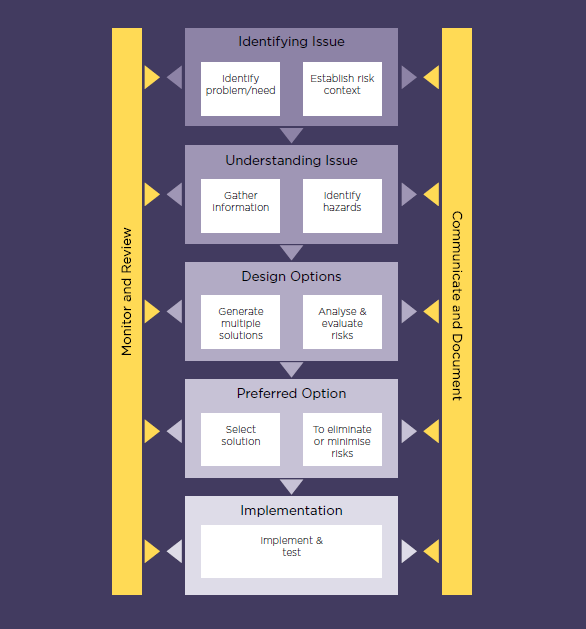
Good work design should systematically apply the risk management approach to workplace hazards and risks. See Principle 4 for more details.

Typically good work design will involve ongoing discussions with all stakeholders to keep refining the design options.  Each stage in the good work design process should have decision points for review of options and to consult further if these are not acceptable. This allows for flexibility to quickly respond to unanticipated and adverse outcomes.

Figure 5 outlines how the risk management steps can be applied in the design process

Continuous improvements in work health and safety can in part be achieved if the good work design principles are applied at business start-ups and whenever major organizational changes are contemplated. To be most effective, consideration of health and safety issues should be integrated into normal business risk management.
A diagram of steps in the good work design process
Figure 5 – Steps in the good work design process

Principle 10: Learn from experts, evidence, and experience

  • Continuous improvement in work design and hence work health and safety requires ongoing collaboration between the various experts involved in the work design process.
  • Various people with specific skills and expertise may need to be consulted in the design stage to fill any knowledge gaps. It is important to recognize the strengths and limitations of a single expert’s knowledge.
  • Near misses, injuries and illnesses are important sources of information about poor design.

Most work design processes will require collaboration and cooperation between internal and sometimes external experts. Internal advice can be sought from workers, line managers, technical support and maintenance staff, engineers, ICT systems designers, work health and safety advisors, and human resource personnel.

Depending on the design issue, external experts may be required such as architects, engineers, ergonomists, occupational hygienists, and psychologists.

Information: If you provide advice on work design options it is important to know and work within the limitations of your discipline’s knowledge and expertise. Where required make sure you seek advice and collaborate with other appropriate design experts.

For complex and high-risk projects, ideally, a core group of the same people should remain involved during both the design and implementation phases with other experts brought in as necessary.

The type of expert will always depend on the circumstances. When assessing the suitability of an expert consider their qualifications, skills, relevant knowledge, technical expertise, industry experience, reputation, communication skills, and membership of professional associations.

Information:  Is the consultant suitably qualified?
A suitably qualified person has the knowledge, skills, and experience to provide advice on a specific design issue. You can usually check with the professional association to see if the consultant is certified or otherwise recognized by them to provide work design advice.

The decision to design or redesign work should be based on sound evidence. Typically this evidence will come from many sources such as both proactive and reactive indicators, information about new technology, or the business decisions to downsize, expand or restructure or to meet the requirements of supply chain partners.

Proactive and reactive indicators can also be used to monitor the effectiveness and efficiency of the design solution.

Information: Proactive indicators provide early information about the work system that can be used to prevent accidents or harm. These might include for example: key process variables such as temperature or workplace systems indicators such as the number of safety audits and inspections undertaken.

Reactive indicators are usually based on incidents that have already occurred. Examples include the number and type of near misses and worker injury and illness rates.

Useful information about common work design problems and solutions can also often be obtained from:

  • work health and safety regulators
  • industry associations and unions
  • trade magazines and suppliers, and
  • specific research papers.
A diagram of the HOW principles
Figure 6, Sources of Work Design Information

Good Work Design: Summary

The ten principles of good work design can be applied to help support better work health and safety outcomes and business productivity. They are deliberately high level and should be broadly applicable across the range of Australian businesses and workplaces. Just as every workplace is unique, so is the way each principle can be applied in practice.

When considering these principles in any work design also ensure you take into account your local jurisdictional work health and safety requirements.

My name’s Simon Di Nucci. I’m a practicing system safety engineer, and I have been, for the last 25 years; I’ve worked in all kinds of domains, aircraft, ships, submarines, sensors, and command and control systems, and some work on rail air traffic management systems, and lots of software safety. So, I’ve done a lot of different things!

Good Work Design: Copyright

Much of the content of this post is taken from the Principles of Good Work Design handbook from Safe Work Australia. The handbook is © Commonwealth of Austr​alia, 2019; this document is covered by a Creative Commons licence (CCBY 4.0) – for full details see here.

I have made some changes to the text to improve the layout and correct minor problems with Figure numbering in the original document. ‘Top Tips’ are my own, based on my 10+ years of experience working in system safety under Austalian WHS.

What do you think of Good Work Design?

Back to the Home Page

Categories
Behind the Scenes Blog

Testimonials

Testimonials from 20+ years in the industry. Hear what some clients and ex-colleagues have to say about The Safety Artisan.

General Testimonials

The way you teach this subject makes it comprehensible and part of an integral whole. It seems like your approach is rare (and valuable) in the world of System Safety.

Thomas Anthony
Director, Aviation Safety and Security Program
Viterbi School of Engineering
University of Southern California

“Hi Simon, I would just like to say that the content you have been putting out recently is absolutely amazing and I enjoy reading and listening through it.”

James Moodie

“Simon, Love the even-handed approach you’ve adopted and also the tongue-in-cheek comments.” 

Paul Bird, Former Manager Safety Engineering, BAES Australia

“Explanation about the military standard was very interesting, because for the first time somebody talked about possible disadvantages.”

Henri Van Buren, reviewing “System Safety Risk Analysis Programs”

“Valuable information, Clear explanations, Engaging delivery, Helpful practice activities, Accurate course description, Knowledgeable instructor.”

Manuel Louie B. Santos, reviewing “Risk Management 101”

“Understanding safety law can be difficult and, at times, confronting.  Thankfully, Simon has a knack of bringing clarity to complex legal requirements, using real work examples to help understanding.  I highly recommend Simon to any director or manager wanting to understand their legal obligations and ensure a safe workplace.”

Jonathan Carroll, Senior Leadership, Pacific National

“Simon, You are and always will be the master at explaining the way Safety management works in real life. It is great to see your broad and vast experience being available through this medium and The Safety Artisan website. I will definitely be dropping in to seek your trusted guidance.”

Kevin Payne, Systems Safety Consultant at QinetiQ

Testimonials from Udemy Courses

Principles of Software Safety Standards (scores 4.42 out of 5.00)

Performance by course attribute:

  • Are you learning valuable information? 97% said YES!
  • Are the explanations of concepts clear? 100% said YES!
  • Is the instructor’s delivery engaging? 95% said YES!
  • Are there enough opportunities to apply what you are learning? 86% said YES!
  • Is the course delivering on your expectations? 94% said YES!
  • Is the instructor knowledgeable about the topic? 97% said YES!

Get your discount here (please use this link, otherwise Udemy take 67% of the price).

How to Design a System Safety Program (scores 4.29 out of 5.00)

Performance by course attribute:

  • Are you learning valuable information? 100% said YES!
  • Are the explanations of concepts clear? 100% said YES!
  • Is the instructor’s delivery engaging? 100% said YES!
  • Are there enough opportunities to apply what you are learning? 100% said YES!
  • Is the course delivering on your expectations? 75% said YES!
  • Is the instructor knowledgeable about the topic? 100% said YES!

Get your discount here (please use this link, otherwise Udemy take 67% of the price).

How to Prepare for the CISSP Exam (scores 4.61 out of 5.00)

Performance by course attribute:

  • Are you learning valuable information? 100% said YES!
  • Are the explanations of concepts clear? 100% said YES!
  • Is the instructor’s delivery engaging? 100% said YES!
  • Are there enough opportunities to apply what you are learning? 100% said YES!
  • Is the course delivering on your expectations? 100% said YES!
  • Is the instructor knowledgeable about the topic? 100% said YES!

Get it for FREE here.

Risk Management 101 (scores 4.48 out of 5.00)

Performance by course attribute:

  • Are you learning valuable information? 100% said YES!
  • Are the explanations of concepts clear? 100% said YES!
  • Is the instructor’s delivery engaging? 100% said YES!
  • Are there enough opportunities to apply what you are learning? 94% said YES!
  • Is the course delivering on your expectations? 97% said YES!
  • Is the instructor knowledgeable about the topic? 100% said YES!

Get it for FREE here.

Back to Home Page.

Categories
Behind the Scenes

How to Get the Most from The Safety Artisan #3

This is ‘How to Get the Most from The Safety Artisan #3’.

Last time #2, I posted about the two major focus areas for The Safety Artisan’s teaching. These are System Safety and Australian Work Health and Safety or WHS.

In my first post, I talked about the fundamental lessons under the start here topic. Even if you are experienced in safety, you may find that things are done very differently in another industry or country – I did. 

Now for Something Completely Different

Hi everyone, and welcome to The Safety Artisan. I’m your host, Simon. In this post, I want to talk about how you can connect with me, The Safety Artisan, and get more out of the website.

There are three ways you can do this.

Get Free and Low-cost Courses on Udemy

I have lots of free and paid and low-cost courses on Udemy. In these, I provide video lessons and lots of supporting content, for example, my PHIA Guide.

Front cover of PHIA Guide
Subscribe to The Safety Artisan Mailing List and get your Free Gift!

Follow on YouTube or Social Media

Second, you can follow the safety Artisan on YouTube or on social media. If you sign up on my YouTube Channel and tick for notifications, you will be reminded every time I issue a new video lesson.

I’m also on Twitter, Instagram, Facebook, Google My Business, Tumblr, Pinterest, and Vkontakte. Phew! 

On LinkedIn, you can see my full resume/CV and find my most popular articles.

Just Get in Touch

Third, you can directly get in touch with me by commenting on a post – ask a question! There is no such thing as a ‘dumb’ question, only dumb accidents.

You can also ask general questions by filling in the form on the Connect Page. (This is better than sending me a Direct Message on social media, as I get a lot of spam.)

There are a lot of different topics that I could cover. It is surprisingly difficult to find out what people really like to hear about. So, if there’s something that you want to learn about then just ask. I will bump the topic up on my ‘to do’ list.

That’s All, folks!

Well, that’s it from me, I hope you enjoy The Safety Artisan website and get as much as you can out of it. See you soon!

How to Get the Most from #3: What subjects do you want?

Leave a comment.

Categories
Behind the Scenes

How to Get the Most fromThe Safety Artisan #2

Hi everyone, and welcome to The Safety Artisan. I’m Simon, your host. This is ‘How to Get the Most from The Safety Artisan #2’.

In my previous post (#1) I talk about the Start Here topic page. There you will find lessons that deal with fundamental issues – most of them are free.

This time I’m talking about two other topic areas, which are the main focus of The Safety Artisan – so far. 

System Safety

The first topic is system safety. I spend a lot of time talking about system safety because it’s used in so many different industries. You can apply its principles to just about anything.

And because it takes a systematic approach to safety you can scale it up or down. It is used on the biggest, multinational, multi-billion dollar projects you can imagine. You can also tailor it so that it can be used sensibly on much smaller projects. You can get good results for a lot less money and time.

So I present a whole suite of sessions on system safety, in particular how to do system safety analysis according to a US Military Standard 882E. Whether you’re working on US military systems or not doesn’t matter. The principles, practices, and procedures in the standard will equip you to tackle almost any standard.

But you’ve got to understand your standard, and what it was designed to achieve. Then you can make it work for you.

Australian Work Health and Safety

The second topic that I cover in detail is Australian Work Health and Safety (WHS). I’ve done a series on WHS because I find that is often misunderstood.

Unusually for health and safety legislation, WHS covers not just workplace health and safety, but the duties of designers, manufacturers, importers, installers, and users of plant, substances, and structures. In fact, anyone who is involved through its lifecycle.

Coming to Australia?

WHS also contains and concepts like ‘So Far As Is Reasonably Practicable or SFAIRP/SFARP. These are often misunderstood and misapplied. This is a shame because the public guidance that is out there is excellent.

For example, I introduce Codes of Practice, especially the ones that tell you how to manage risk and Consult, Cooperate, and Coordinate on WHS matters. From my personal experience, I explain how to use this guidance and how to get results.

Even if you don’t work in Australia, you’ll find that many principles used in WHS law are found in other western nations. For example, I compared safety laws in the UK and Australia, based on my experience of working in both countries.

How to Get the Most from The Safety Artisan #3: Coming Soon…

Next time, I talk about how you can connect and interact with The Safety Artisan to get better learning results for you!

Categories
Behind the Scenes

How to Get the Most from The Safety Artisan #1

In this post, ‘How to Get the Most from The Safety Artisan #1’ I will show you some of the free resources you can access…

Welcome

Hi everyone, and welcome to The Safety Artisan, my name is Simon and I’m a professional system safety engineer with more than 25 years of experience in various industries.

Simon Di Nucci, FIE(Aust), MSc, CPEng NER

In the next three posts, I’m going to tell you how to get the most from The Safety Artisan website. I’m going to start with the basics. 

Start Here

As the name suggests, start here is a good place for newcomers to start looking at blog posts and lesson videos. Most of them are Free!

Now, before you skip this bit because you’ve done some work in safety before, let me share two things with you.

Concepts

I have worked on many projects where we didn’t have a clear and unambiguous idea of what ‘safe’ means. I’m not joking!

That’s right, we were spending lots of money trying to make something safe, but we didn’t really know what that meant. Surprisingly, the bigger and more expensive the project, the more difficult it is to get a clear picture of the basics. This might sound daft but on a big project, you have to work hard to stay focused on the fundamental principles of what you’re trying to achieve.

If from the very beginning, you can understand clearly what safe means in your particular domain is, and how are you are going to manage risk, then you can arrive at a successful end game. But it’s not easy.

Second, Differences Across Countries and Industries

Another point to note is that many industries do things differently. You may have worked in rail, or in a chemical plant, or with ships, submarines, or planes and you know how safety works in your industry. But it’s still good to learn from others – and their mistakes.

‘Learn from others’ Mistakes’ said Bismark.

I have worked in all of these industries – and more – and I can tell you that the way things are done in different domains varies greatly. So when you’re going for an interview, or when you’re starting a new job, you might get some surprises…

The law on safety (and environmental protection) also varies from country to country. I’ve worked on projects in the UK, Australia, Europe, and the USA, and there are significant differences in practice. In particular, I emigrated from the UK to Australia, and I’ve compared practices in the two countries.

Coming Next…

Next week I will tell you about the more advanced topics that I cover. In the Third Post, I will talk about how you can connect with The Safety Artisan and get the online learning that YOU want.

Categories
Blog Functional Safety

Functional Safety

The following is a short, but excellent, introduction to the topic of ‘Functional Safety’ by the United Kingdom Health and Safety Executive (UK HSE). It is equally applicable outside the UK, and the British Standards (‘BS EN’) are versions of international ISO/IEC standards – e.g. the Australian version (‘AS/NZS’) is often identical to the British standard.

My comments and explanations are shown [thus].

[Functional Safety]

“Functional safety is the part of the overall safety of plant and equipment that depends on the correct functioning of safety-related systems and other risk reduction measures such as safety instrumented systems (SIS), alarm systems and basic process control systems (BPCS).

[Functional Safety is popular, in fact almost ubiquitous, in the process industry, where large amounts of flammable liquids and gasses are handled. That said, the systems and techniques developed by and for the process industry have been so successful that they are found in many other industrial, transport and defence applications.]

SIS [Safety Instrumented Systems]

SIS are instrumented systems that provide a significant level of risk reduction against accident hazards.  They typically consist of sensors and logic functions that detect a dangerous condition and final elements, such as valves, that are manipulated to achieve a safe state.

The general benchmark of good practice is BS EN 61508, Functional safety of electrical/electronic/programmable electronic safety related systems. BS EN 61508 has been used as the basis for application-specific standards such as:

  • BS EN 61511: process industry
  • BS EN 62061: machinery
  • BS EN 61513: nuclear power plants

BS EN 61511, Functional safety – Safety instrumented systems for the process industry sector, is the benchmark standard for the management of functional safety in the process industries. It defines the safety lifecycle and describes how functional safety should be managed throughout that lifecycle. It sets out many engineering and management requirements, however, the key principles of the safety lifecycle are to:

  • use hazard and risk assessment to identify requirements for risk reduction
  • allocate risk reduction to SIS or to other risk reduction measures (including instrumented systems providing safety functions of low / undefined safety integrity)
  • specify the required function, integrity and other requirements of the SIS
  • design and implement the SIS to satisfy the safety requirements specification
  • install, commission and validate the SIS
  • operate, maintain and periodically proof-test the SIS
  • manage modifications to the SIS
  • decommission the SIS

BS EN 61511 also defines requirements for management processes (plan, assess, verify, monitor and audit) and for the competence of people and organisations engaged in functional safety.  An important management process is Functional Safety Assessment (FSA) which is used to make a judgement as to the functional safety and safety integrity achieved by the safety instrumented system.

Alarm Systems

Alarm systems are instrumented systems designed to notify an operator that a process is moving out of its normal operating envelope to allow them to take corrective action.  Where these systems reduce the risk of accidents, they need to be designed to good practice requirements considering both the E,C&I design and human factors issues to ensure they provide the necessary risk reduction.

In certain limited cases, alarm systems may provide significant accident risk reduction, where they also might be considered as a SIS. The general benchmark of good practice for management of alarm systems is BS EN 62682.

BPCS [Basic Process Control Systems]

BPCS are instrumented systems that provide the normal, everyday control of the process.  They typically consist of field instrumentation such as sensors and control elements like valves which are connected to a control system, interfaced, and could be operated by a plant operator.  A control system may consist of simple electronic devices like relays or complicated programmable systems like DCS (Distributed Control System) or PLCs (Programmable Logic Controllers).

BPCS are normally designed for flexible and complex operation and to maximize production rather than to prevent accidents.  However, it is often their failure that can lead to accidents, and therefore they should be designed to good practice requirements. The general benchmark of good practice for instrumentation in process control systems is BS 6739.”

[To be honest, I would have put this the other way around. The BCPS came first, although they were just called ‘control systems’, and some had alarms to get the operators’ attention. As the complexity of these control systems increased, then cascading alarms became a problem and alarms had to be managed as a ‘thing’. Finally, the process industry used additional systems, when the control system/alarm system combo became inadequate, and thus the terms SIS and BCPS were born.]

[It’s worth noting that for very rapid processes where a human either cannot intervene fast enough or lacks the data to do so reliably, the SIS becomes an automatic protection system, as found in rail signaling systems, or ‘autonomous’ vehicles. Also for domains where there is no ‘fail-safe’ state, for example in aircraft flight control systems, the tendency has been to engineer multiple, redundant, high-integrity control systems, rather than use a BCPS/SIS combo.]

Copyright

The above text is reproduced under Creative Commons Licence from the UK HSE’s webpage. The Safety Artisan complies with such licensing conditions in full.

[Functional Safety – END]

Back to Home Page

Categories
Mil-Std-882E Safety Analysis System Safety

How to Understand Safety Standards

Learn How to Understand Safety Standards with this FREE session from The Safety Artisan.

In this module, Understanding Your Standard, we’re going to ask the question: Am I Doing the Right Thing, and am I Doing it Right? Standards are commonly used for many reasons. We need to understand our chosen system safety engineering standard, in order to know: the concepts, upon which it is based; what it was designed to do, why and for whom; which kinds of risk it addresses; what kinds of evidence it produces; and it’s advantages and disadvantages.

Understand Safety Standards : You’ll Learn to

  • List the hazard analysis tasks that make up a program; and
  • Describe the key attributes of Mil-Std-882E. 
Understanding Your Standard

Topics:  Understand Safety Standards

Aim: Am I Doing the Right Thing, and am I Doing it Right?

  • Standards: What and Why?
  • System Safety Engineering pedigree;
  • Advantages – systematic, comprehensive, etc:
  • Disadvantages – cost/schedule, complexity & quantity not quality.

Transcript: Understand Safety Standards

Click here for the Transcript on Understanding Safety Standards

In Module Three, we’re going to understand our Standard. The standard is the thing that we’re going to use to achieve things – the tool. And that’s important because tools designed to do certain things usually perform well. But they don’t always perform well on other things. So we’re going to ask ‘Are we doing the right thing?’ And ‘Are we doing it right?’

What and Why?

So, what are we going to do, and why are we doing it? First of all, the use of standards in safety is very common for lots of reasons. It helps us to have confidence that what we’re doing is good enough. We’ve met a standard of performance in the absolute sense. It helps us to say, ‘We’ve achieved standardization or commonality in what we’re doing’. And we can also use it to help us achieve a compromise. That can be a compromise across different stakeholders or across different organizations. And standardization gives us some of the other benefits as well. If we’re all doing the same thing rather than we’re all doing different things, it makes it easier to train staff. This is one example of how a standard helps.

However, we need to understand this tool that we’re going to use. What it does, what it’s designed to do, and what it is not designed to do. That’s important for any standard or any tool. In safety, it’s particularly important because safety is in many respects intangible. This is because we’re always looking to prevent a future problem from occurring. In the present, it’s a little bit abstract. It’s a bit intangible. So, we need to make sure that in concept what we’re doing makes sense and is coherent. That it works together. If we look at those five bullet points there, we need to understand the concept of each standard. We need to understand the basis of each one.

And they’re not all based on the same concept. Thus some of them are contradictory or incompatible. We need to understand the design of the standard. What the standard does, what the aim of the standard is, why it came into existence. And who brought it into existence. To do what for who – who’s the ultimate customer here?

And for risk analysis standards, we need to understand what kind of risks it addresses. Because the way you treat a financial risk might be very different from a safety risk. In the world of finance, you might have a portfolio of products, like loans. These products might have some risks associated with them. One or two loans might go bad and you might lose money on those. But as long as the whole portfolio is making money that might be acceptable to you. You might say, ‘I’m not worried about that 10% of my loans have gone south and all gone wrong. I’m still making plenty of profit out of the other 90%’. It doesn’t work that way with safety. You can’t say ‘It’s OK that I’ve killed a few people over here because all this a lot over here are still alive!’. It doesn’t work like that!

Also, what kind of evidence does the standard produce? Because in safety, we are very often working in a legal framework that requires us to do certain things. It requires us to achieve a certain level of safety and prove that we have done so. So, we need certain kinds of evidence. In different jurisdictions and different industries, some evidence is acceptable. Some are not. You need to know which is for your area.

And then finally, let’s think about the pros and cons of the standard, what does it do well? And what does it do not so well?

System Safety Pedigree

We’re going to look at a standard called Military Standard 882E. Many decades ago, this standard developed was created by the US government and military to help them bring into service complex-cutting edge military equipment. Equipment that was always on the cutting edge. That pushed the limits of what you could achieve in performance.

That’s a lot of complexity. Lots of critical weapon systems, and so forth. And they needed something that could cope with all that complexity. It’s a system safety engineering standard. It’s used by engineers, but also by many other specialists. As I said, it’s got a background from military systems. These days you find these principles used pretty much everywhere. So, all the approaches to System Safety that 882 introduced are in other standards. They are also in other countries.

It addresses risks to people, equipment, and the environment, as we heard earlier. And because it’s an American standard, it’s about system safety. It’s very much about identifying requirements. What do we need to happen to get safety? To do that, it produces lots of requirements. It performs analyses in all those requirements and generates further requirements. And it produces requirements for test evidence. We then need to fulfill these requirements. It’s got several important advantages and disadvantages. We’re going to discuss these in the next few slides.

Comprehensive Analysis

Before we get to that, we need to look at the key feature of this standard. The strengths and weaknesses of this standard come from its comprehensive analysis. And the chart (see the slide) is meant to show how we are looking at the system from lots of different perspectives. (It’s not meant to be some arcane religious symbol!) So, we’re looking at a system from 10 different perspectives, in 10 different ways.

Going around clockwise, we’ve got these ten different hazard analysis tasks. First of all, we start off with preliminary hazard identification. Then preliminary hazard analysis. We do some system requirements hazard analysis. So, we identify the safety requirements that the system is going to meet so that we are safe. We look at subsystem and system hazard analysis. At operating and support hazard analysis – people working with the system. Number seven, we look at health hazard analysis – Can the system cause health problems for people? Functional hazard analysis, which is all about what it does. We’re thinking of sort of source software and data-driven functionality. Maybe there’s no physical system, but it does stuff. It delivers benefits or risks. System of systems hazard analysis – we could have lots of different and/or complex systems interacting. And then finally, the tenth one – environmental hazard analysis.

If we use all these perspectives to examine the system, we get a comprehensive analysis of the system. From this analysis, we should be confident that we have identified everything we need to. All the hazards and all the safety requirements that we need to identify. Then we can confidently deliver an appropriate safe system. We can do this even if the system is extremely complex. The standard is designed to deal with big, complex cutting-edge systems.

Advantages #1

In fact, as we move on to advantages, that’s the number one advantage of this standard. If we use it and we use all 10 of those tasks, we can cope with the largest and the most demanding programs. I spent much of my career working on the Eurofighter Typhoon. It was a multi-billion-dollar program. It cost hundreds of billions of dollars, four different nations worked together on it. We used a derivative of Mil. Standard 882 to look at safety and analyze it. And it coped. It was powerful enough to deal with that gigantic program. I spent 13 years of my life on and off on that program so I’d like to think that I know my stuff when we’re talking about this.

As we’ve already said, it’s a systematic approach to safety. Systems, safety, engineering. And we can start very early. We can start with early requirements – discovery. We don’t even need a design – we know that we have a need. So we can think about those needs and analyze them.

And it can cover us right through until final disposal. And it covers all kinds of elements that you might find in a system. Remember our definition of ‘system’? It’s something that consists of hardware, software, data, human beings, etc. The standard can cope with all the elements of a system. In fact, it’s designed into the standard. It was specifically designed to look at all those different elements. Then to get different insights from those elements. It’s designed to get that comprehensive coverage. It’s really good at what it does. And it involves, not just engineers, but people from all kinds of other disciplines. Including operators, maintainers, etc, etc.

I came from a maintenance background. I was either directly or indirectly supporting operators. I was responsible for trying to help them get the best out of their system. Again, that’s a very familiar world to me. And rigorous standards like this can help us to think rigorously about what we’re doing. And so get results even in the presence of great complexity, which is not always a given, I must say.

So, we can be confident by applying the standard. We know that we’re going to get a comprehensive and thorough analysis. This assures us that what we’re doing is good.

Advantages #2

So, there’s another set of advantages. I’ve already mentioned that we get assurance. Assurance is ‘justified confidence’. So we can have high confidence that all reasonably foreseeable hazards will be identified and analyzed. And if you’re in a legal jurisdiction where you are required to hit a target, this is going to help you hit that target.

The standard was also designed for use in contracts. It’s designed to be applied to big programs. We’d define that as where we are doing the development of complex high-performance systems. So, there are a lot of risks. It’s designed to cope with those risks.

Finally, the standard also includes requirements for contracting, for interfaces with other systems, for interfaces with systems engineering. This is very important for a variety of disciplines. It’s important for other engineering and technical disciplines. It’s important for non-technical disciplines and for analysis and recordkeeping. Again, all these things are important, whether it is for legal reasons or not. We need to do recordkeeping. We need to liaise with other people and consult with them. There are legal requirements for that in many countries. This standard is going to help us do all those things.

But, of course, in a standard everything has pros and cons and Mil. Standard 882 is no exception. So, let’s look at some of the disadvantages.

Disadvantages #1

First of all, a full system safety program might be overkill for the system that you want to use, or that you want to analyze.  The Cold War, thank goodness, is over; generally speaking, we’re not in the business of developing cutting-edge high-performance killing machines that cost billions and billions of dollars and are very, very risky. These days, we tend to reduce program risk and cost by using off-the-shelf stuff and modifying it. Whether that be for military systems, infrastructure in the chemical industry, transportation, whatever it might be. Very much these days we have a family of products and we reuse them in different ways. We mix and match to get the results that we want.

And of course, all this comprehensive analysis is not cheap and it’s not quick. It may be that you’ve got a program that is schedule-constrained. Or you want to constrain the cost and you cannot afford the time and money to throw a full 882 program at it. So, that’s a disadvantage.

The second family of problems is that these kinds of safety standards have often been applied prescriptively. The customer would often say, ‘Go away and go and do this. I’m going to tell you what to do based on what I think reduces my risk’. Or at least it covers their backside. So, contractors got used to being told to do certain things by purchasers and customers. The customers didn’t understand the standards that they were applying and insisting upon. So, the customers did not understand how to tailor a safety standard to get the result that they wanted. So they asked for dumb things or things that didn’t add value. And the contractors got used to working in that kind of environment. They got used to being told what to do and doing it because they wouldn’t get paid if they didn’t. So, you can’t really blame them.

But that’s not great, OK? That can result in poor behaviors. You can waste a lot of time and money doing stuff that doesn’t actually add value. And everybody recognizes that it doesn’t add value. So you end up bringing the whole safety program into disrepute and people treat it cynically. They treat it as a box-ticking exercise. They don’t apply creativity and imagination to it. Much less determination and persistence. And that’s what you need for a good effective system safety program. You need creativity. You need imagination. You need people to be persistent and dedicated to doing a good job. You need that rigor so that you can have the confidence that you’re doing a good job because it’s intangible.

Disadvantages #2

Let’s move onto the second kind of family of disadvantages. And this is the one that I’ve seen the most, actually, in the real world. If you do all 10 tasks and even if you don’t do all 10, you can create too many hazards. If you recall the graphic from earlier, we have 10 tasks. Each task looks at the system from a different angle. What you can get is lots and lots of duplication in hazard identification. You can have essentially the same hazards identified over and over again in each task. And there’s a problem with that, in two ways.

First of all, quality suffers. We end up with a fragmented picture of hazards. We end up with lots and lots of hazards in the hazard log, but not only that. We get fragments of hazards rather than the real thing. Remember I said those tests for what a hazard really is? Very often you can get causes masquerading as hazards. Or other things that that exacerbating factors that make things worse. They’re not a hazard in their own right, but they get recorded as hazards. And that problem results in people being unable to see the big picture of risk. So that undermines what we’re trying to do. And as I say, we get lots of things misidentified and thrown into the pot. This also distracts people. You end up putting effort into managing things that don’t make a difference to safety. They don’t need to be managed. Those are the quality problems.

And then there are quantity problems. And from personal experience, having too many hazards is a problem in itself.  I’ve worked on large programs where we were managing 250 hazards or thereabouts. That is challenging even with a sizable, dedicated team. That is a lot of work in trying to manage that number of hazards effectively. And there’s always the danger that it will slide into becoming a box-ticking exercise. Superficial at best.

I’ve also seen projects that have two and a half thousand hazards or even 4000 hazards in the hazard log. Now, once you get up to that level, that is completely unmanageable. People who have thousands of hazards in a hazard log and they think they’re managing safety are kidding themselves. They don’t understand what safety is if they think that’s going to work. So, you end up with all these items in your hazard log, which become a massive administrative burden. So people end up taking shortcuts and the real hazards are lost. The real issues that you want to focus on are lost in the sea of detail that nobody will ever understand. You won’t be able to control them.

Unfortunately, Mil. Standard 882 is good at generating these grotesque numbers of hazards. If you don’t know how to use the standard and don’t actively manage this issue, it gets to this stage. It can go and does go, badly wrong. This is particularly true on very big programs. And you really need clarity on big projects.

Summary of Module

Let’s summarize what we’ve done with this module. The aim was to help us understand whether we’re doing the right thing and whether we’ve done it right. And standards are terrific for helping us to do that. They help us to ensure we’re doing the right thing. That we’re looking at the right things. And they help us to ensure that we’re doing it rigorously and repeatedly. All the good quality things that we want. And Mil. Standard 882E that we’re looking at is a system safety engineering standard. So it’s designed to deal with complexity and high-performance and high-risk. And it’s got a great pedigree. It’s been around for a long time.

Now that gives advantages. So, we have a system safety program with this standard that helps us to deal with complexity. That can cope with big programs, with lots of risks. That’s great.

The disadvantages of this standard are that if we don’t know how to tailor or manage it properly, it can cost a lot of money. It can take a lot of time to give results which can cause problems for the program. And ultimately, you can accidentally ignore safety if you don’t deliver on time. And it can generate complexity. And it can generate a quantity of data that is so great that it actually undermines the quality of the data. It undermines what we’re trying to achieve. In that, we get a fragmented picture in which we can’t see the true risks. And so we can’t manage them effectively. If we get it wrong with this standard, we can get it really wrong. And that brings us to the end of this module.

This is Module 3 of SSRAP

This is Module 3 from the System Safety Risk Assessment Program (SSRAP) Course. Risk Analysis Programs – Design a System Safety Program for any system in any application. You can access the full course here.

You can find more introductory lessons at Start Here.

Categories
Behind the Scenes

Welcome to the New Website!

Welcome to the New Website! It has been professionally redesigned to provide a much better user experience by the awesome Sam Jusaitis. My thanks to him for doing such a great job.

The Main Pages

You can now browse through the main pages, which give you all the content that you might need, in the order that you choose it:

  • Topics. This page showcases the main safety topics that I cover, so far they are:
    • Start Here. Mostly free introductory videos for those new to safety;
    • Safety Analysis. A complete and in-depth suite of lessons on this subject; and
    • Work Health & Safety. All you need to know about Australian WHS legislation and practice.
  • About. Some information about The Safety Artisan – why you would choose safety tuition from me.
  • Connect. Here, you can sign up for free email newsletters, subscribe to our YouTube Channel, and follow us on social media.
  • Frequently Asked Questions. The most commonly Googled questions are here, with links to posts and videos that answer them.
  • Checkout. You’ll get there if you purchase any of the downloadable videos and content – but there’s plenty of free stuff too!

Welcome to the New Website Logo

Sam also designed the new logo, which reminds some people of the human eye. It was actually derived from the shapes of various warning signs, as shown below. Clever, eh?

Meet the Author

Learn safety engineering with me, an industry professional with 25 years of experience, I have:

•Worked on aircraft, ships, submarines, ATMS, trains, and software;

•Tiny programs to some of the biggest (Eurofighter, Future Submarine);

•In the UK and Australia, on US and European programs;

•Taught safety to hundreds of people in the classroom, and thousands online;

•Presented on safety topics at several international conferences.

Categories
Work Health and Safety

Consultation, Cooperation & Coordination CoP

In this 30-minute session, we look at the Consultation, Cooperation & Coordination Code of Practice (CC&C CoP). We cover the Commonwealth and Model versions of the CoP, appendices & a summary of detailed requirements; and further commentary. This CoP is one of the two that are generally applicable.

This is the three-minute demo of the full, 30-minute video.

Consultation, Cooperation & Coordination CoP: Topics

  • CC&C in the Federal or Commonwealth CoP;
  • Extra CC&C in the Model CoP;
  • (Watch out for Jurisdiction);
  • Further commentary; and
  • Where to get more information.

Consultation, Cooperation & Coordination CoP: Transcript

Click Here for the Transcript

Consultation, Cooperation & Coordination CoP

Hello, everyone, and welcome to The Safety Artisan. I’m Simon and today we’re going to be talking about a very useful subject, which is Codes of Practice. And one Code of Practice in particular, which is the Code of Practice for Consultation, Cooperation and Coordination. And it doesn’t sound like the most exciting subject, I’ll admit, but this is one of only two Codes of Practice that you must be aware of if operating in Australia, or exporting to Australia, or importing stuff to Australia, whatever it might be. The other Code of Practice that you must be aware of is the Risk Management Code of Practice. There are a lot more Code of Practices than these two, but they don’t always apply. So, I mean if you’re not doing anything to do with asbestos, you don’t have to worry about what it says in the Asbestos Code of Practice. But this one you do because it applies to everything.

Topics for this Session

And I’ve used this Code of Practice to help clients and to do particular things and help everybody understand what we have to do, and it’s very useful. And in this session, I will be explaining how to get the best out of this Code of Practice and, at the end, where to get more information. So, I hope you’ll find that useful. So we’re going to be talking about the – I’m just going to call it the C, C & C CoP for short because it’s a dreadful mouthful, isn’t it? We’re going to be looking at the federal or Commonwealth Code of Practice and then we’re going to look at some extras in the Model Code of Practice. So just to explain that briefly, the Model Code of Practice is on the Safe Work Australia website, and that is the Model from which all other CoPs are developed. However, Safe Work Australia is not a regulator. So individual regulators and the example I’m using is the Commonwealth one- or Comcare, as it’s known- they have chosen to edit the Model CoP and change it and remove quite a bit of material. Now, why they chose to do that, I do not know. So, you have to be careful which jurisdiction you’re operating in, in Australia. If you are in a Commonwealth workplace, then you need to apply the Commonwealth or the federal version of WHS, including this CoP. And if you’re in a state or territory workplace, or a commercial workplace in a state or territory, you need to apply the relevant one there. And just to complicate matters, Western Australia has not yet introduced WHS and Victoria has no plans to do so. So, of course, in Australia, we like to make life simple for ourselves, don’t we? Oh no, we don’t!

So after I’ve gone through some basics of what’s in the CoP, because you’ll see there’s an awful lot of material in there that I’m not going to talk about. I produced some commentary that I think you will find helpful and where to get more information, as I promised. So, let’s get on with it!

When to Consult

So, first of all- and you’ll notice that I’m only including those bits really that say when you must do something. So, this is quoting Section 49 of the WHS Act, which says that if you’re conducting a business or some kind of undertaking- so it’s not just a commercial business, but anything- you must consult with your workers when identifying hazards and assessing risks, making decisions about how you’re going to control those risks, making decisions about the adequacy of facilities for welfare, proposing changes that affect health and safety, and making decisions about procedures for consulting with workers, providing information and training, and so on and so forth. So, there’s a whole raft of things that you have to consult your workers on. So, this is all workplace so far. Now, in my role as a safety consultant, I’m often working with people who are introducing they’re buying bits of kit, or designing or importing bits of kit, and there is no work yet, so there’s no workers. But we always try and get a representative of the end-user involved because that really does help you do good quality safety work and avoid- to be honest- wasting time and money on things that are theoretically possible or theoretically sound problematic but in reality, it just doesn’t arise for whatever reason. So, I really do recommend getting those end-user representatives involved.

Effective Consultation

And if we go on to Section 48- for some reason, the cop quotes these things in reverse order- to be effective in consultation, we require information to be shared. Workers have got to have a reasonable opportunity to express their views. They’ve got to have a reasonable opportunity to contribute to decisions. Their views must be taken into account and they must be advised of the outcomes of consultation. So, all good common-sense stuff, I would think. Nothing controversial about this and that- to be honest- that’s a feature of CoPs. They tell you to do things that you think, “Yeah, I really ought to be doing that!”.

Consultation Procedures

Continuing with the countdown, we’re on to Section 47. Consultation procedures, again more basic common sense. If you’ve agreed to procedures for consultation, you must follow those procedures. It’s not rocket science, is it, folks? Let’s move on.

Sections 16 & 46

OK, now this is a bit more interesting, I think. This is getting into the real guts of this Code of Practice because where consultation, cooperation and coordination really come into play is where you’ve got multiple stakeholders, multiple duty holders- that is to say, those with a duty to protect the health and safety of people. Where multiple stakeholders, duty holders, have to get together and work together in order to come up with a solution. So the law says- Section 16 says where more than one person has a duty for the same thing, for the same matter, each person retains that responsibility. You cannot wriggle out of your responsibility just because you only control a bit over here and not over here. So, the two duty holders who have control here and here, they have to work together. The law says so. And so this is really the guts of this Code of Practice. And they must work together to discharge their duties to the extent to which they can. And the extent to which you can is the extent to which you influence and control the matter. So, WHS law is very big about control. If you have control of the bit, you’ve got to do your bit and you must work with people who have control of other things. You might be designing or buying a piece of kit. Other people might control the workplace. There might be another group of people who represent the operators, and then another group who represent the maintainers, and so on and so forth. They’ve all got to be involved if they’re relevant to managing risk. And of course, as risk in WHS is cradle to grave, then pretty much everyone is involved.

So, Section 46, and in these situations where you have got multiple duty holders, each person with a duty must, so far as is reasonably practicable, consult, cooperate and coordinate with all other persons. And I’m going to do a session quite soon on so far as is reasonably practicable, or SOFARP, and in it, I will tell you that SOFARP is an objective test and the law sets objective expectations for what a reasonable person would do. So, you can’t just say, “Well, I’ll decide what is reasonable or not reasonable.”. The law has already done it for you and there’s guidance out there to help you so follow it. So, we will do something on that guidance, about what is reasonable and what is reasonably practicable. But we’ve got to work with each other SOFARP. For the greater good! Sorry, that’s a quote from one of my favourite comedy films, by the way.

CoP Appendices

So, appendices to the CoP. If we look at the appendices in the federal or Commonwealth CoP, there are only three. So, they’ve got some examples of arrangements. They’ve got a consultation checklist, and they’ve got an appendix on C, C and C activities, which is all good. That’s all good stuff. In addition, if you go back to the Model Code of Practice, you will find that there’s also a glossary. Yes, they’ve got the consultation checklist. And then in Appendix E, you’ve got a summary of all the consultation requirements in the WHS regulations, which is really useful. So even if in the CoP that applies to you, your version of the CoP doesn’t have the appendix, I would recommend going and having a look in the Model CoP. And if you’re not aware what you got, if you’ve got a high-risk business, then you’re going to find some extra requirements in the regulations. So, I would go and have a look at Appendix E if you’re doing anything that could kill one or more people. So, if you’re dealing with more serious risks, then I would go and have a look at that just to- as a good lead in to the regulations. If you already know the regulations backwards, then great, you don’t need to bother. But there are over 600 regulations in WHS, so it’s always worth checking up to make sure you haven’t missed anything.

Extras in the Model CoP

We’ve kind of started already, but now we’ve really started we’re going to talk about the extras in the Model Code of Practice.

Further Duties of PCBUs

In the modal Code of Practice, we get a reminder that designers, manufacturers, importers and suppliers have got safety responsibilities to ensure, so far as is reasonably practicable, that the plant’s substance or structure that they are designing, etc, etc, is without risks to health and safety. And they’ve got a duty to carry out testing and analysis and to provide specific safety-related information about plant or substance. So there’s a good reminder in there that we all, wherever we are in the supply chain, we’ve all got these responsibilities. And to assist in meeting these duties, the WHS regulations require manufacturers to consult with designers, importers to consult with designers and manufacturers, and whoever commissions construction work to consult with the designer of the structure, for example. There’s a lot of useful extra pointers in the Model Code of Practice, which may not be in the version that, technically speaking/strictly speaking, you have to follow. So, worth a look.

Officers (of the PCBU)

And then there’s also a reminder to officers of the business or undertaking. Basically, officers says- for example, company directors, those kinds of people, have a duty to exercise due diligence. And you have to go look at due diligence to see what that is. There are basically six bullet points in the act that describe due diligence. Again, it’s all good common-sense stuff. There’s nothing esoteric in there or objectionable. And that due diligence includes taking reasonable steps to ensure that you’ve got appropriate processes for complying with the duty to consult as well as to duty- with workers sorry, as well as consulting, cooperating and coordinating with other duty holders. And there’s further guidance on what’s an officer in that interpretive guideline and under Section 27 of the law.

Principal Contractors

And then here is one I picked out. I’ve not got all of the requirements, but here’s a useful one. There’s a particular regulation, number 309, that says if you’re doing construction work the principal contractor for a construction project has a specific duty under WHS regulations to document in their WHS management plan the arrangements for consultation, cooperation and coordination. Now that’s not unique, as we’ve just seen, to construction, but there is a specific requirement in there for a principal contractor. And WHS assumes a particular structure where you’ve got a prime contractor, or a principal contractor, who is leading the construction for the customer. So, have a look at that. There’s also a CoP on the construction of structures so if you’re in that game you’ll find that useful too.

Major Hazard Facilities

And then I’ve got one slide on major hazard facilities. Now, a major hazard facility, strictly speaking, is a facility where you’ve got enough of a dangerous chemical- and it might be flammable, it might be toxic, it might be explosive, whatever it is. There’s a whole list of chemicals in the regulations and it says if you’ve got so many tons of this or that, you’ve hit the threshold and you are operating a major hazard facility. There’s a whole raft of extra regulations that apply to MHFs. And it says, for example, regulation 552 requires a major facility- sorry, a major hazard facilities safety case outline- so a safety case report by another name- to include a description of the consultation with workers that’s been undertaken in the preparation of the safety case. Again, you’ve got a very specific requirement to consult with workers and to document it. Which, interestingly enough, generally, you don’t have a duty to do that. It’s not mandatory to document consultation. It’s recommended. It’s a good idea but you don’t, strictly speaking, have to do it unless you’re operating an MHF. And as it says there, there’s a whole bunch of regulations that cover consultation about MHFs. But as I said, if you look at Appendix E of the Model Code of Practice, it’s got them all listed, which is very helpful.

Detailed Requirements

A quick word about detailed requirements. Every Code of Practice contains detailed requirements that follow this formula. So, there are three words that indicate a legal requirement that must be complied with. And those three words are ‘must’, ‘requires’- or variations on that word-, and ‘mandatory’. So, any instances of those words- Probably not always, because they occasionally you come across a usage of ‘must’ or ‘requires’ where you go “Actually, that’s just an English use-“ (if you know what I mean)-  “That’s just an English use of those words! It’s not really indicating a mandatory requirement”. But most of them do. So, in the Commonwealth Code of Practice, we have 41 instances of ‘must’. So, you’ve got to comply with those. You have 46 instances of ‘require’ and you’ve got to comply with those by law. Now, interestingly, in the Model Code of Practice, those numbers go up to 71 and 58, respectively. So, there’re a lot more requirements in the Model Code of Practice. So, again, do make sure you’ve got the right Code of Practice that’s been issued by the regulator for your jurisdiction. Because otherwise you might miss something you need to comply with or you might be complying with something that, strictly speaking, you don’t have to. Although, of course, it’s not a bad thing to do that but you don’t have to.

Then there’s the use of the word ‘should’, which is a recommended course of action, and ‘may’, suggests something that is optional. And again, in the Commonwealth Code of Practice, there are 62 instances of ‘should’ and 86 of ‘may’. Although I note that one of those instances of may, at least one, refers to the month of May when that Code of Practice was published. So, you’ve got to go through and make sure that they are relevant. And then it’s slightly more in the Model Code of Practice. It’s 66 and 90, respectively. But the difference is not so great for the mandatory stuff. Now as I’ve said before, and in the risk management Code of Practice, my advice to you is you must comply with ‘musts’ and ‘required’s. ‘Should’ is recommendation so I would suggest complying with that unless you’ve got a good reason not to. In which case, I would document the fact that you’ve got a good reason not to and why you’re not going to. And then ‘may’ is optional. You can do it if you want to and you can record the fact that you’ve considered those things and reject them if you want to but they are only options. So, I think there’s- effectively we’ve got three tiers here. We’ve got ‘must comply’, ‘recommended’, and ‘you can do this if you think it’s a good idea’.

And so the comment at the bottom, CoPs are not huge documents that typically a few tens of pages long. They will repay careful reading because you do have to comply with quite a lot of stuff that’s in there and that’s very clearly signposted, by the way. And also, of course, this particular Code of Practice is very useful for safety management plans. If you’ve got to write a safety management plan and you want to know what you have to include in it, then look in this Code of Practice and look in the Risk Management Code of Practice and make sure you include everything that is mandatory or ‘must’ or ‘requires’ and look at all the other stuff as well. And why not? If the copyright permits you to do so, which it usually does- not always, but usually. If the copyright permits you to do so and just copy and paste the stuff into your plan and then you know that you’ve got what you need. Then you can change the wording if you need to. But it will save you a lot of bother if you’ve got to write a safety management plan. It’ll help you to make sure you’ve got everything you need to and it will save you a lot of effort. So, I recommend that I’ve done that myself.

Commentary #1

I think I’ve just got a couple of slides of commentary. It’s worth reiterating that Codes of Practice are for all Australian industry. Whether it be a sole trader like myself operating out of our study or their garage or something, or whether it be a small operation- a family-run garage or shop, or whether it be the biggest corporation in Australia, whoever that is- if you’re running a major mining operation. So, Codes of Practice provide minimum requirements. These are the things that you must comply with. In high-risk industries, you’re probably going to have to do a lot more. And they do have a workplace application. So, they are written for the workplace. They’re not really written for the designer, manufacturer, importer, supplier, etc. But nevertheless, it is very, very helpful if you are those people to look at the CoP in order to get an idea of what your customers have got to comply with and therefore what you’re going to have to supply.

And as I’ve already said, CoP will repay careful reading because whilst they are guidance, they are really more than guidance. If you are ignorant of CoP and you don’t do what they say you are exposing yourself to prosecution. So, see my introduction to Codes of Practice where I talk about that. There are three reasons why you must be aware of Codes of Practice. And this is one of those two Codes of Practice that everyone must be aware of. The others- if you’re working with asbestos or welding or whatever it might be then there are specific Codes of Practice that you must be aware of for those activities. But this is one of those ones that applies to absolutely everybody, potentially. And as I’ve said before, the Model CoP has more detail than maybe some of the regulator-enforced Codes of Practice, which you will, I think, find helpful for higher risk applications. Whether legally you’ve got an MHF or not.

Commentary #2

And in fact, that’s my point in slide two. So, not everyone is required to have a formal safety management system for managing safety risk in a- while something is in service, while it’s being used. So, this CoP does not require us to have a formal safety management system, but it is required for major hazard facilities. It will be required for large and complex, say, defence systems and facilities and certain regulators do require you to have a safety management system. For example, if you’re operating offshore oil and gas platform, the NOPSEMA regulator requires you to have a formal SMS. As does the national rail regulator. And they’ll require you to follow CENELEC standards and all the other good stuff, depending on exactly what you’re doing. But they will require you to have a formal SMS and there will be others as well. So do check up with your regulator, some of whom are regionally or depending on where you are. Others, depending on whether it’s Commonwealth and others are depending on what kind of thing you do. If you’re in the rail industry or that these particular industries, I’m guessing you probably know already.

But if you don’t or you’re thinking of importing stuff. If you’re based outside of Australia and you want to know how we do things, do look it up. Do look up the regulator and see what they require because it’s the regulator that has the final say. So, do look at standards of good practice and do consult the regulator. It’s perfectly OK to ring up the regulator and ask questions and get them to give you an answer. And a good regulator will work hard in order to achieve clarity and help you to comply and do all the right things. Now, if you don’t have specific requirements from a regulator or you’re just not sure, but you think you’re working in a high-risk area where you could kill one or more people. And by the way, high-risk plant includes stuff like amusement rides and things like that. So, it’s not necessarily, all sort of radiation and poisonous stuff and things. It can be all kinds of stuff.

But if you’ve got the potential to really hurt lots of people, then I do recommend looking at the suite of guidance that is published for major hazard facilities which is excellent. And it will walk you through process, documentation- good things to do. So, if you work in those kinds of industries, do have a look at the MHF guidance because it’s really helpful. As I say, the regulator has the final say, but if you haven’t received any specific guidance I would suggest having a look at the MHF stuff. It’s on the Safe Work Australia website.

Copyright & Attribution

So just to let you know, I’ve quoted information from Safe Work Australia. I’ve also quoted information from the Commonwealth Register of Legislation. And I’ve done so in accordance with the requirements of the copyright license that those organisations impose on people who use their stuff, basically. So, I’ve got the statement there for the Federal Register of Legislation. If you go on the website- on SafetyArtisan.com, you’ll also find the relevant statement for Safe Work Australia or you can go to their website and look at the copyright statement and you will see that I complied with the requirements and been very careful to do so. As I said, you can go to the website and there’s more stuff there.

For More…

And if you want more information, then I heartily recommend that you subscribe to the Safety Artisan channel on YouTube, which is free. And if you do that, every time I issue a new free video- and I do short free versions of all the paid videos as well.- every time one comes up you will receive an email telling you that it’s come out and been released. So, I recommend subscribing.

And for all other lessons and resources, there’s lots of stuff available, please go to www.safetyartisan.com. As you can see, it’s a secure site, so you should be nice and safe browsing there.

End

Well, that is the end of this session on what I have to say on the consultation, cooperation and coordination Code of Practice. But do you remember I haven’t given you all the information you do need to read the CoP still. But hopefully, my- this session will have equipped you to do so effectively and make the best use in the minimum time.

So, all that remains for me to do is to say thank you very much for watching and supporting the Safety Artisan and I’ll see you next time. Goodbye.

End: Consultation, Cooperation & Coordination

Back to the WHS Topic Page.

Categories
Work Health and Safety

Risk Management Code of Practice

In this 40-minute session, we look at the Risk Management Code of Practice (CoP). We cover: who has WHS duties; the four-step process; keeping records, appendices & a summary of detailed requirements; and further commentary. This CoP is one of the two that are generally applicable.

The Risk Management Code of Practice (Demo of the full, 40-minute, video).

Risk Management Code of Practice: Topics

Risk Management Code of Practice (CoP):

  • Who has WHS duties;
  • The four-step process;
  • Keeping records, appendices & summary of detailed requirements;
  • Further commentary; and
  • Where to get more information.

Risk Management Code of Practice: Transcript

Risk Management Code of Practice: Transcript

Hello, everyone, and welcome to the Safety Artisan. I’m Simon, your host, and today we’re going to be talking about the Risk Management Code of Practice.

Today we’re talking about the Risk Management Code of Practice. It’s a code of practice that I’ve used myself. I’ve used it to guide my work and to guide other people to help them in their work. I’ve used it to simplify the whole practice of what we do because once you know what you’re supposed to do, you can do that and then you don’t have to worry about working out what you need to do. And conversely, it’s giving you everything you need to do so you can do more if you want to, but you don’t have to. So, it makes life a lot easier and simpler. And then finally, you can use it to justify what you’ve done. That what you’ve done is correct, and what you’ve done is complete and is enough. So, it’s very useful and that’s why I’m teaching it because it makes life easier.

And I’m going to explain how to use it- you’ll still need to go away and read the Code of Practice, as you’ll see, to get all the details – but I’m going to go through the leading particulars and explain how to use it. And then finally, at the end of the session, I’m going to show you where you can get more help on this topic and indeed other related topics because this Code of Practice is one of several. And there’s one other that you must refer to. This Risk Management Code of Practice is one that you really can’t do without. There is one more and then the others are optional, depending on whether you’re working in their respective areas. Anyway, let’s get on with it.

Code of Practice: Risk Management

So we’re talking about the Risk Management Code of Practice, which is under Australian Work Health and Safety Law. Now, if you’re not operating in Australia, this is not a requirement for you but nevertheless, it does contain some very useful guidance. And I’ve seen similar requirements in the US and in the UK, and I suspect all across the English-speaking world.

Topics for this Session

So, what we’re going to cover today. First of all, who has WHS duties because it’s a wider group of people than you might think it is. There’s the four-step process for actually doing risk management. And then I think we’ve got a slide each on keeping records, the appendices in the Code of Practice, and a summary of the detailed requirements in the Code of Practice. Then I’ve provided some further commentary and, as I’ve said before, where to get more information.

Who has WHS Duties?

So, first of all, who has WHS duties? Well, it’s kind of everybody. First of all, if you are a person conducting a business or undertaking or a PCBU for short, then you have duties. And it says business or undertaking, so it includes voluntary groups, non-profit, government, military, you name it. It doesn’t have to be a commercial business. Then you have duties if you are a designer, manufacturer, importer, supplier, or if you install test or commission plant substances or structures. So again, a wide range of people.

And it’s not just about managing safety in a workplace. There’re lots of duties on duty holders with upstream software- sorry not software, upstream safety duties. Like designers and manufacturers. Then finally, officers have additional duties and an officer basically is like a director of a company that sort of level. So, senior management with control over resources and they have to provide due diligence. So, there’s a bunch of requirements on them as well. And then, of course, there’s the workers and any visitors. They’ve got to cooperate and take reasonable care of themselves and look out for each other, which is all very important.

And as it says, and this is a quote from the CoP, “A person can have more than one duty at the same time, and more than one person can share the same duty”. So, you can’t go playing tag, as it were. A sort of a responsibility tag. ‘It wasn’t me. It was him. Governor!’ The court ultimately decides who is responsible.

A Four-Step Process

So, in our four-step process, we have; first of all, we have to identify hazards. We have to assess the risks. So, we need to look at causes and consequences. And the CoP doesn’t say this, but exposure comes into it as well. So, a risk might be present, but if nobody is exposed to that risk, then you can’t hurt them. So, that’s an important point to remember. And controlling exposure is important to one degree or another in almost all areas, but very important in certain industries. Those industries that have got the real estate to be able to separate the risky thing from the human and this is very useful. So step three, we have to control risks. And then step four, we have to review control measures because it’s recognized that these control measures will be in place for some time, for the lifetime of whatever it is we’re doing or undertaking. So, they need to be periodically reviewed and there’s guidance on that.

Now, I keep saying guidance – take a look at the introduction to Codes of Practice and you will see why Codes of Practice are a bit more than guidance. They are guidance that you cannot afford to ignore because if things go wrong, you will get hung out to dry based on what CoP said you should have done. So, if you are ignorant of what CoP said and haven’t done it, then you’re stuffed basically before you even start. That’s point one to note.

And secondly, you’ll notice in the diagram on the left, we’ve got management commitment at the centre and we’ve got consultation all the way around. And there’s another Code of Practice, the Code of Practice on Communication, Cooperation and Coordination . So the C,C&C CoP and that is the other CoP that is essential. So, this one and the C, C and C CoP you must have a look at because they apply to everything in effect. Let’s move on.

Step 1, Identify Hazards

So, first of all, we need to identify hazards. Now, CoP is written for any Australian business or undertaking, so it’s pretty basic. It’s pretty pragmatic, but it’s pretty basic and it’s got a workplace focus. So, it says inspect the workplace, look around, talk to your workers. Now, I work in a business and day job for a consultancy where we, generally speaking, are not looking at an existing workplace, but we’re helping a customer buy or assure a complex product that’s going to come into service at some time in the future. So, there are no current workers to discuss, but we always do try and include end-user representatives in our safety workshops. So, you may not be able to consult workers directly, but you should try and include people who have relevant work experience.

Secondly, the CoP tells us to use good work design and safe design. Now that’s a whole topic in itself and I’ve got some guidance on safe design. If you go to that safety artisan.com page on safe design (www.safetyartisan.com/welcome/safe-design), you will see it and I’ll take you through the subject and refer you on to the source material itself.

Thirdly, we need to consult supply chains and networks. I think that works two ways. First of all, when you get people to supply you stuff, make sure that they supply the data that you need. The safety data, all the information that you need to take and use the product safely. And that’s part of the duty on all of these duty holders, on the designer, the manufacturer, the importer, the supplier. They all have duties to pass on the relevant safety information but make sure you ask for it in your contract. And secondly, suppliers, particularly if you’re buying an expensive piece of kit off them, suppliers can be an excellent source of information. If they’re the designers, then they know this kit better than anybody else. Make use of their expertise, contract them to do some work for you and take part of the load off you. They are best placed to do some of the work, so get them to do it.

And then fourthly, it says review available information. Now, this is very important. There’s historical information or there should be – it’s not always easy to come by sometimes. Do make the effort to get actual historical information for your piece of kit, maybe from the supplier. Or if you can’t do that, if it’s a new piece of kit, then try and get information on similar equipment, or services, or functionality, or go to a trade organization, or go to the regulator depending on what domain you’re in. Do look around for historical information. It is out there. It can be hard to find, but it is worth the effort because, again, the guidance requires it. So, if you don’t do it, if you don’t bother or you’ve not made reasonable efforts to do so, you’ll get clobbered if things go wrong.

And then it’s also advisable to compliment that historical information with diverse approaches. One of them is you can use a hazard checklist approach, and we talk about that in the session on preliminary hazard identification. There are lots of checklists freely available out there on the Internet. Some are general and some are more specific to different pieces of kit or different domains. Try and find the most relevant one for you and use it. And then maybe there are specific safety analyses techniques that you can use as well so have a go at those. And a lot of them are quite simple so don’t be put off. You don’t have to necessarily have to get an expensive consultant in to do this for you. A lot of these techniques are really quite simple and just require a bit of imagination and a little bit of self-discipline in the way you go about it. And I talk about analysis methods for hazard identification in that same session on Preliminary Hazard Identification (PHI).  

So, that’s identifying hazards.

Step 2, Assess Risks

Step two, we need to assess the risks. So, if we recall risk is a combination of likelihood and severity. So, how likely is the harm could arise? And how severe is that harm? The way to do that, the CoP says, is to work out how hazards may cause harm. And as always, don’t be afraid to ask the dumb questions. That’s part of my job as a consultant. You’re allowed to turn up and ask dumb questions. Or maybe sensitive questions that nobody in the firm dares to ask because they think they get fired. So, be brave and do try and work out how to ask the questions in a non-threatening way, but do ask the questions.

Work out how severe the harm could be. What is the worst credible consequence? And also, to keep it simple, what’s the worst direct consequence? Yes, you can come up with a fanciful chain of events that will lead to ‘it’s the end of the world as we know it’, but keep it direct would be my advice. At least to start with. It’s better to get a range of stuff than to work one scenario to the nth degree, I would suggest.

Then work out the likelihood of that harm occurring. Very often the most severe harm can only occur when there is a particular combination of circumstances. And if you read any kind of accident report, even in the press, you’ll very often say this was happening and it just so happened on this particular day that somebody wasn’t available to supervise and then this went wrong and something else went wrong. And then the final result of this chain of consequences was somebody gets hurt. So, do factor in all of those things.

There are probably lots of existing controls already unless you’re doing something very novel indeed, which is unusual. So, do look at what’s there and record it all. Conversely, do be aware of the ‘it will never happen brigade’ is I’ve met several people who say, ‘Oh, that will never happen; or was it ‘No British pilot would be stupid enough to do that. Ho, ho, ho.’ I was foolish enough to believe that. Anyway, that’s another story. So, don’t believe the people who say, ‘It can never happen’. Well, if I say, ‘OK, what’s the justification? Why can it never happen? Where’s the evidence for that claim?’ So, do dig into those responses.

There’s more detail in the Code of Practice. There are some good questions to ask in the workplace. And with a bit of imagination, you can take your imaginary piece of kit and sort of think about it in the workplace and go, ‘Well, let’s think up a suitable question.’ So, there’s good guidance in there. Historical data can’t be beat as a reality check and it shuts up the naysayers as well because if you can pull out information, say, ‘Well this accident has happened and it’s happened lots of times to lots of good people who thought they were clever’. So, it shuts up the naysayers do work hard to get the historical data. It’s fantastic if you can get it.

And then, as I said before, there are multiple specialist cause and consequence analysis techniques available. I talk about some of them and in other posts that I’ve already done, and I will talk about more in the future. But you may not need that level of sophistication. It’s always better to do some good basic work as early as you can. Then maybe if you come up against something and say, ‘We’re not cracking this. We suspect there’s a problem, but we can’t be sure’ then think about bringing out big guns. But if you’ve done the basic work first, that will really help you zero in on the areas where you think you need to do more work.

Step 3, Control Risks

The third one, controlling risks. Really, this is what it’s all about because you can do all the analysis you like, but you don’t do analysis for the sake of it. You do analysis in order to inform your selection of risk controls. And we are required to use a hierarchy of control measures, and that’s a legal requirement in Australia. It’s also a requirement in other jurisdictions and in other many other standards – safety standards that you’ll see it just may not be called this. But it will talk about more and less effective controls.

At the top of the control hierarchy, we’ve got the most effective control which is to eliminate the risk entirely. And by that, I mean you get rid of it. Let’s say you’re working in an explosive atmosphere and you’ve decided you don’t want any electrical devices in that explosive atmosphere. So, if you need to have power for machinery, you’re going to do it with pneumatics, let’s say, or hydraulics. So, you’ve eliminated the electrical risk. Elimination does not mean massaging the probability figures to get them very low and then you have eliminated the risk you have not. You’ve just played games with probability figures. So first off, that’s what elimination really means.

The second level, you’ve got three choices. We can substitute something hazardous with a safer alternative. I’ve mentioned getting rid of electricity entirely. You could say, ‘Well, I’ve got hydraulics, but they can burst and cause damage so I’ll have something else. Or let’s say there was a particular lubricant, which is ideal, but actually it’s quite dangerous this lubricant, so we’ll pick something safer. Maybe it doesn’t perform quite as well. Or a refrigerant, let’s say, an ideal refrigerant might be a potent greenhouse gas so we go ‘We’re going to have something else instead’.

You can isolate the hazard from people – I’ve spoken about that before. Some industries you’ve got a lot of real estate to play with. You can keep the hazard away from people. Or you can reduce the risk through engineering controls. And by engineering controls, I mean, you can build a safety feature or an interlock or something physically into the product. You’re not relying on a person to avoid the risk. It’s been done for them. It’s automatic or built-in.

At third level, we can use admin controls. So we can give people procedures and rules and we can say, ‘Do this, don’t do that’. And most of the time they’ll probably do it and obey the rules, but sometimes they won’t. And sometimes for good reason, by the way, because people come up with ridiculous rules that can’t be obeyed or that make the task or the job so difficult that people break the rules all the time because that’s the only way to get the job done effectively. So, do be aware of putting silly controls onto people because they won’t get obeyed. It’s your responsibility to consult the workers and come up with something practical.

And then finally, we can use personal protective equipment. Now that doesn’t do anything to the probability of the accident, but it reduces the severity. So, for example, if I’m wearing a hard hat, something falls on my head. It reduces the severity of the accident. If I’m wearing protective goggles and there’s a spark or a piece of debris flies out of the machine. If I’m wearing the goggles, it just bounces off probably and saves my eyes. So, there’s a couple of really good examples of where the PPE will help us. And of course, in this season of COVID, we’ve all got PPE bonkers. It’s become headline news all over the world. So, we all now know what PPE is, which is great. Well, and it’s not great. It’s terrible, but it’s good for knowledge.

So, we have to work through that hierarchy in that order. We have to see whether it’s feasible to eliminate the risk to start at the top with the most effective controls and work our way down. We have to do that. And the subject of another chat, another lesson, we have to apply all reasonably practical controls in order to say that we have eliminated or minimized risks SFARP. So far as is reasonably practicable. So, we’ve got to apply all reasonably practical controls. I’ll explain exactly what that means in a separate session.

Aside: Control Effectiveness

A Quick aside: are controls effective? I’ve sort of hinted at this before about the admin stuff. How do we get effective controls? Well, the CoP says we need people to be accountable for health and safety. We need maintenance of plant and equipment. We need up to date training and competency for our people. We need up to date hazard information – that’s a duty in its own right. And we need regular review and consultation. And you’ll find out about that in the CC&C CoP in my next lesson.

Now, these things are required everywhere, they can be achieved informally. If you work in a high-risk industry, you’ll probably have a thing called a safety management system. And your safety management system will be documented in a safety management plan. And typically, the safety management system is the thing that delivers all of these things, all five of these things and much more. So, that’s what you’ll probably end up doing.

First thing to say on that, of course, is that this information has got to be generated. You’ve got to get it from source and it’s usually the designer, the manufacturer, and the installer, and the testers who can provide this information. So, do make sure that you are imposing requirements on your suppliers, on your subcontractors to do this stuff and to provide you with the information. It is their duty to do so. It’s a legal duty, but you’re probably still going to have to pay for it and say when you want it and in what format that’s most useful to you and all the other good stuff.

Step 4, Reviewing Controls

Step four, which is maybe not so obvious. We’ve got some controls, we’re up and running, we need to review those controls. Well, why would we review them? First of all, if you’ve discovered that the control measure is not effective. So, you might have had some incident data., you might’ve had some near misses. Or you might have some reliability data that says ‘My control isn’t as reliable as I thought it was going to be’. But of course, to be aware of that, you’ve got to be collecting this information and you’ve got to be on the lookout for it.

So, you do need a workable incident reporting system and you do need to encourage people to use it and use it either anonymously or honestly. So, that’s where a good safety culture comes in, where you do not punish people for telling the truth. Where you encourage and reward them for the reporting stuff and making things better, you champion. And that’s where management commitment comes in.

The other point where the guidance says you have to do it is if you’re making any kind of change that’s likely to alter or give rise to new risks and you suspect that the existing control measures may not be effective. So, you’re going to make some kind of change – you’ve got to review what you’re doing. But of course, how would the PCBU know that unless they’d actually sort of basically documented the baseline situation? So, you’ve got to have some kind of control over your workplace or over your product or functionality to know what your current situation is and to know that a change is coming. You’ve got to have some kind of baseline control and change control to be able to do that. As I say, it doesn’t have to be that complicated, you just control what goes on at the workplace.

You’ve got to do it if you’ve identified a new hazard or risk. Once you’ve identified something, you’ve got to kind of start from scratch. But that’s okay because hopefully, you’ve already got all of the background analysis that you’ve done. So, you know what you’ve done in the past and therefore you can spot what the delta is. I’m anticipating the record-keeping, but this is where good record keeping really helps you when it comes to managing change. Because if you’ve documented the baseline and understand it, change is relatively straightforward.

Another reason, maybe you’ve consulted with workers or health and safety representatives and you’ve discovered those consultations suggest that a review is necessary. Or maybe a health and safety representative requests a review. In that case, you need to do one.

So those are the five cases where you must conduct a review of controls in order to keep things safe. And very often that’s how accidents occur. We start pretty well and then over a period of time, maybe years or decades, slowly our performance degrades over time or we get a bit blasé about stuff because we’ve never had a problem or so we think. If you’ve got poor incident and near-miss reporting, you won’t be aware of the problems that are happening. So, things slide over time so maybe it’s a good idea to have a periodic review even if you haven’t had any of these triggers. So, that’s a good idea as well. I don’t think it’s in the Code of Practice, but it’s sensible.

Keeping Records

Those are the four steps. Now let’s talk about these three other things, the first of which is keeping records. As it says, keeping records demonstrates what you have done. So, if you have a problem and the regulator comes round to inspect you or maybe even consider shutting you down or issuing a notice to improve or prohibition, then the fact that you’ve got some documentation is going to help you. And also helps you with downstream risk management activities, as I’ve just said.

Then also, there are some specific recordkeeping requirements for particular hazards. So, if you’re exposing people to noise or certain chemicals that may accumulate in the body, then you’re almost certainly going to have to have a monitoring program and a tracking program to keep an eye on this stuff and monitor people’s exposure. So, if you if you’ve got those particular hazards, then there’s going to be some very specific requirements on you that you have to meet and you must keep the records for the time periods required. In general, I would advise keeping the records for at least the life of the system, equipment service, whatever it is, and then a few years afterwards. Just in case there’s an issue that emerges later on. Exactly what you do is up to you.

And from a pragmatic point of view, I would say from experience precision and clarity in record-keeping is so important. Work hard on precision. It might sound like you’re being a bit anal about the way you record stuff if you feel you’re overdoing it, believe me, you are not. Make it simple. Make it crystal clear what you mean. Be very specific and precise as you can and then your records will be a lot more use. I put my hand up and say I’ve written stuff down and then a couple of years or even a few months later, I’ve gone back to something I’ve written down and thought, ‘What did I mean by that?’ Ambiguity is very easy to achieve so write some stuff down. Get somebody else to independently look at it for you and say’ What do you understand that to mean?’ Because English, unfortunately, is a very ambiguous language, very flexible.

Appendices

So, going back to the CoP, in particular, there are four appendices to the CoP. First of all, in A there’s a glossary of terms, which is very useful. Appendix B, we got some examples of a risk management process. Appendix C, there’s some help and guidance on assessing how things can go wrong. And then in Appendix D, there is a sample format blank risk register for you to use if you haven’t got anything else. And all of these examples and appendices, they are simple. They are workplace focused. As I say, if you work in a high-risk domain, maritime, aviation, you work with flammable chemicals or a big industrial plant, the CoP is not going to be sophisticated enough for your use. You’re going to have to meet and exceed it but you’re probably going to be using a standard that requires far more than what the CoP asks for. And that’s okay.

Detailed Requirements

But looking at it the other way around, the CoP is where everybody needs to start and there are some detailed requirements in each Code of Practice. And in this one, the words ‘must’, ‘requires’ or ‘mandatory’ tell you that there is a legal requirement that must be complied with. There are 35 ‘musts’, 39 ‘required’ of various kinds, and three instances are ‘mandatory’ in this Code of Practice. So, you’ve got to obey them.

Then there’s the word ‘should’, which indicates a recommended course of action and ‘may’ is an option. There are 43 ‘shoulds’ in this document and 82 ‘mays’. Again, my advice would be if it’s a ‘should’, I would do it unless you’ve got a reason not to. In which case you should probably write down why you’re not doing it. And that’s perfectly okay. If it isn’t going to work in your circumstances, or you don’t think it’s reasonable to do something, or you’ve got another way of doing it, which is better. Great. Do that, write it down.

And then the ‘mays’ are options so if you think they’re going to be useful and helpful, do it. If not, you don’t have to. There’re the different levels of compliance that you’ve got in the Code of Practice. And those three levels are in all the Codes of Practice.

Commentary

So, I’ve gone through what’s in the Code of Practice, I’m just going to give you a brief resumé of what I think is good advice based on personal and practical experience. I’ve said it already, but a quick reminder, Code of Practice provide minimum requirements. So, you do need to start with CoP and probably as the risk gets higher in whatever industry you’re in, you need to do more with higher-risk or to manage higher-risk.

It does have a workplace focus, so it isn’t a lot to use if you’re a designer and you’re trying to work out ‘What safety margins do I need? I need to do a design trade-off’. I know I’ve sort of leaked into the final point. The CoP won’t help you do that. You’ll need a more sophisticated approach, probably based on standards and tolerability. So, the CoP won’t help you with this sophisticated design decisions and trade-offs, and how much margin is enough. You’re probably going to have to go to standards and industry good practice for that.

And, really, what we’re now talking about is, are the risks are SFARP. Have we done everything that’s reasonably practicable? So first of all, have we done enough? Look at the definition of reasonably practicable, which is in Section 18 of the WHS Act. And if you look at that definition, you’ll find that it is a risk assessment process. So, by following the risk management CoP, the risk assessment process, you will have inherently begun to address SFARP. And you need to do that to demonstrate that you reduce risks SFARP. Then deciding how much is enough, well that depends on the particular risk. A simple approach may suffice and for most instances, for some risks can have to do some more sophisticated work. Which will take you beyond the bounds of the CoP.

And then the last point I’m going to make is the Codes of Practice, not just this one but all of them will repay careful reading. There are some detailed requirements in there and they contain lots of good, sensible, pragmatic advice. And if you have to write a safety management plan or a hazard management plan, then do go to CoP and steal the wording. Don’t make stuff up when you don’t have to. If the CoP tells you what to do and that’s part of your solution just copy and paste it. Use it – you’re allowed to!

Do pay attention to the copyright where you go to do make sure you get the right version of CoP for your jurisdiction. So, if it’s a federal workplace you need the Commonwealth version of CoP. If it’s commercial, then you probably state and territory. So, go to the correct regulator’s website, find the right CoP. You will probably find that the copyright allows you to copy and paste absolutely everything out of the CoP. So, do that and save yourself some work. And also, if you’ve done that it’s very easy to demonstrate that you’ve met the requirements of CoP because you’ve copied them. What could be easier? Save yourself some hassle.

As a consultant, I never make up anything unless I can’t possibly avoid it. So, do use the stuff out there because CoP has been developed for you by a bunch of people in consultation. Lots of people have put a lot of hard work into coming up with a good CoP, which is authorised by the relevant government minister. So, use it, don’t ignore it. It’s there to help you.

Copyright & Attribution

Now, I’ve mentioned that you can dig this stuff out of the right website, and that’s exactly what I’ve done. So, any words that you see in italics, in speech marks, I have lifted from the Federal Register of legislation and I’m allowed to do so under the terms of the Creative Commons license. And as part of the terms of that license, I’m required to tell you that I got this stuff on the 15th of August 2020. But you should always go to the www.legislation.gov.au website to check that you’re using the latest version. Don’t rely on what I’ve said, go and check you using the latest version. And for more information on what you can and can’t do with this Creative Commons license, I’ve got a page at the Safety Artisan that sets out what my obligations are and you’ll be able to see that I’ve met them.

For More…

And then for more information, if you’d like to get free video lessons on safety and free previews of paid content, do please go look at the Safety Artisan channel on YouTube and hit that subscribe- Yes, please! And you will then be informed of whenever a new video comes out which you believe you will find very helpful. And then for all lessons and resources, you can go to www.safetyartisan.com. And as you can see, it’s a secure website, so you’re safe to browse there. Go and have a look at the stuff that’s on there. This lesson is there, as are many others.

End

So that’s the end of our lesson for today, and we’ve gone on for almost 40 minutes. That’s because there’s a lot of good stuff out there to talk about. So just remains me to say thanks very much for tuning in and bothering to listen to this. Thank you for supporting the Safety Artisan. Your subscription, your money, enables me to carry on doing this stuff, and I hope you and many others will find it helpful. So, thanks very much. Bye-bye.

End: Risk Management Code of Practice

You can find the Model Code of Practice here.  Back to the Topics Page.