Categories
Blog Cybersecurity

CISSP 2021: What’s New?

In this course, ‘CISSP 2021: What’s New?’, I look at the significant changes made to the CISSP Official Exam Outline (the course syllabus). You can now get this entire course for free here.

What You Can Learn

  • What’s new in the CISSP Curriculum, from May 1st, 2021 (next update in 2024)
  • There are still Eight Domains – D1, D3 & D7 are still broader in content than others.
  • Very small changes (+/-1%) to the weighting of two domains.
  • Notable changes to all domains, except D1.
  • As of late 2019, some of the changes were Already in Official Course (AOC), i.e. the Student (course) Guide; Study Guide; and Official Practice Tests.
  • D2: Resource types and data activities listed (AOC);
  • D3: Fourteen designs/solutions listed (50% AOC); and thirteen cryptanalytic attacks listed (some AOC);
  • D4: Lists several new network architectures;
  • D5: Additions to all existing sub-domains & new 5.6 on authentications systems;
  • D6: More detail on security test output and reporting;
  • D7: Minor changes to 6/15 sub-domains; and
  • D8: More detail added to all sub-domains.
This is the Introduction & Foreword to the full three-hour course.

Who is this Course for?

Students wishing to become Certified Information Systems Security Professionals.

Are there any Prerequisites?

I designed this course to help students prepare for the current (2021-2024) version of the CISSP Exam. It does not replace the official ISC2 course materials, but it will help you get the most out of them.

CISSP 2021: What’s New?

I’ve just passed the new version of the CISSP Exam, and I created this Course to help you pass as well!

This course describes the changes to the Certified Information Systems Security Professional Exam Outline. Now, CISSP has been around for quite some time and the previous version of the course syllabus was established in April 2018.  In 2021, ISC2 updated the Exam Outline significantly.  In this course, I’m going to go through all of that material for you and show you what has changed, in detail, to help you with your revision.

Here, I give you an overview of what’s changed and how this material has been developed for you.

In the course, we’re going to cover all eight domains from ‘Security and Risk Management’ all the way through to ‘Software Development Security.  The CISSP is a very broad course and it covers all sorts of things like physical security and fire prevention right through to some more detailed technical stuff on the workings of the Internet, software development, and security testing as well.

There have been significant changes to all of those domains except one. (There’s a small change to number one, as we will see, but it’s not huge.) However, Domains 2 to 8 have all gone undergone significant changes.  (Some of those changes were already in the official course material, in the study guide and some were already in the official practice tests; we will cover that too.)

Course Creation

Also, I wanted to let you know what I’ve done to create this course.

I went on the official five-day course, which cost about $2,500 (US), where we went through hundreds of slides per day.  You get a course guide with it, which is 800-pages long.  There is a lot of good material in there, an awful lot to learn.  In addition, I’ve also been through the official study guide, which is 1,000 pages and contains quite a lot of material that wasn’t in the official course. 

Then there is the CISSP glossary, which is about 50 pages and that’s got over 400 definitions in.  (The glossary is not so much use. It seems to be quite out of date to me. There are a lot of definitions that you don’t need and quite a few that you do need that are missing.) 

The bibliography lists 50+ references for you to read.  You shouldn’t have to read 50+ books and standards!

Just the first two are 1,800 pages long.  So it’s an enormous hill to climb without some guidance to help you where to look.  I’ve included page numbers for the Official Study Guide – where it covers the material we’re going to talk about.  However, even the Study Guide doesn’t cover everything – as you will see.  So, I’ve been online and looked up the information to get you started.

Links to CISSP 2021: What’s New?

(Learn about my CISSP 2021 Exam Journey here. That course is also FREE.)

Categories
Human Factors System Safety

Introduction to Human Factors

In this 40-minute video, ‘Introduction to Human Factors’, I am very pleased to welcome Peter Benda to The Safety Artisan.

Peter is a colleague and Human Factors specialist who has 23 years’ experience in applying Human Factors to large projects in all kinds of domains. In this session, we look at some fundamentals: what does Human Factors engineering aim to achieve? Why do it? And what sort of tools and techniques are useful?

This is The Safety Artisan, so we also discuss some real-world examples of how erroneous human actions can contribute to accidents. (See this post for a fuller example of that.) And, of course, how the Human Factors discipline can help to prevent them.

In ‘Introduction to Human Factors’, Peter explains these vital terms to us!

Topics

  • Introducing Peter;
  • The Joint Optimization Of Human-Machine Systems;
  • So why do it (HF)?
  • Introduction to Human Factors;
  • Definitions of Human Factors;
  • The Long Arm of Human Factors; and
  • What is Human Factors Integration?

Introduction to Human Factors: Transcript

Introduction

Simon:  Hello, everyone, and welcome to the Safety Artisan: Home of Safety Engineering Training. I’m Simon, and I’m your host, as always. But today we are going to be joined by a guest, a Human Factors specialist, a colleague, and a friend of mine called Peter Benda. Now, Peter started as one of us, an ordinary engineer, but unusually, perhaps for an engineer, he decided he didn’t like engineering without people in it. He liked the social aspects and the human aspects, and so he began to specialise in that area. And today, after twenty-three years in the business, and a first degree and a master’s degree in engineering with a Human Factors speciality. He’s going to join us and share his expertise with us.

So that’s how you got into it then, Peter. For those of us who aren’t really familiar with Human Factors, how would you describe it to a beginner?

Peter:   Well, I would say it’s The Joint Optimization Of Human-Machine Systems. So it’s really focusing on designing systems, perhaps help holistically would be a term that could be used, where we’re looking at optimizing the human element as well as the machine element. And the interaction between the two. So that’s really the key to Human Factors. And, of course, there are many dimensions from there: environmental, organisational, job factors, human and individual characteristics. All of these influence behaviour at work and health and safety. Another way to think about it is the application of scientific information concerning humans to the design of systems. Systems are for human use, which I think most systems are.

Simon:  Indeed. Otherwise, why would humans build them?

Peter:   That’s right. Generally speaking, sure.

Simon:  So, given that this is a thing that people do, then. Perhaps we’re not so good at including the human unless we think about it specifically?

Peter:   I think that’s fairly accurate. I would say that if you look across industries, and industries are perhaps better at integrating Human Factors considerations or Human Factors into the design lifecycle, that they have had to do so because of the accidents that have occurred in the past. You could probably say this about safety engineering as well, right?

Simon:  And this is true, yes.

Peter:   In a sense, you do it because you have to, because the implications of not doing it are quite significant. However, I would say the upshot, if you look at some of the evidence –and you see this also across software design and non-safety critical industries or systems –that taking into account human considerations early in the design process typically ends up in better system performance. You might have more usable systems, for example. Apple would be an example of a company that puts a lot of focus into human-computer interaction and optimizing the interface between humans and their technologies and ensuring that you can walk up and use it fairly easily. Now as time goes on, one can argue how out how well Apple is doing something like that, but they were certainly very well known for taking that approach.

Simon:  And reaped the benefits accordingly and became, I think, they were the world’s number one company for a while.

Peter:   That’s right. That’s right.

Simon:  So, thinking about the “So why do it?” What is one of the benefits of doing Human Factors well?

Peter:   Multiple benefits, I would say. Clearly, safety and safety-critical systems, like health and safety, Performance, system performance, Efficiency and so forth. Job satisfaction and that has repercussions that go back into, broadly speaking, that society. If you have meaningful work that has other repercussions, and that’s sort of the angle I originally came into all of this from. But, you know, you could be looking at just the safety and efficiency aspects.

Simon:  You mentioned meaningful work: is that what attracted you to it?

Peter:   Absolutely. Absolutely. Yes. Yes, as I said, I had a keen interest in the sociology of work and looking at work organisation. Then, for my master’s degree, I looked at lean production, which is the Toyota approach to producing vehicles. I looked at multiskilled teams and multiskilling, and job satisfaction. Then, looking at stress indicators and so forth versus mass production systems. So that’s really the angle I came into this. If you look at it, mass production lines where a person is doing the same job over and over, it’s quite repetitive and very narrow, versus the more Japanese-style lean production. There are certainly repercussions, both socially and individually, from a psychological health perspective.

Simon:  So, you get happy workers and more contented workers –

Peter:   – And better quality, yeah.

Simon:  And again, you mentioned Toyota. Another giant company that’s presumably grown partly through applying these principles.

Peter:   Well, they’re famous for quality, aren’t they? Famous for reliable, high-quality cars that go on forever. I mean, when I moved from Canada to Australia, Toyota had a very, very strong history here with the Land Cruiser, and the Hilux, and so forth.

Simon:  All very well-known brands here. Household names.

Peter: They are known to be bombproof and can outlast any other vehicle. And the lean production system certainly has, I would say, quite a bit of responsibility for the production of these high-quality cars.

Simon:  So, we’ve spoken about how you got into it and “What is it?” and “Why do it?” I suppose, as we’ve said, what it is in very general terms, but I suspect a lot of people listening will want to know to define what it is, what Human Factors is, based on doing it. On how you do it. It’s a long, long time since I did my Human Factors training. Just one module in my master’s, so could you take me through what Human Factors involves these days in broad terms?

Peter:   Sure, I actually have a few slides that might be useful –  

Simon:  – Oh, terrific! –

Peter:   – Maybe I should present that. So, let me see how well I can share this. And of course, sometimes the problem is I’ll make sure that – maybe screen two is the best way to share it. Can you see that OK?

Simon:  Yeah, that’s great…

(See the video for the full content)

Introduction to Human Factors: Leave a Comment!

Categories
Safe Design

Safe Design in Australia: Overview, Statistics, and Principles

This post provides an overview of Safe Design in Australia: Overview, Statistics, and Principles.

Introduction

Learn about safe design in Australia, integrating hazard identification and risk assessment methods early in the design process to minimize injury risks.

Safe design is about integrating hazard identification and risk assessment methods early in the design process, to eliminate or minimize risks of injury throughout the life of a product. This applies to buildings, structures, equipment, and vehicles.

Statistics and Research

Discover key statistics on work-related fatalities caused by unsafe design and design-related factors in Australia.

  • Of 639 work-related fatalities from 2006­­ to 2011, one-third (188) were caused by unsafe design or design-related factors that contributed to the fatality.
  • Of all fatalities where safe design was identified as an issue, one-fifth (21%) was caused by inadequate protective guarding for workers.
  • 188 work-related fatalities from 2006-2011 were caused by unsafe design.
  • 21% of fatalities where safe design was identified as an issue were caused by inadequate guarding.
  • 73% of all design-related fatalities were from agriculture, forestry, and fishing, construction, and manufacturing industries.

A Safe Design Approach

Understand the importance of safe design in various industries and explore the considerations involved in the design process.

Safe design begins at the concept development phase of a structure when you’re making decisions about:

  • the design and its intended purpose
  • materials to be used
  • possible methods of construction, maintenance, operation, demolition or dismantling, and disposal
  • what legislation, codes of practice, and standards need to be considered and complied with.

Consider how safety can best be achieved in each of the lifecycle phases, for example:

  • Designing a machine with protective guarding that will allow it to be operated safely, while also ensuring it can be installed, maintained, and disposed of safely.
  • Designing a building with a lift for occupants, where the design also includes sufficient space and safe access to the lift well or machine room for maintenance work.

Five Principles of Safe Design

Explore the five principles of safe design, enabling health and safety promotion throughout the product lifecycle.

  • Principle 1: Persons with control—those who make decisions affecting the design of products, facilities or processes are able to promote health and safety at the source.
  • Principle 2: Product lifecycle—safe design applies to every stage in the lifecycle from conception through to disposal. It involves eliminating hazards or minimizing risks as early in the lifecycle as possible.
  • Principle 3: Systematic risk management—apply hazard identification, risk assessment, and risk control processes to achieve a safe design.
  • Principle 4: Safe design knowledge and capability—should be either demonstrated or acquired by those who control design.
  • Principle 5: Information transfer—effective communication and documentation of design and risk control information amongst everyone involved in the phases of the lifecycle is essential for the safe design approach.

These principles have been derived from Towards a Regulatory Regime for Safe Design [note that this is a 230-page document and somewhat outdated].  For more [useful] detail see Guidance on the principles of safe design for work.

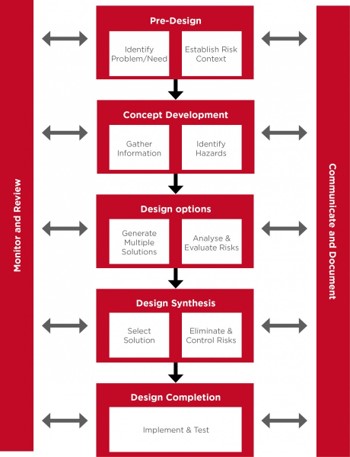
Figure 1, Model of Safe Design Process

Ergonomics and Good Work Design

Learn how safe design incorporates ergonomics principles and promotes good work design for a healthy and safe work environment. Safe design incorporates ergonomics principles as well as good work design.

  • Ensure workplace hazards and risks are eliminated or minimized so all workers remain healthy and safe at work.
  • It can involve the design of work, workstations, operational procedures, computer systems, or manufacturing processes.

Responsibility for Safe Design

Discover the parties responsible for ensuring safe design in different stages of the lifecycle and the importance of collaboration.

When it comes to achieving safe design, responsibility rests with those groups or individuals who control or manage design functions. This includes:

  • Architects, industrial designers, or draftspersons who carry out the design on behalf of a client.
  • Individuals who make design decisions during any of the lifecycle phases such as engineers, manufacturers, suppliers, installers, builders, developers, project managers, and WHS professionals.
  • Anyone who alters a design.
  • Building service designers or others designing fixed plant such as ventilation and electrical systems.
  • Buyers who specify the characteristics of products and materials such as masonry blocks and by default decide the weights bricklayers must handle.

Safe design is achieved more effectively when all the parties who control and influence the design outcome collaborate on incorporating safety measures into the design.

For more information on who is responsible for safe design see Guidance on the principles of safe design for work, the Principles of Good Work Design Handbook, and the model Code of Practice: Safe Design of Structures and WHS Regulations.

Design Considerations for Plant

Explore the essential considerations when designing plant equipment to ensure safety throughout its lifecycle. Examples of things we should consider when designing plant include:

  • All the phases in the lifecycle of an item of plant from manufacture through use, to dismantling and disposal.
  • Design for safe erection and installation.
  • Design to facilitate safe use by considering, for example, the physical characteristics of users, the maximum number of tasks an operator can be expected to perform at any one time, and the layout of the workstation or environment in which the plant may be used.
  • Consider intended use and reasonably foreseeable misuse.
  • Consider the difficulties workers may face when maintaining or repairing the plant.
  • Consider types of failure or malfunction and design the plant to fail in a safe manner.

Product Lifecycle

Understand the significance of considering the product lifecycle in safe design and how it contributes to sustainability.

The lifecycle of a product is a key concept of sustainable and safe design. It provides a framework for eliminating the hazards at the design stage and/or controlling the risk as the product is:

  • constructed or manufactured
  • imported, supplied, or installed
  • commissioned, used, or operated
  • maintained, repaired, cleaned, and/or modified
  • de-commissioned, demolished, and/or dismantled
  • disposed of or recycled.

Create a safer product by eliminating or controlling the hazards and risks that could impact on downstream users in the lifecycle. Do this during design, manufacture, or construction. In these early phases, there is greater scope to design out hazards and/or incorporate risk control measures that are compatible with the original design concept and functional requirements of the product.

  • Designers must have a good understanding of the lifecycle of the item they are designing, including the needs of users and the environment in which that item may be used.
  • New risks may emerge as products are modified or the environments in which they are used change.

Safety can be further improved if each person who has control over actions taken in any of the lifecycle phases. Take steps to ensure health and safety is proactively addressed, by reviewing the design and checking it meets safety standards in each of the lifecycle phases.

Subsequent stages of the product’s lifecycle should not go ahead until the preceding phase design reviews have been considered and approved by those with control.

Figure 2: Lifecycle of Designed Products 

Figure 2, Safe Design Lifecycle.

Benefits of Safe Design

Discover the benefits of implementing safe design practices, including injury prevention, cost reduction, and compliance with legislation.

It is estimated that inherently safe plant and equipment would save between 5–10% of their cost through reductions in inventories of hazardous materials, reduced need for protective equipment, and the reduced costs of testing and maintaining the equipment.

  • The direct costs associated with unsafe design can be significant, for example retrofitting, workers’ compensation and insurance levies, environmental clean-up, and negligence claims.
  • Since these costs impact more on parties downstream in the lifecycle who buy and use the product more, the incentive for these parties to influence and benefit from safe design is also greater.

A safe design approach results in many benefits including:

  • prevent injury and disease
  • improve the useability of products, systems, and facilities
  • improve productivity
  • reduce costs
  • better predict and manage production and operational costs over the lifecycle of a product
  • comply with legislation
  • innovate, in that safe design demands new thinking.

Learn about the legal duties imposed on different parties involved in the design process to ensure health and safety compliance.

Australian WHS laws impose duties on a range of parties to ensure health and safety in relation to particular products such as:

  • designers of plant, buildings, and structures
  • building owners and persons with control of workplaces
  • manufacturers, importers, and suppliers of plant and substances
  • persons who install, erect or modify plant.

These obligations may vary depending on the relevant state, territory, or Commonwealth WHS legislation.

Those who make decisions that influence design such as clients, chief financial officers, developers, builders, directors, and managers will also have duties under WHS laws if they are employers, self-employed or if they manage or control workplaces.

  • For example, a client who has a building or structure designed and built for leasing becomes the owner of the building and may therefore have a duty as a person who manages or controls a workplace.

There are other provisions governing the design of buildings and structures in state and territory building laws. The BCA is the principal instrument for regulating architects, engineers, and others involved in the design of buildings and structures.

  • Although the BCA provides minimum standards to ensure the health and safety of building occupants (such as structural adequacy, fire safety, amenities, and ventilation), it does not cover the breadth of WHS matters that may arise during the construction phase or in the use of buildings and structures as workplaces.

In addition, there are technical design standards and guidelines produced by government agencies, Standards Australia, and relevant professional bodies

Healthy and Safe by Design

Explore how the Australian Work Health and Safety Strategy emphasizes the elimination and minimization of hazards through effective design.

This is one of the Seven action areas in the Australian Work Health and Safety Strategy 2012-2022.

Hazards are Eliminated or Minimised by Design

The most effective and durable means of creating a healthy and safe working environment is to eliminate hazards and risks during the design of new plant, structures, substances, and technology and of jobs, processes, and systems. This design process needs to take into account hazards and risks that may be present at all stages of the lifecycle of structures, plant, products, and substances.

Good design can eliminate or minimize the major physical, biomechanical, and psychosocial hazards and risks associated with work. Effective design of the overall system of work will take into account, for example, management practices, work processes, schedules, tasks, and workstation design.

Sustainable return to work or remaining at work while recovering from injury or illness is facilitated by good job design and management. Managers have an obligation to make reasonable adjustments to the design of the work and work processes to accommodate individuals’ differing capabilities.

Workers’ general health and well-being are strongly influenced by their health and safety at work. Well-designed work can improve worker health. Activities under the Australian Strategy build appropriate linkages with healthy worker programs to support improved general worker well-being as well as health and safety.

National activities support the following outcomes:

  • Structures, plant, and substances are designed to eliminate or minimize hazards and risks before they are introduced into the workplace.
  • Work, work processes, and systems of work are designed and managed to eliminate or minimize hazards and risks.

END: Safe Design in Australia

My name’s Simon Di Nucci. I’m a practicing system safety engineer, and I have been, for the last 25 years; I’ve worked in all kinds of domains, aircraft, ships, submarines, sensors, and command and control systems, and some work on rail air traffic management systems, and lots of software safety. So, I’ve done a lot of different things!

The original webpage is © Commonwealth of Austr​alia, 2020; it is covered by a Creative Commons licence (CCBY 4.0) – for full details see here.

Back to Safe Design Page | Back to Home Page

Categories
Blog System Safety

Understanding System Safety Engineering

Understanding System Safety Engineering: A Holistic Approach to Ensuring Safety. To know that we first need to understand what Systems Engineering is…

Section 1: The Basics of Systems Engineering

It starts with needs and concepts, which may be quite abstract, and progressively breaks these down into concrete, specific requirements. We also determine how those requirements will be verified.

Section 2: The Transformative Process

We then transform those requirements into a logical architecture and then into a design. Then the design is translated into physical and functional components that can be developed or bought. Through all these transformations, the requirements are decomposed and flow down. Thus, we see how each component, or Configurable Item, contributes to meeting the requirements for the overall System.

Section 3: The Practice of System Safety Engineering

Finally, we must put the components together – integrate them – perhaps testing as we go to make sure that they work together. We can then verify the completed system, and support customer validation.

That’s the theory (albeit very briefly, I went on a week-long course just to learn the basics). In my experience, the practice of System Safety Engineering involves five things, it:

  1. Deals with the whole system, including software, data, people, and environment;
  2. Uses a systematic (rigorous) process;
  3. Concentrates on requirements (to cope with complexity);
  4. Considers safety early in the system life cycle; and
  5. Handles complexity cost-effectively and efficiently.

Understanding System Safety Engineering: A Holistic Approach to Ensuring Safety

Understanding System Safety Engineering: A Holistic Approach to Ensuring Safety – watch the Lesson Here.

System Safety Engineering: Transcript

What is system safety or system safety engineering? Well, as the name suggests, system safety is engineering safety in a systems-engineering context. Okay. So it’s safety that’s deliberately sat within a systems-engineering framework.

That drives everything about how we consider safety.  Like systems engineering in general, it follows systems theory. But I’m not going to talk about systems theory now. That’s a huge subject.

I’m not actually an expert in [the theory], but I’m going to talk about three practical things that I’ve observed from doing system safety for 25 years or so.

Section 5: Considering the Whole System

First of all, we consider the system holistically. So it’s not just the technical stuff. It’s not just the hardware. It’s the software as well if there’s any software in the system.

It’s the operating environment around the system and what we’re doing with it, the functions that we’re asking it to do, all the applications that we’re putting it to, and we include the people who are using it. We include all the data that’s being used, all of the documentation, everything. So we are looking at the system as a whole in accordance with systems theory. That’s the first point.

Section 6: A Systematic Process

The second point is that it is systematic from a process point of view.

We’re following a rigorous process whereby maybe we start with some sort of high-level requirements, and we think about in safety terms what could go wrong. And we think about all of our safety obligations, what we must do. And then we decompose that, break down the problem piece by piece, systematically down to a component level. And then we consider all of the components, and then we systematically integrate it all back together.

And what I’m kind of indicating is the V model, where we start at the top left-hand corner with our requirements. And then from our requirements, we think about, well, how are we going to demonstrate that we’ve met those requirements at the end of the process? And then we carry on going down the decomposing into more detail but also thinking about how we’re going to verify and validate that we’ve done what we needed to do at every stage when we integrate and come back up the other side.

So that’s the systematic part of the process.

Section 7: Requirements and Safety

And then Thirdly, which are kind of hinted up already, is a big thing about requirements.

In systems engineering, we are talking about complex stuff. It’s hard to understand. It’s not a toaster. It’s not a simple commodity item, where we can just go, well, I want a toaster and everybody knows what a toaster does or should do and what it shouldn’t do. We want to want it to toast bread and other things, but we don’t want it to electrocute people.

You know what a toaster is. You don’t need to articulate the requirements of a toaster. But if it’s something more complicated, like a ship or a power station or a complex piece of information technology, you want to develop a big software system to do something, then that’s very complicated, and you need to consider the requirements in a systematic fashion, starting at the top level, thinking about big picture stuff, what’s the system and its boundaries, what does it interact with?  What do we want it to do?

Then we need to go to a lot of effort to rigorously decompose that and come up with requirements, which you then verify and validate at the end of the project – or preferably before to avoid surprises. That’s a big part of systems engineering, as we’re dealing with complexity, and systems safety evolved to fit in with systems engineering.  It uses all of those concepts, all of those are powerful levers to help us engineer safety into a system rather than just adding it on at the very end.

Section 8: Think Safety from the Start

I guess that’s the fourth big point. We start to think about safety right at the beginning, at the top left-hand corner of the V, not just at the end, and then add it on and hope everything will be all right, because that doesn’t usually work. And that’s a very, usually a very expensive and ineffective way to do things.

So that’s another point that system safety engineering. We are engineering safety into the system early because that is a more cost-effective way of doing it.

Summary

To summarise system safety engineering, remember:

  • It’s systematic in terms of the way we think about the system and all of its parts;
  • It’s systematic in terms of the process, the way we approach the task and break down the tasks rigorously and put them back together; and
  • It borrows from systems engineering and systems theory in the way we consider requirements.

Those three things are system safety engineering. For more on system safety try the FAQ post and the system safety assessment page.

Understanding System Safety Engineering: A Holistic Approach to Ensuring Safety

Did I Miss Anything? Leave a Comment!

Categories
Work Health and Safety

Guide to the WHS Act

This Guide to the WHS Act covers many topics of interest to system safety and design safety specialists. The full-length video explains the Federal Australian Work Health and Safety (WHS) Act (latest version, as of 14 Nov 2020). Brought to you by The Safety Artisan: professional, pragmatic, and impartial.

This is the four-minute demo of the full, 44-minute-long video.

Recap: In the Short Video…

which is here, we looked at:

  • The Primary Duty of Care; and
  • Duties of Designers.

Topics: Guide to the WHS Act

In this full-length video, we will look at much more…

  • § 3, Object [of the Act];
  • § 4-8, Definitions;
  • § 12A, Exclusions;
  • § 18, Reasonably Practicable;
  • § 19, Primary Duty of Care;
  • § 22-26, Duties of Designers, Manufacturers, Importers, Suppliers & those who Install/Construct/Commission;
  • § 27, Officers & Due Diligence;
  • § 46-49, Consult, Cooperate & Coordinate;
  • § 152, Function of the Regulator; and
  • § 274-276, WHS Regulations and CoP.

Transcript: Guide to the WHS Act

Click here for the Transcript

Hi everyone and welcome to the Safety Artisan. Where you will find instructional videos like this one with professional, pragmatic and impartial advice which we hope you enjoy. I’m Simon and I’m recording this on the 13th of October 2019. Today we’re going to be talking about the Australian Federal Work Health and Safety Act. I call it an unofficial guide or system or design safety practitioners (whatever you want to call yourselves). I’m looking at the WHS Act from the point of view of system safety and design safety.

 As opposed to managing the workplace although it does that as well. I recorded a short video version of this. In that, we looked at the primary duty of care and the duty of designers. We spent some time looking at that and that video is available. It’s available at safetyartisan.com and you can watch it on YouTube. So just search for safety artisan on YouTube.

Topics

So, in this video, we’re going to look at much more than that. I say selected topics we’re not going to look at everything in the WHS Act. As you can see there are several hundred sections of it. We’ll be here all day. So, what we’re going to look at are things that are relevant to systems safety to design safety. So, we look very briefly at the object of the act, at what it’s trying to achieve. Just one slight of definitions because there’s a lot of exclusions because the Act doesn’t apply to everything in Australia.

 We’re going to look at the Big Three involved. So really the three principles that will help us understand what the act is trying to achieve is:

  • what is reasonably practicable. That phrase that I’ve used several times before.
  • What is the primary duty of care so that sections 18 and 19. And if we jump to
  • Section 27 What are or who are officers and what does due diligence mean in a WHS setting?

So, if I step back to Sections 22 to 26 you know the duties of various people in the supply chain.  We cover that in the short session. So, go ahead and look at that and then moving on. There are requirements for duty holders to consult cooperate and coordinate. Then there’s a brief mention of the function of the regulator. And finally, the WHS Act enables WHS regulations and codes of practice. So we’re just mentioned that so those are the topics we’re going to cover quite a lot to get through. So that’s critical.

Disclaimer

So, first, this is a disclaimer from the website from the federal legislation site. It does remind people looking at the site that the information put up there is for the benefit of the public and it’s free of charge.

 So, when you’re looking at this stuff you need to look at the relevance of the material for your purposes. OK, I’m looking at the Web site. It is not a substitute for getting legal or appropriate professional advice relevant to your particular circumstances. So quick disclaimer there. This is just a way a website with general advice. Hence, this video is only as good as the content that’s being presented okay?

The Object of the Act

So, the object of the act, then. I’m quoting from it because I’m using quotation marks, so the main object of the act is to provide a balanced and nationally consistent framework for the health and safety of workers and workplaces.

 And that’s important in Australia because Australia is a federated state. So, we’ve got states and territories and we’ve got the federal government or the Commonwealth as it’s usually known. The laws all those different bodies do not always line up. In fact, sometimes it seems like the state and territories delight in doing things that are different from the Commonwealth. And that’s not particularly helpful if you’re trying to operate in Australia as a corporation. Or if you’re trying to do something big and trying to invest in the country.

 So, the WHS act of a model WHS Act was introduced to try and harmonize all this stuff. And you’ll see some more about that on the website. By the way and I’ve missed out on some objectives. As you can see, I’m not doing one subset B to H go to have a look at it online. But then in Section 2 The reminder is the principle of giving the highest level of protection against harm to workers and other persons as is reasonably practicable. Wonderful phrase again which will come back to okay.

Definitions

 Now there are lots of definitions in the act. And it’s worth having a look at them particularly if you look at the session that I did on system safety concepts. There I was using definitions from the UK standard. Now I did that for a reason because that set of definitions was very well put together. So it was ideal for explaining those fundamental concepts where the concepts in Australia WHS are very different. If you are operating in Australian jurisdiction or you want to sell into an Australian jurisdiction do look at those definitions. Being aware of what the definitions are will actually save you a lot of hassle in the long run.

 Now because we’re interested systems safety practitioners of introducing complex systems into service. I’ve got the definitions here of plant structure and substance. So basically, plant is any machinery equipment appliance container implement or to any component of those things and anything fitted or connected to any of those things. So, they go going for pretty a pretty broad definition. But bearing in mind we’re talking about plants we’re not talking about consumer goods. We’re not talking about selling toasters or electric toothbrushes to people. OK. There’s other legislation that covers consumer goods.

 Then when it comes to structure again, we’ve got anything that is constructed be fixed or movable temporary or permanent. And it might include things on the ground towers and masks underground pipelines infrastructure tunnels and mining any components or parts thereof. Again, a very broad definition and similarly substance any natural or artificial substance in whatever form it might be. So again, very broad and as you might recall from the previous session a lot of the rules for designers’ manufacturers, importers and suppliers cover plant structure and substances. So hence that’s why I picked just those three definitions out of the dozens there.

Exclusions

 It’s worth mentioning briefly exclusions: what the Act does not apply to. So, first, the Act does not apply to commercial ships basically. So, in Australia, the Federal legislation covering the safety of people in the commercial maritime industry is the Occupational Health and Safety Act (Maritime Industry) 1993, which is usually known as “OSHMI” applies to commercial vessels, so WHS does not. And the second exclusion is if you are operating an offshore petroleum or greenhouse gas storage platform and I think it’s more than three nautical miles offshore.

 But don’t take my word for that if you’re in that business go and check with the regulator NOPSEMA then this act the Offshore Petroleum and Greenhouse Gas Storage Act 2006 applies or OPGGS for short. So, if you’re in the offshore oil industry then you’ve got a separate Commonwealth act plot but those are the only two exceptions. So, where Commonwealth law applies the only things that WHS. does not apply to is commercial ships and offshore platforms I mentioned state and territory vs. Commonwealth. All the states and territories have adopted the model WHS system except Victoria which so far seems to be showing no interest in adopting WHS.

 Thanks, Victoria, for that. That’s very helpful! Western Australia is currently in process of consultation to adopt WHS, but they’ve still got their current OH&S legislation. So just note that there are some exclusions there. OK so if you’re in those jurisdictions then WHS does not apply. And of course, there are many other pieces of legislation and regulation that cover particular kinds of risk in Australia. For example, there’s a separate act called ARPANS that covers ionizing a non-ionizing radiation.

There are many other acts that cover safety and environmental things. Let’s go back one when I’m talking about those specific acts. They only apply to specific things whereas WHS act is a general Act applies to everything except those things that it doesn’t like to write move on.

So Far As is Reasonably Practicable

Okay now here we come to one of these three big ticket items and I’ve got two slides here. So, in this definition of reasonably practicable when it comes to ensuring health and safety reasonably practicable means doing what you are reasonably able to do to achieve the high standards of health safety in place.

 Considering and weighing up all the relevant matters; including, say, the first two we need to think about the likelihood of a hazard or risk. How likely is this thing to occur as a potential threat to human health? And what’s the degree of harm that might result from the hazard or risk? We’ve got a likelihood and degree of harm or severity. If we recall the fundamental definition of risk is that it’s though it’s the factor of those two things taken together. So, in this first part, we’re thinking about what is the risk.

 And it’s worth mentioning that hazard is not defined in the Act and risk is very loosely defined. So, the act is being deliberately very broad here. We’re not taking a position on or style of approach to describing risks, so to the second part.

Having thought about the risk now we should consider what the person PCBU or officer, whoever it might be, ought reasonably to know about the hazard or risk and the ways of eliminating or minimizing the risks. So, what we should know about the risk and the ways of dealing with it of mitigating it of controlling and then we’ve got some more detail on these ways of controlling the risk.

 We need to think about the availability and suitability of ways to eliminate or minimize the risk. Now I’m probably going to do a separate session on reasonably practicable because there is a whole guidebook on how to do it. So, we’ll go through that and at some stage in the future and go through that step by step about how you determine availability and suitability et cetera. And so, once you get into it it’s not too difficult. You just need to follow the guidelines which are very clear and very well laid out.

 So having done all of those things, after assessing the extent of the risk and the available ways of controlling it the we can then think about the cost associated with those risk controls and whether the cost of those controls is grossly disproportionate to the risk. As we will see later, in the special session, if the cost is grossly disproportionate to the risk reduction then it’s probably not reasonable to do it. So, you don’t necessarily have to do it but we will step back and just look at the whole thing.

So, in a and b we’re looking at the likelihood and severity of the risk so and we’re (quantifying or qualitatively) assessing the risk. We’re thinking about what we could do about it, how available and suitable are those risk controls, and then putting it all together. How much will it cost to implement those risk controls and how reasonably practicable to do so. So what we have here is basically a risk assessment process that leads us to a decision about which controls we need to implement in order to achieve that ‘reasonably practicable’ statement that you see in so many parts of the act and indeed it’s also in the definition itself.

 So, this is how we determine what is reasonably practicable. We follow a risk assessment process. There is a risk assessment Code of Practice, which I will do a separate session on. It gives you a basic minimum risk assessment process to follow that will enable us to decide what is reasonably practicable. Okay, quite a big topic there. And as I say we’ll come back and do a couple more sessions on how to determine reasonably practical. Let’s move on to the primary duty of care we covered in the short session.

The Primary Duty of Care

 So I’m not really going to go through this again [in detail] but basically our primary duty is to ensure so far as is reasonably practicable the health and safety of workers, whether we’ve engaged them whether we’ve got somebody else to engage them or whether we are influencing or directing people carrying out the work. We have a primary duty of care if we’re doing any of those things. And secondly, it’s worth mentioning that the person conducting a business or undertaking the PCBU must ensure the health and safety of other people. Say, visitors to the workplace are members of the public who happen to be near the workplace.

 And of course, bearing in mind that this law applies to things like trains and aircraft if you have an accident with your moving vehicle or your plant you could put people in danger – in the case of aeroplanes anywhere in Australia and beyond. So, it’s not just about the work, the workers in the workplace. With some systems, you’ve got a very onerous responsibility to protect the public depending on what you’re doing. Now for a little bit more detail that we didn’t have in the short session. When we say we must ensure health and safety we’re talking about the provision and maintenance of a safe work environment or safe plant structures or safe systems of work talking about safe use handling and storage of structures and substances.

 We’re talking about adequate facilities for workers that are talking about the provision of information, training, instruction or supervision. Those workers and finally the health of workers and conditions of the workplace are monitored if need be for the purpose of preventing illness or injury. So, there should be some general monitoring of health and safety-related incidents. And if you’re dealing with certain chemicals or are you intentionally exposing people to certain things you may have to conduct special monitoring looking for contamination or poisoning of those people whatever it may be. So, you’ve got quite a bit of detail there about what it means to carry out the primary duty of care.

 And this is all consistent with the duties that we’ve talked about on designers, manufacturers, importers, and suppliers and for all these things there are codes of practice giving guidance on how to do these things. So, this whole work health and safety system is well thought through, put together, in that the law says you’ve got to do this. And there are regulations and codes of practice giving you more information on how you can fulfil your primary directive and indeed how you must fulfill your primary duty.

 And then finally there’s a slightly unusual part for at the end and this covers the special case where workers need to occupy accommodation under the control of the PCBU in order to get the job done. So you could imagine if you need workers to live somewhere remote and you provided accommodation then there are requirements for the employer to take care of those workers and maintain those premises so that they not exposed to risks.

 That’s a big deal because she might have a remote plant, especially in Australia which is a big place and not very well populated. You might be a long way away from external help. So if you have an emergency on-site you’re going to have to provide everything (not just an emergency you need to do that anyway) but if you’ve got workers living remotely as often happens in Australia you’ve got to look after those workers in a potentially very harsh environment.

And then finally it’s worth mentioning that self-employed persons have got to take care of their own health and safety. Note that a self-employed person is a PCBU, so even self-employed people have a duty of care as a PCBU.

The Three Duties

OK, sections 22 to 26. Take that primary duty of care and elaborate it for designers and manufacturers, importers and suppliers and for those installing constructing or commissioning plant substances and structures. And as we said in the free session all of those roles all of the people BCBS is doing that have three duties they have to ensure safety in a workplace and that includes you know designing and manufacturing the thing and ensuring that it’s safe and meets Australian regulations and obligations.

 We have a duty to test which actually includes doing all the calculations analysis and examination that’s needed to demonstrate safety and then to provide needed information to everybody who might use or come into contact with the system so those three duties apply consistently across the whole supply chain. Now we spent some time talking about that. We’re going to move on OK, so we are halfway through. So, a lot to take in. I hope you’re finding this useful and enjoying this. Let’s move on. Now this is an interesting one.

Officers of the PCBU

Officers of the PCBU have additional duties and an officer of the PCBU might be a company director. That’s explicitly included in the definition. A senior manager somebody who has influence. Offices of the PCBU must exercise due diligence. So basically, the implied relationship is you’ve got a PCBU, you’ve got somebody directing work whether it be design work manufacturing operating a piece of kit whatever it might be. And then there are more senior people who are in turn directing those PCBUs (the officers) so the officers must exercise due diligence to ensure that the PCBUs comply with their duties and obligations.

Sections 2 to 4 cover penalties for offices if they fail. I’m not going to discuss that because as I’ve said elsewhere on the Safety Artisan website, I don’t like threatening people with penalties because I actually think that results in poor behavior, it actually results in people shirking and avoiding their duties rather than embracing them and getting on with it. If you frighten people or tell them what’s going to happen to them, they get it wrong. So, I’m not going to go there. If you’re interested you can look up the penalties for various people, which are clearly laid out. We move on to Section 5.

Due Diligence

 We’re now talking about what is due diligence in the context of health and safety. OK, I need to be precise because the term due diligence appears in other Australian law in various places meaning various things, but here this is the definition of due diligence within the WHS context. So, we’ve got six things to do in order to demonstrate due diligence.

So, officers must acquire and keep up to date with knowledge of work health and safety matters obligations and so forth. Secondly, officers must gain an understanding of the nature of the operations of the piece and risks they control.  So, if you’re a company director you need to know something about what the operation does. You cannot hide behind “I didn’t know” because it’s a legal requirement for you to do it. So that closes off a whole bunch of defenses in court. You can’t plead ignorance because ignorance is, in fact, illegal and you’ve got to have a general understanding of the hazards and risks associated with those operations. So, you don’t necessarily have to be up on all the specifics of everything going on in your organization but whatever it is that your organization does. You should be aware of the general costs and risks associated with that kind of business.

Now, thirdly, we are moving on basically C D E and F refer to appropriate resources and processes, so the officers have got to ensure that PCBUs have available and use appropriate resources and processes in order to control risks. OK so that says you’ve got to provide those resources and processes and there is supervision, or some kind of process or requirement to say, yep, we put in let’s say a safety management system that ensures people do actually use the stuff that they are supposed to use in order to keep themselves safe.

 And that’s very relevant of course because often people don’t like wearing, for example, protective personal protective equipment because it’s uncomfortable or slows you down, so the temptation is to take it off. Moving on to part D we’re still on the appropriate processes; we must have appropriate processes for receiving and considering information on incidents, hazards and risks. So again, we’ve got to have something in place that keeps us up to date with the incidents, hazards and risks in our own plants and maybe similar plants in the industry and, we need a process to respond in a timely way to that information.

 So, if we discover that there is a new incident or hazard that you didn’t previously know about. We need to respond and react to that quickly enough to make a difference to the health and safety of workers. So again as another that sort of works in concert with part B doesn’t it. In part A and B we need to keep up to date on the risks and what’s going on in the business and part A, we need to ensure that the PCBU has processes for compliance with any duty or obligation and follows them again to provide that stuff.

In the system safety world, often the designers will need to provide the raw material that becomes those processes. Or maybe if we’re selling the product, we sell a product with the instruction manual with all the processes that could be required.

And then finally the officers must verify the provision and use of these resources and processes that we’ve been talking about in C D an E. So, we’ve got a simple six-point program that comprises due diligence, but as you can see it’s very to the point and it’s quite demanding. There’s no shirking this stuff or pretending you didn’t know and it’s I suspect it’s designed to hang Company directors who neglect and abuse their workers and, as a result, harm happens to them.

But I mean ultimately let’s face it this is all good common-sense stuff. We should be doing this anyway. And in any kind of high-risk industry we should have a safety management system that does all of this and more. These are only the minimum required for all industries and all undertakings in Australia. OK let’s move away from the big stick. Let’s talk about some sort of cozy, softer stuff.

Consult, Cooperate and Coordinate

If you are a duty holder, if you’ve got a duty of care to people as a PCBU or an officer, you must consult, cooperate and coordinate your activities with all other offices and bases be used.

You have a duty in relation to the same matter. So perhaps you are a supplier of kit and you get information from the designer or the manufacturer with the updates on safety or maybe they inform you of problems with the kit. You must pass that on. Let’s imagine you’re introducing a complex system into service. There are going to be lots of different stakeholders, and you all must work together in order to meet WHS obligations. So, there’s no excuse or trying to ask the buck to other people.

That’s not going to work if you haven’t actively managed the risk, as you are potentially already doing something illegal and again, we won’t talk about the penalties of this. We’re just talking about the good things we’re expected to do. So, we’re trying to keep it positive. And you’ve got a duty to consult with your workers who either carry out work or who are likely to be directly affected by what’s going on and the risks. Now, this is a requirement that procedures in Sections 2 and 3, but of course we should be consulting with our workers because they’ve often got practical knowledge about controlling risks and what is available and suitable to do so, which we will find helpful.

So, consulting workers is not only a duty it’s actually a good way of doing business and doing business efficiently so moving on to section 152.

The Regulator

There are several sections about the regulator, but to my mind, they don’t add much. So, we’re just going to talk about Section 152, which is the functions of a regulator and the regulator has got several functions. So, they give advice and make recommendations to the relevant minister or Commonwealth Minister of the government. They monitor and enforce compliance with the act.

 They provide advice and information to duty holders and the community they collect analyse and publish statistics. They’re supposed to foster a co-operative, consultative relationship in the community to promote and support education and training and to engage in and promote and coordinate the sharing of information. And then finally they’ve got some legal duties with courts and industrial tribunals, and here’s the catch-all, any other function conferred on the regulator by the Act. If we look at the first six the ones that I’ve highlighted there are a number of regulators in Australia and because of the complexity of our federal government system, we’ve got.

 It’s not always clear which regulator you need to deal with and not all regulators are very good at this stuff. I have to say having worked in Europe and America and Australia, for example on Part D. Australian regulators are not very good at analyzing and publishing statistics in general. Usually, if you want high-quality statistics from a regulator, you’re usually better off looking at a European regulator in your industry or an American regulator. The Aussie ones don’t seem to be very good at that, in general.

There are exceptions. NOPSEMA, for example in the offshore world, are particularly good. But then you would expect because of the inherent dangers of offshore operations. Otherwise, I’ve not been that impressed with some of the regulators. The exception to that is Safe Work Australia. So, if you’re looking for advice and information, statistics, education and training and sharing of information then Safe Work Australia is your best bet. Now ironically Safe Work Australia is not a regulator.

Safe Work Australia

They are a statutory authority and they created, in consultation with many others I might say, they created a model WHS Act the model regulations and the Model Codes practice. So, if you go on their website you will find lots of good information on there and indeed I tend to look at that in order to find information to post on safety artisan. So, they’ve got some good WHS information on there. But of course, the wherever you go look at their site you must bear in mind that they are not the regulator of anything or anyone. So, for you’ve also got to go and look at the find the relevant regulator to your business or undertaking and you’ve got to look at what your regulator requires you to do.

 Very often when it comes to looking at guidance your best bet is safe work Australia okay.

Regulations and Codes of Practice

I’ve mentioned regulations and codes of practice. Basically, these sections of the act enable those codes of practice and regulations so the Minister has power to approve Commonwealth codes of practice and similarly state and territory ministers can do the same for their versions of WHS. This is very interesting and we’ll come back to relook at codes of practice in another session. An approved code of practice is admissible in court as evidence, it’s admissible as the test of whether or not a duty or obligation under the WHS Act has been complied with.

 And basically, the implication of this is that you are ignorant of codes of practice at your peril because if something goes wrong then codes of practice are what you will be judged against at minimum. So that’s a very important point to note and we’ll come back to that on another session.

Next, Codes of Practice and then regulation-making powers. For some unknown reason to me, the Governor-General may authorize regulations. I mean that doesn’t really matter. The codes of practice and the regulations are out there, and the regulations are quite extensive.  I think six hundred pages. So, there’s a lot of stuff in there. And again, we’ll do a separate session on WHS regulations soon OK.

That’s All Folks!

I appreciate we’ve covered quite a lot of ground there but of course, you can watch the video as many times as you like and go and look at the Act online. Mentioning that all the information I’ve shown you is pretty much word for word taken from the federal register of legislation and I’m allowed to do that under the terms of the license.

Creative Commons Licence

 And it’s one of those terms I have to tell you that I took this information yesterday on the 12th of October 2019. You should always go to that website to find the latest on Commonwealth legislation (and indeed if you’re working on it state or territory jurisdiction you should go and see the relevant regulator’s legislation on their site). Finally, you will find more information on copyright and attribution at the SafetyArtisan.com website, where I’ve reproduced all of the requirements, which you can check. At the Safety Artisan we’re very pleased to comply with all our obligations.

Now for more on this video, you may have seen it on Patreon on the Safety Artisan page or you may have seen it elsewhere, but it is for sure available Patreon.com/SafetyArtisan. Okay. So, thank you very much for listening and all that remains for me to do is to sign off and say thanks for listening and I look forward to presenting another session to you in a month’s time. Take care.

Learn safety engineering with me, an industry professional with 25 years of experience, I have:

•Worked on aircraft, ships, submarines, ATMS, trains, and software;

•Tiny programs to some of the biggest (Eurofighter, Future Submarine);

•In the UK and Australia, on US and European programs;

•Taught safety to hundreds of people in the classroom, and thousands online;

•Presented on safety topics at several international conferences.

Back to the WHS Topic Page.

Categories
Behind the Scenes

Which Skills Should Humans Learn in an Age of ‘AI’?

Which Skills Should Humans Learn in an Age of ‘AI’? In my previous article, I looked at the new challenge that faces all who teach online. How do we stop students from using AI to cheat on assessments?

Well, the short answer is: we can’t. Not entirely. AI is now good enough at answering questions to pass some quite tough exams, for example, to become a licensed doctor. On many questions of fact, the AI could be generating the entire answer and the student would not be tested at all.

In such cases, we would really be testing students on how good they were at using AI.  This is not a facetious idea. As AI is such a wonderful research assistant, perhaps we should be training students to use it – wisely.

Learning & Writing with AI

We know that AIs don’t always give correct answers because the data used to train them is not always correct. So students using this technology need to check the answers. Also, I’m beginning to hear that Google is finding and eliminating AI-generated content from search results. If Google can do that, then plagiarism-checking tools will soon do that too (damn that AI).

So students will need to check their AI’s output, perhaps paraphrasing content and changing its style to suit. Ironically there’s an AI tool for that too! They may also need to add some personal touches. Google prioritizes E-E-A-T: experience, expertise, authoritativeness, and trustworthiness. Students probably need to do the same.

That said, AI really is a wonderful research assistant. Suppose you feed it your exam question: “Write me an essay about Napolean” and you add “citing sources used”. If your chosen AI does so, you might get a reasonable essay, with citations so that you can fact-check and correct it. Doing so will give you a better essay, which you can then make your own. Result: a good essay!

(Please note that Chat GPT-4 will not write you a whole essay, it will only provide the structure and sources.)

Enter Napoleon

Now, you still have to do some work. But without the AI, it would have taken you many hours to discover lots of things about Napoleon. (Remember: we don’t know what we don’t know.) You could submit a good essay much quicker than without your AI research assistant. Or …

… you could use the time saved to take it to the next level. Supposing you discover that there are two different schools of thought about Napolean (quite likely about any major subject). You could now instruct the AI to write the same essay but twice – once from each point of view. Using these results, you can compare and contrast them and make your own assessment.

You now have a great essay! Perhaps, more importantly, you’ve taken your learning, about Napolean and historical analysis, to another level. You used the AI to do the drudgery so you can focus on the clever stuff. Now you have – rapidly – learned some high-level, transferable skills that you can apply to any historical analysis.

Okay, I’m a safety engineer, so I’m not likely to be answering exam questions about Napoleon. I might conceivably be asked to discuss the approaches of, say, Jens Rasmussen versus Erik Hollnagel. Personally, I’d rather not, but understanding different theories on risk and accident causation is relevant to my profession.

Whatever you are doing there’s probably an AI for it, in fact, there’s a site with over 3,000 AI tools that do all sorts of things. However, this isn’t an article on how to do things with AI, so…

Back to the Challenge

The challenge facing online educators is to assess students in a way that tests the student, not the AI. Online education is a multi-billion-dollar business, and AI could undermine the credibility of most qualifications, so this is a critical issue.

I think it’s fair to say that we won’t all go back to physically sitting exams in a room with strict security (although I did just that to get my CISSP certification). The costs are too great, and we need remote assessment techniques.

This means that universities and other education or training providers will look for assessment strategies that AIs struggle with. This means that – if we want top marks – we will need to be good at things that AIs don’t do well.

Are there any things that AI can’t do (yet)? If so, what are they?

We Reflect on ‘AI’

We have to remind ourselves that ‘AI’ is not really intelligent. A lot of what is sold as ‘AI’ is just using statistics to analyze lots of data. I’ve worked with a statistician, and I was amazed at what she could deduce from a data set. Even human behavior is amenable to statistical analysis. We all like to think that we’re original and unique, but we’re mostly not. Sorry.

The next level up from statistics is Machine Learning (ML). This is a phrase that represents what’s going on much better than ‘AI’.

Machine Learning

ML is much more powerful than statistics because it uses a variety of algorithms. These can be much more complex than generic, statistical equations. Specific algorithms are developed to solve specific classes of problems.

Nevertheless, all ML works by training algorithms on a data set. Humans review the results and tweak the algorithms or the data set, or both, to produce better results. Or perhaps we give the machine a goal and it tweaks itself to get there better and/or faster.

ML is so effective because decades of research by the best human minds have gone into developing it. An awful lot of human ingenuity is encoded in those algorithms.

ML itself though works by brute force. Computers are very fast, and they can process vast amounts of data. This data is now easily accessible on the internet, which contains a significant proportion of the vast treasure store of human knowledge. ML isn’t intelligent, it just appears to be because it has been trained by vast repetition. It impersonates human intelligence by copying, merely by rote learning.

It’s been said that to really be intelligent AI must be able to create something truly original. That article refers to an AI playing the Asian game ‘Go’ – a game rather like checkers. The AI beat a world champion using a revolutionary strategy that no human is ever taught. However, even with this example, I note that Go is a 2D board game where all the counters are identical in character. Surely, this is a problem that is inherently amenable to being solved by a computer?

But so what?

Well, if we humans want to stay relevant, then we need to do things that machines can’t. If we understand what they can and can’t do, and get better at the latter, then we add value.

We Reflect to be Different from Machines

In my previous article, I mentioned that Chat GPT-4 struggles to reflect on learning. If we go online and look up the word ‘reflect’, we get:

embody or represent (something) in a faithful or appropriate way.
think deeply or carefully about.
(of an action or situation) bring credit or discredit to the relevant parties.

Google Search

We have three meanings here, as follows:

  • To represent – to portray, describe, or paraphrase, but not copy – something faithfully or appropriately. We are not simply repeating details, but capturing the essence of something.
  • To think deeply and carefully – not quickly or superficially.
  • To make a value judgment about something, its validity, morality, or desirability.

At this point, my fellow engineers, as well as scientists and mathematicians, might be wondering what this has got to do with them. After all, 2+2=4, and what is there to reflect on? This ‘reflection’ sounds like something that arts and humanities folk do. OK, perhaps psychologists and business studies too. But us?

I think we do. In terms that might appeal to engineers, etc., let’s call it the difference between ‘verification’ and ‘validation’.

Verification versus Validation

Verification asks: “Did we build the thing right?” We can answer that question by testing it, inspecting it, or analyzing it: does it do what it’s supposed to? If we can’t fully verify the product, perhaps we need some process evidence as well. Did we develop it using a sound process? Does it comply with or conform to applicable standards?

Verification may be complex, but it’s mechanistic. In verification, “right” means correct – and only that.

Validation asks: “Did we build the right thing?” In this case, “right” means a whole lot more than just correct.

It means complete: did we do the whole job? Meet the overall need and not just the written specification? It means comprehensible: does it make sense in context? is it usable by those who need to? is it appreciated by those who paid for it, or wanted by those who might pay for it?

It may also mean other things. Does it help? Is it ethical? Sustainable? Valuable to a person, group, or society as a whole?

A thing can be successfully verified yet fail validation, in one or more ways. Becoming skilled at reflecting on the wider implications of what we do can help us all, no matter what our field of endeavor.

We Curate, not Just Collect as Machines Do

One of my hobbies is writing fiction – badly. Again and again, I read that to get better, I must read better. I must read a lot, but not just in quantity; I must read the best quality I can get, the best, most successful authors. Writers should not just read within their chosen genre, either, but they must get out of their comfort zone and read all sorts.

Similarly, I’ve heard it said that ‘the best bands have the best record collections’. The best is not the biggest, but the broadest collection of good-quality music. The aim is not just to collect, but to curate.

This makes sense as we seek to differentiate ourselves from competing machines. Earlier versions of Chat GPT (and other ‘AI’s) were trained on millions or even billions of web pages. We can’t compete with machines on quantity. Referring back to my previous article, I note that Chat GPT-4 is “safer and more aligned” (good validation words) because it was trained on a human-curated data set.

Mere repetition is not going to help us. We need to reflect on a broad range of the best-quality stuff we can find. Looking deeper, and slower, asking those ‘validation’ questions. Skills like comprehension, summarising, and producing a precis of others’ work are valuable (b*gger me, my English Literature teacher was right all along). Drawing what I see, not what I think I see (thanks are also due to my Art teacher). Learning from disciplines other than the ones we practice.

Being a well-rounded person, I guess.

What do You think?

Categories
Safety Analysis System Safety

Foundations of Safety Assessment

In this post on the Foundations of Safety Assessment, I’m going to look at the (few) things that we need to do in every System Safety Program.

Because we don’t always need to do everything. We don’t always need to throw everything at the problem. Some systems are simpler than others, and they don’t need the ‘whole nine yards’ in order to get a decent result. With that knowledge, we’re going to be able to design an analysis program for different applications or for different systems.

As an example, I’m going to use Military Standard 882E (Mil-Std-882E). Under that standard we would use these Tasks:

  • Task 201 – Preliminary Hazard Identification;
  • Task 202 – Preliminary Hazard Analysis; and
  • Task 203 – System Requirements Hazard Analysis.

(You will also find related material in my posts on Safety Analysis Techniques Overview and tailoring your Risk Analysis Program.)

Foundations of Safety Assessment – The Big Picture

I promised you we were going to look at the overview of the sequence.

And I think this is what pulls it all together and explains it powerfully. So the background to this is we’ve got, an accident or mishap sequence. Whatever you want to call it and we start with causes on the left and causes lead two a hazard, and then a has it can lead to multiple consequences.

Bowtie diagram showing five types of hazard analysis.
Bowtie showing the Foundations of System Safety

That is what the bowtie here is representing. It’s showing that multiple causes can lead to a single hazard, and a single hazard can lead to multiple consequences.

Don’t worry too much about the bow tie. I’m not pushing that in particular, it’s a useful technique, but it’s not the only one. We’ll come onto that – that’s the background.

This is the accident sequence we’re trying to discover and understand. I’m going to talk a lot about discovery and understanding.

Preliminary Hazard Identification

Typically, we will start by trying to identify hazards. There are techniques out there that will help us identify hazards associated with the system being used in a specific application, or purpose, in a specific operating environment.

Always bear in mind those three questions about the context, that help us to do this. What’s the system? What are we using it for? and in what environment?

And if we change any of those things, then probably the hazards will change. But we start off with preliminary hazard identification, which is intended to identify hazards. There’s a big, big arrow pointing at hazards, but also, inevitably, it will identify causes and consequences as well, because it’s not always clear. What is the hazard when you start? talking of discovery, we’re going to discover some stuff.

We may finally classify what we’re talking about later. we’re trying to discover hazards. In reality, we’re going to discover lots of stuff, but mainly we hope hazards, that’s stage one.

System Requirements Hazard Analysis

Now, then we’re actually going to step outside of the accident sequence itself. We’re going to do some requirements analysis, and the requirements analysis has to come after the PHIA because some safety requirements are driven by the presence of certain hazards.

If you’ve got a noise hazard somebody’s hearing might be affected, then regulations in multiple countries are going to require you to do certain things to monitor the noise. Let’s say or monitor the effect that it’s having on workers and put in place a program to handle that. The presence of certain hazards will drive certain requirements for safety controls or risk controls.

Then there are the broader requirements. Analysis of what the law requires, what the regulations require, codes of practice, etc. We’ll get onto that, and one of the things that requirements analysis is going to do is give us an initial stab of what we’ve got to have – certain controls because we’re required to. That’s a little bit of an aside in terms of the sequence, but it’s very, very important.

Preliminary Hazard Analysis

Thirdly, and, fourthly, once we’ve discovered some hazards, we’re going to need to understand what might cause those hazards and therefore how likely is the hazard to exist in particular circumstances, and then also think about the consequences that might arise from a hazard. And once we’ve explored those, we will be in a position to actually capture the risk.

 Because we will have some view on likelihood. And we would also have some view on the severity of consequences from considering the consequences. We’ll come onto that later.

Looking at Controls

Finally, having done all those other things, we will be in a position to take a much more systematic look at controls and say, we’ve got these causes. We’ve got these hazards. We’ve got these potential consequences.  What do I need to do to control this risk and prevent this accident sequence from playing out?

What I need to put in place to interrupt the accident sequence, and I’ve put the controls. The dashed lines indicate that we’ve got barriers to that accident sequence, and they are dashed because no control is perfect. (Other than gravity. But of course, if you turn your vehicle upside down, then gravity is working against you, so even gravity isn’t foolproof.)

No control is 100% effective. We need to just accept that and deal with that, and understand. There is your overview of the sequence, and I’ve spent a bit of time talking about that because it is absolutely fundamental to everything you’re going to do.

Well, That’s a Brief Summary of the Foundations of Safety Assessment

If you have any questions, please leave a comment below.

Categories
Behind the Scenes Blog

How Should We Learn in an Age of ‘AI’?

‘How Should We Learn in an Age of ‘AI’?’ is the first in a series of articles addressing this topical subject.

Introduction

I’ve created and taught courses on technical subjects for about 20 years now.  I started when I inherited a half-finished course on software supportability in 2001. The Royal Air Force relied on software in all its combat aircraft but knew precious little about software, and less about how to support it.  We needed that course.

After I left the Air Force, I joined a firm called QinetiQ. I discovered that we had a contract to teach safety to all UK Ministry of Defence staff that required it; the classroom was just down the road from our office.  I joined the instructing team.

With that experience, I created and taught bespoke safety courses for the Typhoon, Harrier and Raytheon Sentinel platforms.  I also helped create a safety course for the UK Military Aviation Authority.  Since moving to Australia, I have created and sold courses commercially, teaching home workers online for the first time.

It’s still difficult to access system safety training in Australia, and that’s why I started the Safety Artisan.  In my business, I am only teaching online.

The Problem

Recently I’ve been in discussions with colleagues in industry and academia about improving system safety education in Australia.  Because of the COVID-19 pandemic, learning has gone through a revolution.  We are now learning online much more than we ever did; in fact, it’s the ‘New Normal’.

Now another revolution has occurred: generative Artificial Intelligence (AI).

“Generative AI is a set of algorithms, capable of generating seemingly new, realistic content—such as text, images, or audio—from the training data. The most powerful generative AI algorithms are built on top of foundation models that are trained on a vast quantity of unlabeled data in a self-supervised way to identify underlying patterns for a wide range of tasks.”

© 2023 Boston Consulting Group, https://www.bcg.com/x/artificial-intelligence/generative-ai

This presents a challenge to anyone designing an online course that leads to a certification or award. How do we assess students online, when we know that they can use an AI to help them answer the questions?

In some circumstances, the AI could be generating the entire answer and the student would not be tested at all.  What we would really be testing them on is how good they were at using the AI.  (I’m not being facetious. As AI is such a wonderful research assistant, perhaps we should be training students to use it – wisely.)

Enter Chat GPT-4

OpenAI, the creators of Chat GPT-4, make some big claims for their product.

“GPT-4 is more creative and collaborative than ever before. It can generate, edit, and iterate with users on creative and technical writing tasks, such as composing songs, writing screenplays, or learning a user’s writing style.”

OpenAI, https://openai.com/product/gpt-4

“GPT-4 can accept images as inputs and generate captions, classifications, and analyses.”

ibid

“GPT-4 is capable of handling over 25,000 words of text, allowing for use cases like long form content creation, extended conversations, and document search and analysis.”

ibid

But perhaps most significant of all is GPT-4’s claimed ‘safety’:

“We spent 6 months making GPT-4 safer and more aligned. GPT-4 is 82% less likely to respond to requests for disallowed content and 40% more likely to produce factual responses than GPT-3.5 on our internal evaluations.”

ibid

In other words, GPT-4:

  • Is less likely to regurgitate nasty sludge from the bottom of the web; and
  • Is more likely* to not make stuff up.

*Notice that they said “more likely” – this is not certain or assured.  (More on this in a later article.)

This is because the creators were more selective about the data they used to train the model.  Presumably, this implies that previous efforts just used any old rubbish scraped off the web, but nobody is admitting to that!

The Beginning of an Answer…

One of the academics I’ve met (sorry, but I can’t give them credit, yet) has studied this problem.  They’ve come up with some interesting answers.

In their experiments with GPT-4, they found that it was very good at the things you would expect it to be. It was great at answering questions by gathering and collating facts and presenting written answers.

But it wasn’t good at everything.  It was not good at reflecting on learning, for example. GPT-4 could not reflect on the learning that the student had experienced.  Similarly, it could not extrapolate what the student had been taught and apply it to new scenarios or contexts.

Therefore, the way to assess whether students really know their stuff is to get them to do these things. Most assessment marks can still be straightforward questions, which an AI could help answer. But a few marks, maybe only 20%, should require the student to reflect on what they had learnt and to extrapolate it to a new situation, which they must come up with. This bit of the assessment would separate the also-rans from the stars.

…And a Lot More Questions

Now there are obvious, mechanistic, reasons why the AI could not perform these tasks.  It had not been exposed to a student’s learning and therefore could not process it.  Even more difficult would be to take a student’s life and work experience – also unknown to the AI – and use that to extrapolate from the taught content.

(Okay, so there are possible countermeasures to these mechanistic problems.  The next stage is that the AI is exposed to all the online learning alongside the student.  The student also uploads their resume and as much detail as they can about their work to teach the AI.  But this would be a lot of work for the student, just to get those last 20% of the marks. That would probably negate the advantage of using an AI.)

However, the fact is that GPT-4 and its brethren struggle to do certain things. Humans are great at recognising patterns and making associations, even when they are not logical (e.g. ‘whales’ and ‘Wales’).  We also have imagination and emotion. And we can process problems at multiple levels of cognition, coming up with multiple responses that we can then choose from.  We also have personal experience and individuality. We are truly creative – original. Most AI still struggles to do these things, or even pretend to.

So, if we want to truly test the human learner, we have to assess things that an AI can’t do well.  This will drive the assessment strategies of all educators who want to teach online and award qualifications.  

And, guess what?  This is where the $$$ are, so it will happen. Before COVID-19, education was a massive export earner: “Australia’s education exports totalled $40bn in 2019.” This is according to the Strategy, Policy, and Research in Education (SPRE).  

This then begs the question:

What Else Can Humans do that AI Can’t (Yet)?

Why? Because if these are the skills on which we will be assessed, then we need to focus on being good at them. They will get us the best marks, so we can compete for the best jobs and wages.  These skills might also protect us from being made redundant (from those well-paid jobs) by some pesky AI!

This is what I’m going to explore in subsequent articles.

Categories
Mil-Std-882E Safety Analysis

Preliminary Hazard Identification with Mil-Std-882E

Want to know how to perform Preliminary Hazard Identification with Mil-Std-882E? (This is Task 201 under the standard.)

This is the first step in safety assessment.  We look at three classic complementary techniques to identify hazards and their pros and cons.  This includes all the content from Task 201, and also practical insights from my 25 years of experience with Mil-Std-882. 

You Will Learn to:

  • Conduct Preliminary Hazard Identification using diverse techniques for best results;
  • Define what Preliminary Hazard Identification is and does;
  • Record Preliminary Hazard Identification results correctly;
  • Contract for Preliminary Hazard Identification successfully; and
  • Apply it early enough to make a difference.
This is the seven-minute-long demo video.

Topics: Preliminary Hazard Identification with Mil-Std-882E

  • Task 201 Purpose & Task Description;
  • Historical Review;
  • Recording Results;
  • Contracting; and
  • Commentary:
    • Historical Data;
    • Hazard Checklists; and
    • Analysis Techniques.

Transcript: Preliminary Hazard Identification

Hello, everyone, and welcome to the Safety Artisan, where you will find instructional materials that are professional, pragmatic, and impartial because we don’t have anything to sell, and we don’t have an axe to grind. Let’s look at what we’re doing today, which is Preliminary Hazard Identification. We are looking at one of the first actual analysis tasks in Mil-Std-882E, which is a systems safety engineering standard from the US government, and it’s typically used on military systems, but it does turn up elsewhere.

Preliminary Hazard ID is Task 201

I’m recording this on the 2nd of February 2020, however, the Mil-Std has been in existence since May 2012 and it is still current, it looks like it is sticking around for quite a while, and this lesson isn’t likely to go out of date anytime soon.

Topics for this session

What we’re going to cover is, quoting from the task, first of all, we’re going to look at the purpose and the task description, where the task talks quite a lot about historical review (I think we’ve got three slides of that), recording results, putting stuff in contracts and then I’m adding some commentary of my own. I will be commenting all the way through, that’s the value add, that’s why I’m doing this, but then there’s some specific extra information that I think you will find helpful, should you need to implement Task 201. In this session, we’ve moved up one level from awareness and we are now looking at practice, at being equipped to actually perform safety jobs, to do safety tasks.

Preliminary Hazard Identification (T201)

The purpose of Task 201 is to compile a list of potential hazards early in development. two things to note here: it is only a list, it’s very preliminary. I’ll keep coming back to that, this is important. Remember, this is the very first thing we do that’s an analytical task. There are planning tasks in the 100 series, but actually, some of them depend on you doing Task 201 because you can’t work out how are you going to manage something until you’ve got some idea of what you’re dealing with. We’ll come back to that in later lessons.

It is a list of potential hazards that we’re after, and we’re trying to do it early in development. And I really can’t overemphasize how important it is to do these things early in development, because we need to do some work early on in order to set expectations, in order to set budgets, in order to set requirements and to basically get a grip, get some scope on what we think we might be doing for the rest of the program. this is a really important task and it should be done as early as possible, and it’s okay to do it several times. Because it’s an early task it should be quick, it should be fairly cheap. We should be doing it just as soon as we can when we’re at the conceptual stage when we don’t even have a proper set of requirements and then we redo it thereafter maybe. And maybe different organizations will do it for themselves and pass the information on to others. And we’ll talk about that later as well.

Task Description

This is the task description. It says the contractor shall – actually forget about who’s supposed to do it, lots of people could and should be doing this as part of their project management or program management risk reduction because as I said, this is fundamental to what we’re doing for the rest of the safety program and indeed maybe the whole project itself. So, what we need to do is “examine the system shortly after the material solution analysis begins and compile a Preliminary Hazard List (PHL) identifying potential hazards inherent in the concept”. That’s what the standard actually says.

A couple of things to note here. Saying that you start doing it after material solution analysis has begun might be read as implying you don’t do it until after you finish doing the requirements, and I think that’s wrong, I think that’s far too late. To my mind, that is not the correct interpretation. Indeed, if we look at the last four words in the definition, it says we’re “identifying potential hazards inherent in the concept”. That, I think, gives us the correct steer. we’ve got a concept, maybe not even a full set of requirements, what are the hazards associated with that concept, with that scope? And I think that’s a good way to look at it.

Historical Review

This task places a great deal of emphasis on the review of historical documentation, and specifically on reviewing documentation with similar and legacy systems. an old system, a legacy system that we are maybe replacing with this system but there might be other legacy systems around. We need to look at those systems. The assumption is that we actually have some data from similar and legacy systems. And that’s a key weakness really with this, is that we’re assuming that we can get hold of that data. But I’ll talk about the issues with that when I get to my commentary at the end.

We need to look at the following…

End: Preliminary Hazard Identification with Mil-Std-882E

You can find a free pdf of the System Safety Engineering Standard, Mil-Std-882E, here.

Meet the Author

Learn safety engineering with me, an industry professional with 25 years of experience, I have:

•Worked on aircraft, ships, submarines, ATMS, trains, and software;

•Tiny programs to some of the biggest (Eurofighter, Future Submarine);

•In the UK and Australia, on US and European programs;

•Taught safety to hundreds of people in the classroom, and thousands online;

•Presented on safety topics at several international conferences.

Categories
Work Health and Safety

Intro to Work Health and Safety

This Intro to Work Health and Safety (WHS) video looks at Australian legislation that is relevant to System Safety.

When I moved from the UK to Australia in 2012, I had to learn a new legal framework as a safety engineer. I was delighted to find that Australia had taken the principles of UK health and safety law, and crafted a simple, elegant, and readable set of legislation.

In Australia, WHS law applies not just to the workplace, but to designers, manufacturers, importers, and suppliers of plant, substances, and structures. In other words, it covers design and product safety as well.

This short video, and the full-length version, should be helpful to system, functional, and design safety practitioners.  It looks at the three classes of ‘upstream’ safety duties of designers, that also apply to manufacturers, importers, suppliers those who install/commission plant substances and structures. 

Intro to Work Health and Safety: so What?

Many people think the WHS Act only applies to the management of safety in the workplace. They’re wrong – it does much more than that. In this short presentation, I am going to show you why the WHS Act is relevant to those with ‘upstream’ safety responsibilities such as designers.

Intro to Work Health and Safety: Topics

  • The primary duty of care;
  • Safety duties of designers (Section 21); and
  • Similar duties apply to others, such as:
    • Manufacturers (Section 23);
    • Importers (Section 24);
    • Suppliers (Section 25);
    • Those installing, constructing or commissioning (Section 26);
    • Officers (Section 27); and
    • Workers (Section 28).

Intro to Work Health and Safety: Transcript

Click Here for the Transcript

Hi everyone and welcome to the Safety Artisan where you will find Professional, pragmatic And impartial Instruction on safety. Which we hope you enjoy. So today we’re talking about the Work Health and Safety (WHS) Act in Australia. Which is surprisingly relevant to what we do in Fact. Let’s see how surprising and relevant it is.

Were going to look at the WHS Act. And its relevance to what we’re talking about here on the Safety Artisan. And it’s important to answer that question first, The “So what” test. Many people think that the WHS Act is only applicable To safety In the workplace. So they see it as purely an occupational health and safety Piece of legislation.

And it isn’t!

It does do that, but it does so much more as well.
And in this short presentation, I’m going to show you why The WHS act is relevant. To system safety, functional safety, design safety, Whatever we want to call it.

Now I’m actually looking up some information On the work Health and Safety Act, from The Federal Register of Legislation. And, (In blue letters.) And if we go down to the bottom left-hand side of the screen. We will see
A little map of Australia with a big red tick on it. And in green, it says ‘in force latest version’. So I looked at the Website Today, the 6th of October. And this is the latest version. Which is just to make sure that We’ve got the right version. In Australia the Jurisdiction of which version of the act is in place Is complex. I’m not going to talk about that in the short session but I will in the full video version.

The Primary Duty of Care under the WHS Act

The Primary Duty of Care under the WHS Act is as follows. So a person Conducting a business or undertaking and – a Person Conducting a Business or Undertaking is usually abbreviated to PCBU. A horrible, horrible, clunky term! What it’s trying to say is whether you’re doing business or it is non-profit. Whether you work for the government. Or even if you’re self-employed. Whoever you are and whatever you do. If it’s to do with work, being paid for work. Then this applies to you.

Those people doing this stuff Are responsible For ensuring the health and
safety Of workers, who are engaged or paid by the person, by the PCBU. Workers whose activities are influenced or directed by the PCBU while they’re at work. And also the PCBU must ensure the health and safety of Other people. So in the vicinity of the workplace let’s say, or Maybe visitors.

As always the caveat on this ‘ensuring’ Health and Safety is ‘So Far As is reasonably Practicable’. Again we’re not going to be talking about So far as is reasonably practicable in this session, we’ll talk about it in the longer session; and, in fact, I think I’m probably going to do a session Just on the how to do So far as is Reasonably Practicable Because A lot of people Get it wrong. It’s quite a different concept. If you’re not used to it.

Designer Duties under the WHS Act

Moving on. We’ve jumped from Section 19 to Section 22. And we’re now talking about the duties of designers. Well, this doesn’t sound like occupational health and safety does it? So we look at the designer duties of PCBUs who design Plant, Substances, Or structures. So we’re talking industrial plant we’re not talking about commercial goods. There are other
Acts that apply to stuff that you would buy in a shop. So this is industrial plant, Chemical substances and the like. And structures and those might be buildings. Or they might be ships, floating platforms, whatever they might be. Aircraft. Cars.

The First WHS Duty of a Designer

So here we have The First Duty of a designer. And there are three groups of duties. First of all, The designer Has to ensure The health and safety of People in the workplace. If they’re designing plant. If they’re designing or creating. A substance, or A structure. That is to be used, Or might reasonably be expected to be used At a workplace. This duty applies to them. So they’ve got to do whatever it takes. To ensure Health and Safety So far as is reasonably practicable.

Now, carrying on from that. We get a bit more detail. So the designer has got to ensure, so far as is reasonably practicable, that plant, substance or structure Is designed To be without risks. The risks are To the health and safety of persons, who Are At a workplace. Who might, Use it For the purpose for which it was designed, Who might Handle the substance. Who might store the plant or substance? And who might construct a structure? Or, and here’s the catch-all, who might carry out any reasonably foreseeable activity At a workplace In relation to this plant, substance, or structure.

And then if we go on to Part (e)(i) And we now get a long list of stuff. Any reasonably foreseeable activity Includes manufacture, assembly, Use, Proper storage, decommissioning, dismantling, disposal, Etc. We run out of space there. But the bottom line is that the scope of this act is cradle to grave. So from the very first time that we Design A plant, substance or structure. Right through to final disposal of said, Plant Substance and structure. The Designer has safety responsibilities. Thinking about the whole lifecycle of This stuff.

The Second WHS Duty of a Designer

Now we move on to the other Two duties that a designer has. So in subsection 3. The designer has a duty to carry out testing. That’s what it says in the guide. Actually, if you look at the words in the act it says the designer must carry out or arrange for Calculations, analysis, testing, Or examination. Whatever is necessary for the performance of the duty that We just described In Subsection 2. You recall Subsection 2, cradle to grave, from creation to final disposal. Calculations, analysis, testing or examination Might be needed. The designer has got to Carry that out Or arrange it. In order to ensure safety SFARP.

The Third WHS Duty of a Designer

And then, our Final Duty Is having done all of that work. Having designed this stuff to be safe and done all the Calculations and testing. The designer must give Adequate information to each person provided with the design. And the purpose of doing so, We’re not just providing information for the sake of it, or because we felt like it. It’s provided for a specific purpose. So each Purpose, Which the plant, substance or structure was designed. So we need all the information associated With its design purpose.
We’ve got to provide the results of those calculations, analysis, testing and
examination.

And, Probably this is also equally Crucial from a hazard analysis point of view, Any conditions necessary to ensure that the plant, substance or structure Is without risk to health and safety. When it is used for the purpose for which it was designed, Or, (All the other stuff If we go back to
Section 2.)

So Section 4, Does actually say this applies to Section 2(a-e). But we ran out of space on the page, so the designers got to provide all the information necessary. for people to use this stuff and for the life cycle of whatever it is from cradle to grave. Now, If we look at Section 4(a-c), We can say that’s the kind of information we generate from Hazard Analysis from safety analysis. So, yeah, Absolutely We need system safety In order to meet these duties, to satisfy these duties.

A Consistent set of Duties Across the Supply Chain

And these duties are not just on designers, because the WHS Act Is actually Very, very clever. Because it applies Much the same duties, those three duties that we heard of. The duty to ensure health and safety. The duty to test and analyze. And the duty to provide information. If we look at Sections 22, Through 26, We find that very similar duties apply
To designers.
To manufacturers.
To importers.
To suppliers.
And to those installing, constructing, Or commissioning. Substances and
Structures.
And the duties in these sections are all consistent. Basically, it recognizes that there is a supply chain. From design right through to installation and commissioning. And Everybody in that chain Has duties To do their part correctly, or to test what they have to. Pass on information, To the next set of stakeholders.

And then, In addition to that, If we looked in Section 27 we would see the Officers Of the PCBU, so Company directors and the like, People with, major influence, Who are able to direct operations and that kind of thing. So senior management and directors of companies and the equivalent in the public sector Have special requirements applying to them. Again, We’re going to talk about that in the Main Video, Not in this one. And then workers have Duties to Comply with reasonable instructions, That are intended to keep safe And other workers [safe]. So that if we go to Section 28 you get the kind of thing that you would expect to see in work-place safety.

Copyright and Attribution

So that’s it In the short video. Just to mention that I have Shown you information From the Federal Register of Legislation. I’m entitled to do that under the Creative Commons license. And I’m making the required attribution statement. You can see it in the middle of the Screen. And for the full information on these terms on copyright and attribution, Please go to that page On my website. And you will find full details of the terms and conditions, under which this video was created. And if you want to see the full version of the introduction to the WHS Act, which is going to cover a lot more ground than this then please go to the Safety Artisan page On www.Patreon.com.

That’s the Presentation. And it just remains for me to say, Thanks very much for listening. I look forward to meeting you again. Cheers now.

The Full Version is Here…

If you want more, if you want a wider and deeper view of the WHS Act, then there’s a longer version of this video. Which you can get at my Patreon page.

I hope you enjoy it. Well that’s it for the short video, for now. Please go and have a look at the longer video to get the full picture. OK, everyone, it’s been a pleasure talking to you and I hope you found that useful. I’ll see you again soon. Goodbye.

The full-length ‘Guide to WHS’ post and video is here.