Categories
Blog Safety Analysis

Failure Mode Effects Analysis

TL;DR This article on Failure Mode and Effects Analysis explains this powerful and commonly used family of techniques. You can access this webinar (and all the others) here.

I have used FMEA and related techniques on many programs, and it can produce powerful results quickly and cheaply. Recently, I’ve seen some criticism of FEMA on social media. However, I’m convinced that this is only clickbait. The secret of success is to understand what a technique is good for – and not – and to apply it well. It’s as simple as that!

This article covers:

  • A description of the technique, including its purpose;
  • When it might be used;
  • Advantages, disadvantages and limitations;
  • Sources of additional information;
  • A simple example of an FMEA/FMECA; and
  • Additional comments.

I’ve added some ‘top tips’ of my own based on my personal experience in the industry.

Top Tip

In this article, I have used material from a UK Ministry of Defence guide, reproduced under the terms of the UK’s Open Government Licence. I have rewritten the very dull source material to make it more readable!

A Description of the Technique, Including Its Purpose

Failure modes and effects analysis (FMEA) was one of the first systematic techniques for failure analysis. It was developed in the United States military (Military Procedure MIL-P-1629, titled ‘Procedures for Performing a Failure Modes, Effects and Criticality Analysis’, November 9, 1949) as a reliability evaluation technique to determine the effect of system and equipment failures. Failures were classified according to their impact on mission success and personnel, equipment, and safety. In the 1960s, it was used by the aerospace industry and NASA during the Apollo program. More and more industries – notably the automotive industry – have seen the benefits to be gained by using FMEAs to complement their design processes.

This qualitative technique helps identify failure potential in a design or process i.e., to foresee failure before it actually happens. This is done by defining the system that is under consideration to ensure system boundaries are established, and then by following a procedure, which helps to identify design features or process operations that could fail. The procedure requires the following essential questions to be asked:

  • How can each component fail?
  • What might cause these modes of failure?
  • What could the effects be if these failures did occur?
  • How serious are these failure modes?
  • How is each failure mode detected?
  • What are the safeguards in place to protect against accidents resulting from the failure mode?

As always with safety analyses, the more precisely you can answer these questions (above), the better the results you will get.

Top Tip

As an aid in structuring the analysis and ensuring a systematic approach, results are recorded in a tabular format. Several different forms are in use, and the form design can be tailor-made to suit the particular requirements of a study. Examples of forms can be found in several standards (links below).

Make the form support the flow of the process, left-to-right, then top-down!

Top Tip

The FMEA analysis can be extended if necessary by characterizing the likelihood, severity, and resulting levels of risk of failures. FMEAs that incorporate this criticality analysis (CA) are known as FMECAs. A FMECA is an analytical quantitative technique that ranks failure modes according to their probability and consequences (i.e., the resulting effect of the failure mode on the system, mission, and personnel). This technique is referred to as a “bottom-up approach” as it starts by identifying the potential failure modes of a component and analyzing their effects on the whole system. It can be quite complex depending on how the user drives the technique.

We should note that the FMECA does not provide a model by which system reliability can be quantified. Hence, if the objective is to estimate the probability of events, a technique that results in a logic model of the failure mechanisms must be employed, typically a fault tree and/or an event tree.

Reliability Block Diagrams, or for repairable systems, Markov Chains can also be used.

Top Tip

A FMEA or FMECA can be conducted on either a component or a functional level. A functional FMEA/FMECA only covers hardware aspects, but a functional FMEA/FMECA can cover all aspects of a system. For either approach, the general principle remains the same.

When it Might be Used

FMEA is applicable for any well-defined system, but is primarily used for reviews of mechanical and electrical systems. It can be used in many situations, for example, to assess the design of a product in terms of what could go wrong in manufacturing and in-service as a result of the weakness in the design. We can also use it to analyze failures in the manufacturing process itself and during service. It is effective for collecting information needed to troubleshoot system problems and improving maintenance and reliability of plant and equipment (defining and optimizing), as it focuses directly and individually on equipment failure modes.

It’s fair to say that you need a design, on which to perform a FMEA. Pre-design you could use Functional Failure Analysis (FFA) instead.

Top Tip

The FMECA technique is best suited for detailed analysis of system hardware, and should preferably be carried out by the designer in parallel with system development. This will not only speed up the analysis itself, but also force the design team to think systematically about the failure characteristics of the system. The primary use of the FMECA is in verifying that single-component failures cannot cause a catastrophic system failure.

There are a number of areas today in which the use of FMECA has become mandatory to demonstrate system reliability. Examples of such requirements are in the classification of Dynamically Positioned (DP) vessels and in a number of US military applications for which MIL-STD documents apply.

Advantages, Disadvantages, and Limitations

Advantages

  • It is widely used and well-understood, and easy to understand and interpret
  • It can be performed by a single analyst or more if required
  • Qualitative data about the causes and effects can be incorporated into the analysis
  • It is systematic and comprehensive, and should identify hazards with an electrical or mechanical basis
  • The level of detail incorporated can be varied to suit the analysis
  • It identifies safety-critical equipment where a single failure would be critical for the system
  • Even though the technique can be quite time-consuming it can lead to a thorough understanding of the system being considered

Disadvantages

  • The technique adopts a bottom-up approach, and if conducting a component-level FMEA or FMECA, this can be boring and repetitive
  • The benefit gained is dependent upon the experience of the analyst or the group.
  • It requires a hierarchical system drawing as the basis for the analysis, which the analyst usually has to develop before the FMEA process can start
  • It is optimised for mechanical and electrical equipment, and does not apply easily to Human Factor Integration, procedures, or process equipment
  • It is difficult for the technique to cover multiple failures, as equipment failures are generally analysed one by one; therefore, important combinations of equipment failures may be overlooked
  • Most accidents have a significant human or external influence contribution, and these are not a usual failure mode with FMEA
  • More than one FMEA may be required for a system with multiple modes of operation
  • Due to its wide use, there can be a temptation to read across data from ARM or ILS projects where, for example, the fault-tree technique has been used. As a consequence, the safety perspective can be lost as human error has been excluded and the focus has been solely on determining faults and not on more far-reaching safety issues
  • Perhaps the worst drawback of the technique is that all component failures are examined and documented, including those that do not have any significant consequences.
  • For large systems, especially those with a fair degree of redundancy built into them, the amount of unnecessary documentation is a major disadvantage. Hence, the FMECA should primarily be used by designers of reasonably simple systems. It should, however, be noted that the concept of the FMECA form can be quite useful in other contexts, e.g., when reviewing an operation rather than a hardware system. Then the use of a form similar to the FMECA can provide a useful way of documenting the analysis. Suitable columns in the form could, for example, include: operation, deviation, consequence, correcting or reversing action, etc.

ARM = Availability, Reliability, Maintainability
ILS = Integrated Logistic Support (or logistics engineering
)

Top Tip

Sources of Additional Information, such as Standards, Textbooks, and Websites

BS 5760: Part 5 Reliability of Systems, Equipment and Components: Part 5 Guide to Failure Modes, Effects and Criticality Analysis.

HSE Website – Marine Risk Assessment, Offshore Technology Report 2001/063

IEC 60812:2018 Failure modes and effects analysis (FMEA and FMECA)

As always, Understand your Standard (what it was designed to do) to get the best out of it!

Top Tip

A Simple Example of an FMEA/FMECA

An example extract from an FMEA of a ballast system is shown below. This can be found in the HSE Marine Risk Assessment Report. The column headings are based on the US Military Standard Mil-Std 1629A, but with modifications to suit the particular application. For example, the failure mode and cause columns are combined. The criticality of each failure is ranked as minor, incipient, degraded, or critical.
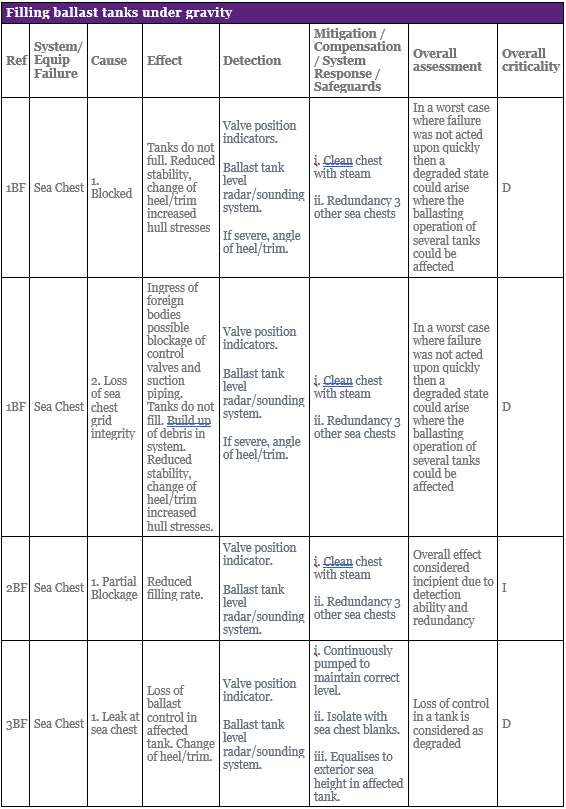
An example of an FMEA Output Table

To properly understand these results you need to know how a Sea Chest works (see context here). Otherwise the example just shows what kind of output a FMEA can produce.

Top Tip

Additional comments

Failure Modes and Effects and Criticality Analysis (FMECA) is an analytical QRA technique, used by ARM and ILS systems engineers, most commonly and effectively at the late design, test and manufacture stage of a project. It requires the breakdown of the system into individual components and the identification of possible failure modes or malfunctions of each component, (such as too much flow through a valve). Referred to as a bottom-up approach, it starts by identifying the potential failure modes of a component and analyzing their potential effects on the whole system. Numerical levels can be assigned to the likelihood of the failure and the severity or consequence of the failure.

Note: It is important to recognize that FMEA/FMECA Standards have different approaches to criticality. Failure mode severity classes 1 – 5 for Standards MIL1629A and ARP926A go from Class 1 being the most severe (e.g. loss of life) to Class 5 being less severe (i.e. no effect), whereas BS 5760 deals with criticality in the opposite direction where Class 5 is the most severe.

Note that FMECA for ARM/ILS looks at availability or mission criticality, not safety criticality.  A FMECA for safety will have a different focus.

Top Tip

Software:

  • Isograph;
  • Reliability Work Bench;
  • Reliasoft;
  • Microsoft Excel.

These are not recommendations!

FMEA/FMECA tables for complex systems can run to hundreds of pages, so good tool support is essential.

Top Tip

Failure Mode Effects Analysis: Have You Used This Technique?

Back to the Safety Assessment topic page.

Meet the Author

Learn safety engineering with me, an industry professional with 25 years of experience. I have:

•Worked on aircraft, ships, submarines, ATMS, trains, and software;

•Tiny programs to some of the biggest (Eurofighter, Future Submarine);

•In the UK and Australia, on US and European programs;

•Taught safety to hundreds of people in the classroom, and thousands online;

•Presented on safety topics at several international conferences.

Categories
Blog Safety Analysis Tools & Techniques

Five Ways to Identify Hazards

In my webinar ‘Five Ways to Identify Hazards’ I look at a mix of techniques. We need these diverse techniques to assure us (give justified confidence) that we have identified the full range of hazards associated with a system.

To do this I draw on my 25 years of experience (see ‘Meet the Author‘, below) and relevant standards. Here’s the introduction to the webinar.

Five Ways to Identify Hazards: Video Introduction

Webinar: ‘Five Ways to Identify Hazards’

Four Things to Remember

For hazard identification, we need to be aware of four things.

What we’re doing is we are imagining what could go wrong. And I want to emphasize, first of all, imagination. We need to be open to what could happen. That’s the mindset that we need, and we’re looking at what could go wrong, not what will go wrong. Think about possibilities, not certainties.

The second thing is that it’s very easy to dive down a rabbit hole and get into mega detail about one particular thing and spend lots of time, waste lots of time doing that. That’s not what we need to be doing. We need a broad approach. We need to go wide and think about as many different possible hazards as we can. Don’t dive deep that will come later, the deep analysis will come later.

Another aspect of that point is we’re talking about hazard identification. We’re just here to identify hazards. We’re not here to try to assess them yet.

Yet another mistake that people make is to try and jump straight to fixing the hazard. Many of us watching will be engineers. We love fixing problems. We like to solve problems, but we’re not here to solve the problem yet. We’re only here to identify it. So we’re going to avoid the temptation to jump in and try and come up with a solution. That’s not what we’re doing with hazard identification.

So those are four things to bear in mind.

Five Ways to Identify Hazards

Let’s move on. So I’ve said that this was entitled five ways to identify hazards.

There are, of course, many ways to identify hazards, but I just thought I’d pick on these five because there was a nice broad range of things and things that I can show you how to do straight away.

Those are the five things that we’ve got and we’ll have a slide on each one of those. First, we can ask the workers or end users or their representatives. Secondly, we can inspect the workplace, we can look around for hazards. And maybe we’ve got a real workplace that we can look at or maybe we’ve just got a representation, we can do both.

We can use a hazard identification checklist, we can survey historical data. So all the squiggly lines at the bottom of the screen, there’s an example of some historical data and we can conduct a number of analyses on that.

But the analysis I picked on (Number 5) is Functional Failure Analysis and we’ll see why in just a moment. So those are the five things that we will cover in the next hour. We’ll also have time for a Question and Answer session and then a worked example of how to do a simple Functional Failure Analysis…

There’s More!

This is just one of many webinars in my Safety Engineering Academy. You can see summaries of them all in this blog post.

Meet the Author

Learn safety engineering with me, an industry professional with 25 years of experience, I have:

•Worked on aircraft, ships, submarines, ATMS, trains, and software;

•Tiny programs to some of the biggest (Eurofighter, Future Submarine);

•In the UK and Australia, on US and European programs;

•Taught safety to hundreds of people in the classroom, and thousands online;

•Presented on safety topics at several international conferences.

Categories
Safety Analysis Tools & Techniques

Exploring Causal Analysis: Techniques and Insights

In this post, ‘Exploring Causal Analysis: Techniques and Insights’, I provide a quick summary of my recent webinar. You can see a short video introduction below, or access the full webinar at my Safety Engineering Academy.

Introduction:

Causal analysis is a vital aspect of system safety engineering, offering insights into the root causes of issues and guiding effective problem-solving strategies. In this webinar, we delve into various causal analysis techniques and discuss their practical applications in diverse domains.

Section 1: Introduction to Causal Analysis

Causal analysis involves understanding the sequence of events leading to an outcome and identifying the underlying factors contributing to it. We explore the fundamentals of causal analysis and its significance in safety engineering.

Section 2: Popular Causal Analysis Techniques

We examine eight popular causal analysis methods, including Pareto charts, Failure Mode and Effects Analysis (FMEA), 5 Whys, Ishikawa diagrams, Fault Tree Analysis (FTA), 8D reporting, DMAIC, and Scatter Diagrams. Each technique is analyzed for its strengths, limitations, and practical utility.

Section 3: Deeper Dive into Selected Techniques

We take a closer look at selected causal analysis techniques, exploring their application in real-world scenarios. Examples include using Pareto charts to identify dominant causes, leveraging FMEA for failure mode analysis, and utilizing Fault Tree Analysis for assessing complex system failures.

Section 4: Insights and Reflections

Drawing from years of experience in system safety engineering across diverse domains and international contexts, we share insights and reflections on the effectiveness of different causal analysis techniques. We emphasize the importance of choosing the right technique based on the specific objectives and available data.

Section 5: Resources and Next Steps

We provide attendees with valuable resources for further exploration of causal analysis techniques, including links to webinars, online courses, and templates. Additionally, we offer a glimpse into ongoing research and developments in the field of safety engineering.

Conclusion:

Causal analysis is a dynamic and evolving field that plays a crucial role in ensuring system reliability and safety. By employing a range of techniques and approaches, safety practitioners can gain deeper insights into the root causes of issues and implement effective risk management strategies.

Bonus: Q&A Sessions

Here are the two Q&A Sessions from the Webinar:

Causal Analysis – Q&A Session 1

Exploring Causal Analysis: Techniques and Insights – Get more here

Learn safety engineering with me, an industry professional with 25 years of experience, I have:

•Worked on aircraft, ships, submarines, ATMS, trains, and software;

•Tiny programs to some of the biggest (Eurofighter, Future Submarine);

•In the UK and Australia, on US and European programs;

•Taught safety to hundreds of people in the classroom, and thousands online;

•Presented on safety topics at several international conferences.

Categories
Blog Safety Management Tools & Techniques

Full Function Hazard Logs: A Deep Dive into Relational Databases

In this post ‘Full Function Hazard Logs: A Deep Dive into Relational Databases’, I explore some things we can do with a hazard log built upon a database.

In my 25-year career in safety engineering, I’ve seen many hazard logs and hazard tracking systems. Most of them were hosted in Microsoft Excel, but there were also commercial tools and bespoke databases. Let’s explore well beyond mere spreadsheets…

The Accident Sequence Illustrated.

In the realm of hazard management, navigating through the complexities of hazard logs, hazard tracking systems, and risk registers is crucial for ensuring safety and compliance. To shed light on this intricate process, we embark on a journey to explore the nuances of full-function hazard logs and their utilization within relational databases. Join us as we unravel the intricacies of hazard identification, risk assessment, and control measures within the realm of safety engineering.

Unveiling the Essence of Full Function Hazard Logs

Entities and Links in an Example Full-function Hazard Log

In our quest to decipher the essence of full-function hazard logs, we delve into the core components of relational databases. Our mission is clear: to unravel the labyrinth of entities within a hazard log, understand their interconnections, and discern the rationale behind data recording. By comprehending the diverse facets of hazard logs, we equip ourselves with the knowledge to tailor hazard log features to meet specific needs, ensuring efficiency and efficacy in hazard management processes.

Illustrating with Cassandra: A Glimpse into Hazard Log Tools

As we embark on this journey, we look closely at Cassandra, an exemplar of hazard log tools. While our focus remains steadfast on elucidating hazard management principles, Cassandra serves as a tangible illustration, offering a practical lens through which to explore complex concepts.

The Cassandra Hazard Log Logo

Through this illustrative example, we navigate the intricacies of accident causal control, dissecting the underlying hazard model that underpins our hazard management endeavors.

Deciphering Hazard Log Screens: A Comprehensive Overview

Venturing further into the realm of hazard log management, we dissect the various screens encapsulated within the hazard log interface.

A Screen with Accident-related Data and Links.

From the overview screen, where we gain a holistic view of accidents, hazards, causes, and controls, to the core screen, where we delve into the specifics of causal analysis, each screen offers a unique perspective on hazard management. By scrutinizing leading particulars, probability, severity, and post-control statuses, we unravel the intricacies of hazard identification and risk mitigation.

Unveiling the Power of Relational Databases

Central to our exploration is the underlying power of relational databases, where entities are intricately linked through many-to-many relationships. As we navigate through the database landscape, we witness the seamless integration of accidents, hazards, causes, and controls, each playing a pivotal role in shaping hazard management strategies. By harnessing the full potential of relational databases, we unlock a myriad of benefits, empowering us to make informed decisions and uphold safety standards with unwavering diligence.

Accessing Additional Resources: Empowering Your Hazard Management Journey

As we conclude our exploration of full-function hazard logs within relational databases, we extend an invitation to delve deeper into the realm of hazard management.

Through free email subscriptions and access to courses on safety engineering, we provide a gateway to further enrich your hazard management knowledge. Join our community of safety enthusiasts, engage in insightful discussions, and embark on a transformative journey toward bolstering safety practices within your organization.

Learn safety engineering with me, an industry professional with 25 years of experience, I have:

•Worked on aircraft, ships, submarines, ATMS, trains, and software;

•Tiny programs to some of the biggest (Eurofighter, Future Submarine);

•In the UK and Australia, on US and European programs;

•Taught safety to hundreds of people in the classroom, and thousands online;

•Presented on safety topics at several international conferences.

Categories
Mil-Std-882E Safety Analysis software safety

Functional Hazard Analysis with Mil-Std-882E

In this video, I look at Functional Hazard Analysis with Mil-Std-882E (FHA, which is Task 208 in Mil-Std-882E). FHA analyses software, complex electronic hardware, and human interactions. I explore the aim, description, and contracting requirements of this Task, and provide extensive commentary on it. (I refer to other lessons for special techniques for software safety and Human Factors.)

This video, and the related webinar ‘Identify & Analyze Functional Hazards’, deal with an important topic. Programmable electronics and software now run so much of our modern world. They control many safety-related products and services. If they go wrong, they can hurt people.

I’ve been working with software-intensive systems since 1994. Functional hazards are often misunderstood or overlooked, as they are hidden. However, the accidents that they can cause are very real. If you want to expand your analysis skills beyond just physical hazards, I will show you how.

This is the seven-minute demo; the full version is 40 minutes long.

Functional Hazard Analysis: Context

So how do we analyze software safety?

Before we even start, we need to identify those system functions that may impact safety. We can do this by performing a Functional Failure Analysis (FFA) of all system requirements that might credibly lead to human harm.

An FFA looks at functional requirements (the system should do ‘this’ or ‘that’) and examines what could go wrong:

  • Does the function work when needed?
  • Does the function work when not required?
  • Does the function work incorrectly? (There may be more than one version of this.)

(A variation of this technique is explained here.)

If the function could lead to a hazard then it is marked for further analysis. This is where we apply the FHA, Task 208.

Functional Hazard Analysis: The Lesson

Topics: Functional Hazard Analysis

  • Task 208 Purpose;
  • Task Description;
  • Update & Reporting
  • Contracting; and
  • Commentary.

Transcript: Functional Hazard Analysis

Introduction

Hello, everyone, and welcome to the Safety Artisan; Home of Safety Engineering Training. I’m Simon and today we’re going to be looking at how you analyze the safety of functions of complex hardware and software. We’ll see what that’s all about in just a second.

Functional Hazard Analysis

I’m just going to get to the right page. This, as you can see, functional hazard analysis is Task 208 in Mil. Standard 882E.

Topics for this Session

What we’ve got for today: we have three slides on the purpose of functional hazard analysis, and these are all taken from the standard. We’ve got six slides of task description. That’s the text from the standard plus we’ve got two tables that show you how it’s done from another part of the standard, not from Task 208. Then we’ve got update and recording, another two slides. Contracting, two slides. And five slides of commentary, which again include a couple of tables to illustrate what we’re talking about.

Functional Purpose HA #1

What we’re going to talk about is, as I say, functional hazard analysis. So, first of all, what’s the purpose of it? In classic 882 style, Task 208 is to perform this functional hazard analysis on a system or subsystem or more than one. Again, as with all the other tasks, we use it to identify and classify system functions and the safety consequences of functional failure or malfunction. In other words, hazards.

Now, I should point out at this stage that the standard is focused on malfunctions of the system. In the real world, lots of software-intensive systems cause accidents that have killed people, even when they’re functioning as intended. That’s one of the shortcomings of this Military Standard – it focuses on failure. But even if something performs as specified, either:

  • The specification might be wrong, or
  • The system might do something that the human operator does not expects.

Mil-Std-882E just doesn’t recognize that. So, it’s not very good in that respect. However, bearing that in mind, let’s carry on with looking at the task.

Functional HA Purpose #2

We’re going to look at these consequences in terms of severity – severity only, we’ll come back to that – to identify what they call safety-critical functions, safety-critical items, safety-related functions, and safety-related items. And a quick word on that, I hate the term ‘safety-critical’ because it suggests a sort of binary “Either it’s safety-critical. Yes. Or it’s not safety-critical. No.” And lots of people take that to mean if it’s “safety-critical, no,” then it’s got nothing to do with safety. They don’t recognize that there’s a sliding scale between maximum safety criticality and none whatsoever. And that’s led to a lot of bad thinking and bad behavior over the years where people do everything they can to pretend that something isn’t safety-related by saying, “Oh, it’s not safety-critical, therefore we don’t have to do anything.” And that kind of laziness kills people.

Anyway, moving on. So, we’ve got these SCFs, SCIs, SRFs, SRIs and they’re supposed to be allocated or mapped to a system design architecture. The presumption in this – the assumption in this task is that we’re doing early – We’ll see that later – and that system design, system architecture, is still up for grabs. We can still influence it.

COTS and MOTS Software

Often that is not the case these days. This standard was written many years ago when the military used to buy loads of bespoke equipment and have it all developed from new. That doesn’t happen anymore so much in the military and it certainly doesn’t happen in many other walks of life – But we’ll talk about how you deal with the realities later.

And they’re allocating these functions and these items of interest to hardware, software, and human interfaces. And I should point out, when we’re talking about all that, all these things are complex. Software is complex, human is complex, and we’re talking about complex hardware. So, we’re talking about components where you can’t just say, “Oh, it’s got a reliability of X, and that’s how often it goes wrong” because those types of simple components are only really subject to random failure, that’s not what we’re talking about here.

We’re talking about complex stuff where we’re talking about systematic failure dominating over random, simple hardware failure. So, that’s the focus of this task and what we’re talking about. That’s not explained in the standard, but that’s what’s going on.

Functional HA Purpose #3

Now, our third slide is on purpose; so, we use the FHA to identify the consequences of malfunction, functional failure, or lack of function. As I said just now, we need to do this as early as possible in the systems engineering process to enable us to influence the design. Of course, this is assuming that there is a system engineering process – that’s not always the case. We’ll talk about that at the end as well.

Also, we’re going to identify and document these functions and items and allocate and it says to partition them in the software design architecture. When we say partition, that’s jargon for separating them into independent functions. We’ll see the value of that later on. Then we’re going to identify requirements and constraints to put on the design team to say, “To achieve this allocation in this partitioning, this is what you must do and this is what you must not do”. So again, the assumption is we’re doing this early. There’s a significant amount of bespoke design yet to be done….

Then What?

Once the FFA has identified the required ‘Level or Rigor’, we need to translate that into a suitable software development standard. This might be:

  • RTCA DO-178C (also know as ED-12C) for civil aviation;
  • The US Joint Software System Safety Engineering Handbook (JSSEH) for military systems;
  • IEC 61508 (functional safety) for the process industry;
  • CENELEC-50128 for the rail industry; and
  • ISO 26262 for automotive applications.

Such standards use Safety Integrity Levels (SILs) or Development Assurance Levels (DALs) to enforce appropriate Levels of Rigor. You can learn about those in my course, Principles of Safe Software Development.

Meet the Author

My name’s Simon Di Nucci. I’m a practicing system safety engineer, and I have been, for the last 25 years; I’ve worked in all kinds of domains, aircraft, ships, submarines, sensors, and command and control systems, and some work on rail air traffic management systems, and lots of software safety. So, I’ve done a lot of different things!

Categories
Blog Mil-Std-882E Safety Analysis

How to do Preliminary Hazard Analysis with Mil-Std-882E

In this 45-minute session, I look at how to do a Preliminary Hazard Analysis with Mil-Std-882E. Preliminary Hazard Analysis, or PHA, is Task 202 in the Standard.

I explore Task 202’s aim, description, scope, and contracting requirements. There’s value-adding commentary, and I explain the issues with PHA – how to do it well and avoid the pitfalls.

Now, I have worked in System Safety since 1996, and I think that PHA is one of the three tasks that EVERY project needs to do. The other two are:

I look at these three tasks together in my course ‘Foundations of Safety Assessment’. This is one of five linked courses on Mil-Std-882E. They will teach you how to get the maximum benefits from your System Safety Program.

This is the seven-minute-long demo video. The full video is 45 minutes long.

Topics: How to do Preliminary Hazard Analysis

  • Task 202 Purpose;
  • Task Description;
  • Recording & Scope;
  • Risk Assessment (Tables I, II & III);
  • Risk Mitigation (order of preference);
  • Contracting; and
  • Commentary.

Transcript: How to do Preliminary Hazard Analysis

Hello and welcome to the Safety Artisan, where you’ll find professional, pragmatic, and impartial safety training resources. So, we’ll get straight on to our session, which is on the 8th of February 2020.

Preliminary Hazard Analysis

Now we’re going to talk today about Preliminary Hazard Analysis (PHA). This is Task 202 in Military Standard 882E, which is a system safety engineering standard. It’s very widely used mostly on military equipment, but it does turn up elsewhere.  This standard is of wide interest to people and Task 202 is the second of the analysis tasks. It’s one of the first things that you will do on a systems safety program and therefore one of the most informative. This session forms part of a series of lessons that I’m doing on Mil-Std-882E.

Topics for This Session

What are we going to cover in this session? Quite a lot! The purpose of the task, a task description, recording, and scope. How we do risk assessments against Tables 1, 2, and 3. These tables describe severities, likelihoods, and the overall risk matrix.  We will talk about all three, about risk mitigation and using the order of preference for risk mitigation, a little bit of contracting, and then a short commentary from myself. I’m providing commentary all the way through. So, let’s crack on.

Task 202 Purpose

The purpose of Task 202, as it says, is to perform and document a preliminary hazard analysis, or PHA for short, to identify hazards, assess the initial risks, and identify potential mitigation measures. We’re going to talk about all of that.

Task Description

First, the task description is quite long here. And as you can see, I’ve highlighted some stuff that I particularly want to talk about.

It says “the contractor” [does this or that], but it doesn’t matter who is doing the analysis, and, the customer needs to do something to inform themselves, otherwise they won’t understand what they’re doing.  Whoever does it needs to perform and document a PHA. It’s about determining initial risk assessments. There’s going to be more work, more detailed work done later. But for now, we’re doing an initial risk assessment of identified hazards. And those hazards will be associated with the design or the functions we propose to introduce. That’s very important. We don’t need a design to do this. We can get in early when we have user requirements, functional requirements, and that kind of thing.

Doing this work will help us make better requirements for the system. So, we need to evaluate those hazards for severity and probability. It says based on the best available data. And of course, early in a program, that’s another big issue. We’ll talk about that more later. It says to include mishap data as well, if accessible: American term mishap, means an accident, but we’re avoiding any kind of suggestion about whether it is accidental or deliberate.  It might be stupidity, deliberate, or whatever. It’s a mishap. It’s an undesirable event.

We look for accessible data from similar systems, legacy systems, and other lessons learned. I’ve talked about that a little bit in the Task 201 lesson, and there’s more on that today under commentary. We need to look at provisions, and alternatives, meaning design provisions and design alternatives to reduce risks and add mitigation measures to eliminate hazards. If we can all reduce associated risk, we need to include all of that. What’s the task description? That’s a good overview of the task and what we need to talk about.

Reading & Scope

First, recording and scope, as always, with these tasks, we’ve got to document the results of the PHA in a hazard tracking system. Now, a word on terminology; we might call a hazard tracking system; we might call it a hazard log; we might call it a risk register. It doesn’t matter what it’s called. The key point is it’s a tracking system. It’s a live document, as people say, it’s a spreadsheet or a database, something like that. It’s something relatively easy to update and change.

Also, we can track changes through the safety program once we do more analysis because things will change. We should expect to get some results and refine them and change them as time goes on. Very important point.

That’s it for the Demo…

End: How to do Preliminary Hazard Analysis

Learn safety engineering with me, an industry professional with 25 years of experience, I have:

•Worked on aircraft, ships, submarines, ATMS, trains, and software;

•Tiny programs to some of the biggest (Eurofighter, Future Submarine);

•In the UK and Australia, on US and European programs;

•Taught safety to hundreds of people in the classroom, and thousands online;

•Presented on safety topics at several international conferences.

You can find a free pdf of the System Safety Engineering Standard, Mil-Std-882E, here.

Categories
Behind the Scenes Blog

Challenges of Online Learning

What are the Challenges of Online Learning?  In my previous article, I looked at ‘Five Key Dimensions of Online Learning’, which explored what makes it popular.  But there’s a downside too – things that put students off.  What are they, and can they be fixed?

“Top reasons cited by students who do not intend to enroll in online education programs include fear of distraction, lack of discipline, and lack of motivation.”

McKinsey Article[1]

Why do Students Hesitate to Enrol in Online Learning?

Many students remain hesitant to enroll in fully remote programs, with students worldwide citing the following top three reasons: fear of becoming more distracted by studying online, boredom if the learning experience is not motivating, and a lack of discipline to complete the online program. Although these perceptions may be partially anticipated, they appear to show that for a segment of students, online programs have not been able to provide a compelling learning experience (see Exhibit 2).

Social factors influence opinions toward in-person, hybrid, and entirely remote models. Students who prefer hybrid learning say they value the combination of flexibility and peer-to-peer connections, whereas students who prefer in-person learning say it provides greater support and peer-to-peer chances. In 80 percent of the countries polled, students stated that the primary reason they prefer face-to-face education is that it is simpler to seek support from professors in person rather than online.

Barriers to Online Learning

But All is NOT Lost – We Can Fix This!

“Our research suggests that higher education institutions can increase their online learning, identifying a correlation between higher satisfaction levels and growth in online learning”

McKinsey Article

An Aside: What Doesn’t Matter?

Before we go on to look at some fixes to problems, it’s helpful to review what don’t we need to worry about.

Expensive qualities are not always valued. Most students do not place a high value on pricey online qualities such as virtual reality (VR), simulations, and complex visual content. This conclusion may indicate that educational institutions and students are still figuring out how to use these tools effectively. Nevertheless, investment in them is increasing. According to one estimate, the global market for education VR is expected to grow.  Networking aspects including “peer-to-peer learning in online settings” and “institution- or student-led networking” were likewise scored in the bottom quartile of relevance in most countries.

Interestingly, this suggests that the investment to achieve Levels 3 and 4 of E-Learning[2] may just not be worth it for most subjects.

Student age and program type had no substantial influence on the perceived quality of online learning experiences. McKinsey’s poll discovered that what students valued most about online learning did not differ significantly across age groups, fields of study, or levels of education (undergraduate versus graduate). Although there are some variances, the consistency of perceptions among groups within each geography might help schools build learning experiences that require less customization for certain student communities.

So What Does Matter?

As already stated, students fear that their online education program may be undermined by distractions at home, a lack of self-discipline, or a lack of motivation.  Let’s look at each of these issues in turn, examining the problems and some possible solutions.  There are also many useful resources at the end of this article.

Fear Of Distraction

If we are not in class then it follows that we are studying somewhen or somewhere else, in a time/place that may not dedicated to learning.  It is quite sensible to worry about being distracted.   

Relevant questions include:

  • Can I study in a place where I can read and work on assignments without distractions?
  • Can I ignore distractions around me when I study?
  • Can I study around people who will not try to distract me?

I have had to revise and study for many exams and qualifications over the years.  I’ve found that doing so in the same place and at the same time every day helps to build a robust studying habit.  (If you can, do schedule a day or days off where you don’t study at all – this will help too.)  

I also found listening to instrumental music (i.e. no vocals) helped me to shut out distractions and concentrate.  Mozart was especially good for maths.  Incidentally, in the modern open-plan office, I’m using this tactic again!

If your friends or family don’t help then tell them that you must withdraw from them for a set time and go to your study chair, corner, or other place.  Put the headphones on / earbuds in.  These are signals to them as well as yourself that you are not available for anything but study.  Take regular breaks and engage with them until your 15-20 minutes are up (set a timer).

If you have a significant other and/or children, then this all becomes much harder.  You will need your partner’s support; perhaps they could be studying or practicing a hobby at the same time.  If you have small children then studying after their bedtime is your best bet – but I know how hard that is.  My daughter was at preschool when I did my master’s degree. 

Can you take an hour off for lunch and find somewhere to hide and study at work?  Can you study on your commute (on public transport) or at least listen to audio while you drive?

Lack Of Discipline

If we are not accountable to someone else, then we may struggle with a lack of self-discipline to study.  Relevant questions to ask ourselves are:

  • Am I good at setting goals and deadlines for myself?
  • Do I finish the projects I start?
  • Do I quit just because things get difficult?
  • Can I keep myself on track and on time?
  • Am I willing to spend 10-20 hours each week on an online course?
  • Do I keep a record of what my assignments are and when they are due?
  • Do I plan my work so that I can turn in my assignments on time?

Just answering these questions honestly will help you be more disciplined.  If you recognize that you struggle with certain things, then you can put in place things to support your weaknesses.

Can you find a study buddy who is different from you?  If you’re always enthusiastic to try new things but they’re not, and they are good at completing tasks then you’re not – you complement each other.  You’re a good match!

Lack Of Motivation

Perhaps this is the most difficult problem to overcome.  Some of the tips we’ve just gone over will help, but there are other questions to ask, such as:

  • Do I have a good reason for taking an online course?
  • Will my online course be just as rigorous as a face-to-face course?
  • Will my online course take less time than a face-to-face course?
  • Will my online course require more than just memorizing content?
  • Can I get my assignments done and turn them in on time?
  • On an online course, I probably will not receive as much personal attention from the instructor (compared to a face-to-face course): does that bother me?

Naturally, if we have a specific reason for taking a course – some goal or reward – then we will be more motivated.  Can we imagine those rewards, those benefits?  Is there a poster or some other reminder of our dream that we can put in our study space?

I remember a world-champion snooker player revealing how he motivated himself to practice.  He would have a favorite snack or drink in reach, but he wasn’t allowed a bite or sip until he had completed a practice shot ten times.  And so on, until the treat was gone.  Could you reward yourself with ten minutes on social media?

A course that just gets you to cram facts is not exciting.  Can you choose a course with regular review sessions and self-assessment tests?  If not, can you add them?  Can you insert review periods when you reflect on what you’ve learned and try to apply it to something that you know about?  Use the model [3] below:

Finally, remember that this period of study, and self-denial, will not last forever.  Do it for a season, set an end date, and promise yourself a reward – if you succeed.  Perhaps you will find it easier to study during a particular season?  There are usually fewer tempting distractions in Winter (unless you are a skier, so do the opposite).

Technical Factors

It’s interesting to note that a mobile phone can help solve all these problems!  Only a few years ago, getting access to a computer with internet access was challenging for many.  These days, even a cheap smartphone will do most things that you need.  There are thousands of free and paid Apps that can teach you subjects or support your learning.

The problem with IT, phones, and Apps is that often we are just not aware of all their features.  It is said that most users exploit only a fraction of the features of their devices.  With some research, and a little practice, could we find the tools and skills to dramatically increase our productivity?

It is still always a good idea to identify a technical support group before taking an online course.

Online Learning Resources

Here are some resources to help you prepare for online study (acknowledgment of source at the end of this article).  

Self Direction

If you would like to pick up a few more time management skills, here are some tutorials.

 Learning Preferences

Here are some tutorials if you would like to pick up a few more relevant skills.

Active Reading

 Active Listening

 Problem-Solving

 Study Habits

Here are some tutorials if you’d like to pick up a few more good study habits.

Note Taking

 Writing Reports

 Online Learning Expectations

It is helpful to have realistic expectations about what it means to be an online learner. If you want to read more on this subject, please refer to the following:

My name’s Simon Di Nucci. I’m a practicing system safety engineer, and I have been, for the last 25 years; I’ve worked in all kinds of domains, aircraft, ships, submarines, sensors, and command and control systems, and some work on rail air traffic management systems, and lots of software safety. So, I’ve done a lot of different things!

Acknowledgments

I gratefully acknowledge that the Section “Online Learning Readiness Help” is derived from the Online Learning Readiness Questionnaire[4] by Penn State University, which is licensed under a
Creative Commons Attribution-Noncommercial-Share Alike 3.0 United States License.  Vicki Willams of Penn State devised the original version of this assessment, which is available at  https://pennstate.qualtrics.com/SE/?SID=SV_7QCNUPsyH9f012B


[1] https://www.mckinsey.com/industries/public-sector/our-insights/what-do-higher-education-students-want-from-online-learning

[2] https://community.articulate.com/articles/get-to-know-the-4-levels-of-e-learning

[3] From https://www.structural-learning.com/post/reflective-practice

[4] https://behrend-elearn.psu.edu/weblearning/questionnaire/ORQ.HTM


Categories
Blog Safety Analysis

Preliminary Hazard Identification & Analysis Guide

Get your free Preliminary Hazard Identification & Analysis, PHIA Guide here!

Introduction

Hazard Identification is sometimes defined as: “The process of identifying and listing the hazards and accidents associated with a system.”

Hazard Analysis is sometimes defined as: “The process of describing in detail the hazards and accidents associated with a system and defining accident sequences.”

Preliminary Hazard Identification and Analysis (PHIA) helps you determine the scope of safety activities and requirements. You can identify the main hazards likely to arise from the capability and functionality being provided. Perform it as early as possible in the project life cycle. Thus, you will provide important early input to setting Safety requirements and refining the Project Safety Plan.

PHIA seeks to answer, at an early stage of the project, the question: “What Hazards and Accidents might affect this system and how could they happen?”

Aim

The PHIA aims to identify, as early as possible, the main Hazards and Accidents that may arise during the life of the system. It provides input to:

  1. Scoping the subsequent Safety activities required in any Safety Plan. A successful PHIA will help to gauge the proportionate effort that is likely to be required to produce an effective Safety Case, proportionate to risks.
  2. Selecting or eliminating options for subsequent assessment.
  3. Setting the initial Safety requirements and criteria.
  4. Subsequent Hazard Analyses.
  5. Initiate Hazard Log.

Description

Perform a PHIA as early as possible to obtain maximum benefit. Use it to understand what the Hazards and Accidents are, why, and how they might be realized. A PHIA is an important part of Risk Management, project planning, and requirements definition. It helps you to identify the main system hazards and helps target where a more thorough analysis should be undertaken.

Usually, PHIA is based on a structured brainstorming exercise, supported by hazard checklists. A structured approach helps to minimize the possibility of missing an important hazard. It also demonstrates that a comprehensive approach has been applied.

Get Your PHIA Guide as part of the FREE Learning Bundle

Front cover of PHIA Guide
Subscribe to The Safety Artisan Mailing List and get your Free Gift!

Find more on basic safety topics at Start Here.

Meet the Author

Learn safety engineering with me, an industry professional with 25 years of experience, I have:

•Worked on aircraft, ships, submarines, ATMS, trains, and software;

•Tiny programs to some of the biggest (Eurofighter, Future Submarine);

•In the UK and Australia, on US and European programs;

•Taught safety to hundreds of people in the classroom, and thousands online;

•Presented on safety topics at several international conferences.

Categories
Behind the Scenes Blog

Five Key Dimensions of Online Learning

In this article ‘Five Key Dimensions of Online Learning’, I discuss the learning dimensions and attributes that students are looking for.

How do I know what students are looking for? Fortunately “McKinsey surveyed more than 7,000 students in 17 countries to find out which elements of online higher education they value most.”[1]

Unfortunately, McKinsey didn’t bother to explain the edu-speak jargon in their article. So let’s look at the essentials and unpack them a bit.

Benefits

Students value several different things in online learning. The top three are:

  1. Recording classes and making them available to watch later.
  2. Easy access to online study materials.
  3. Flexibility that enables students to work and study.

But there are a lot more things that students want. McKinsey used a model with eight Dimensions containing 24 Attributes (see ‘Exhibit 1’, below). It turns out though, that only ten Attributes from five of the Dimensions made the grade. Read on…

Exhibit 1 from McKinsey Article ‘What do higher education students want from online learning?’

One. A Clear Roadmap

The first popular dimension is a clear roadmap. Within this grouping, students want an online program structure, readiness assessment, and readiness leveling. What does this mean?

Photo by cottonbro studio, Pexels.com

Online Programs Structure

Unsurprisingly, students want to know how to navigate their way around e-learning programs.

What is the structure of the online course program?  In which order should courses, lessons, and modules be studied?  Can some students skip some subjects, or are all of them mandatory?  Which items are assessed?

A good online learning offering will make this crystal clear, thus reducing a student’s anxiety. Remember that students may not be studying in their first language, so it is the training provider’s responsibility to make it easy for them.

Readiness Assessment

Not everyone is suited to online learning, either by circumstances, temperament, or for technical reasons. A Readiness Assessment enables students to self-assess their suitability.

“Before enrolling in an online course, you should first assess your readiness for stepping into the online learning environment. Your answers to the following questions will help you determine what you need to do to succeed at online learning.  Instructions: Choose the most accurate response to each statement. Then click the Am I Ready? button.”[3]

Pennsylvaninia State University

The link takes you to an online questionnaire, which is a bit out of date (technology has moved on). But it’s still a useful exercise and the questions will get you to think about whether online learning is for you.

(Spoiler alert: it doesn’t matter how you answer the questions, the website directs you to the same resources. But that’s OK: they are good resources and worth a look!)

Readiness Leveling

Conventionally, there are four levels of E-Learning [4]

Image from Shift E-learning [5]

“Level 1 e-learning is a passive experience, where the learner just consumes information. There’s little to no interactivity with the course and the learner mostly reads and moves forward by clicking Next.”

Shift E-learning

“At Level 2, e-learning courses start to incorporate some multimedia. Courses at this level can contain audio, some video, basic animations, and a few simple transitions. This level of content is often accompanied by narration and click-and-reveal interactions. Level 2 quizzes start to incorporate drag-and-drop interactions and matching activities.”

Shift E-learning

“With Level 3 e-learning courses, the interactions become even more sophisticated. In this level, you can expect to include extensive audio, video, transitions, animations, and more. Quizzing can involve branched, scenario-based questions that allow learners to explore multiple paths and feedback levels.”  [C.f. ‘Choose Your Adventure’]

Shift E-learning

“Level 4 e-learning uses all of the components in levels 1, 2, and 3, plus gamification or simulation. These courses may incorporate 360° images, games or complex gamification, scenarios, avatars, or interactive videos. These courses are more immersive than other levels of e-learning. As learners interact with the course, they receive feedback on their choices. And in some cases, their choices might even impact the content they’re presented with next.”

Shift E-learning

A lot of e-learning offerings are at Levels One or Two, as the higher levels are much more expensive to deliver. Not all learning needs will require these higher levels, so they are not used unless the scenario demands it.

Two. An Easy Digital Experience

This sounds obvious, but within this Dimension, there are three attributes. Only one is popular: Omni channel. What does this mean?

Omni Channel

Photo by Mike Beard, Pexels.com

“Omnichannel is a multi-channel approach to L&D that seeks to provide the learner with a seamless learning experience whether the learner is learning online from a desktop or mobile device, by telephone or in a bricks and mortar office.”[6]

LearningPool.com

“Omnichannel marketing — the use of physical and digital storefronts to reach consumers with a unified experience — is a fundamental strategy of modern retailing. Brands that aspire to this approach seek customers via multiple channels: direct mail, TV ads, YouTube channel, website, telemarketing, social media, mobile site, and storefronts. …omnichannel strategies assume that consumers will move from one channel to another.”[7]

Forbes.com

So, by extension, omni-channel L&D could offer us a mixture of face-to-face and remote delivery. That said, if the student and trainer COULD get together, then why would they be doing remote learning?

Perhaps we need to be a bit more imaginative about what omnichannel could mean in a purely online setting.

Three. Balanced Learning Formats

Students want two, seemingly contradictory things here – Asynchronous Classes and Synchronous Classes.

Get How to Demonstrate #SFARP
Photo by EKATERINA BOLOVTSOVA from Pexels

Synchronous Classes

“Synchronous learning refers to instructors and students gathering at the same time and (virtual or physical) place and interacting in ‘real-time’.”

Stanford University

OK, so the mighty Stanford University is essentially referring to ‘live events’. We can deliver these face-to-face or via e-learning.

Asynchronous Classes

“Asynchronous learning means that learning takes place at all different times for students enrolled in a course. Asynchronous learning is any type of learning that you undertake on your own schedule and which does not require consistent real-time interactions with an instructor.”

Coursera

Here, we’re talking about recorded content (video, audio, text, interactive, etc). This is one of the great strengths of online learning – hence, it’s number-one popularity with students (see Benefits, above).

Four. Captivating Delivery

This sounds obvious, we need to work especially hard to keep students engaged when working online. Surprisingly, of all the things we might imagine, only two things come out of this strongly.

Up To Date Content

Students are looking forward to their future careers, so naturally, they are interested in the ‘latest thing’. In traditional universities, this forward-looking focus was shared by those conducting cutting-edge research. (That said, I have seen university courses in the 2020s based on what was hip and new in the 1970s!)

Those of us who work in online education may not be doing research. And we may be passing on our hard-won experience from long careers. So the challenge is to keep up to date by looking online at what our potential students are searching for – not what we think they should be learning.

Faculty Relevance

This attribute is explicitly referring to a bricks-and-mortar university or higher-education facility. So is it relevant to any other kind of training provider?

I think so. Whether we are a Registered Training Organisation, an industry body, a commercial provider, a consultancy, or even a sole trader, we can ask: how relevant are we to today’s students?

One way to find out is by research. There are lots of great tools out there that can tell us what people are searching for, like Google Trends, Answer the Public and Semrush. Or we might be more specific and look at special interest groups on LinkedIn, Facebook, and other social media. If we have access to our target audience – or a competitor’s target audience – then so much the better.

Five. Practical Learning

Two attributes were popular within the Practical Learning dimension, first support for skills certification, and second portfolio building.

Skills Certification

Photo by Pavel Danilyuk on Pexels.com

This is easy for a university or higher-education facility since they are accredited to award degrees or other qualifications. Similarly, other bodies may be registered (such as RTOs in Australia) to deliver recognized training and award qualifications.

But what do we do if we want our eLearning from an unaccredited or unregistered body (e.g. because it offers Captivating Delivery)? What should commercial providers do who want to offer skills certification without the value-killing bureaucracy? It turns out that there are (at least) two options.

First, are microcredentials. To get a course microcredentialed, we must include some assessment method(s) to determine whether the student has ‘passed’. (Some will complain that this is training not education, but this can’t be helped.) The course itself must also be independently assessed by some government-appointed authority, which sets requirements to award a microcredential. An example of this is the Australian National Microcredentials Framework.

Second are Digital Badges. For this option, we still have to assess our students, but the digital badge is awarded by a third-party commercial platform. Several such platforms are operating online. These badge-givers have no official writ, so we rely on the fact that many thousands of users sign up with them to create a de facto standard.

Of course, microcredentials and Digital Badges can be combined!

Portfolio Building

Related to Skills Certification is Portfolio Building. Let’s not just collect random badges but follow a development path that builds related skills together. After all, what is a course of study, if not a collection of linked modules, made up of individual lessons?

We might assume that the tertiary education providers have cornered this market, but that’s not so. There are a lot of learning frameworks out there, like Skills For the Information Age (SFIA), or the Australian Qualifications Framework (AQF). There’s nothing to stop us from aligning our courses into these frameworks, providing that we don’t make false claims about these bodies endorsing them.

“The truth is, our industry is moving away from hiring based on years of experience or formal education credentials alone. Instead, hiring managers are more interested in the specific skills you can offer right now. This means, when they’re considering you as a potential candidate, they want to see evidence of your skills. And the best way to do this is by building an eLearning portfolio.”[8]

eLearning Academy

I’m not sure that I totally agree with this statement by the eLearning Academy. Sure, many firms are interested in what you can do right now: how you can make money for them. My range of skills (aerospace, safety, software, logistics engineering) has certainly got me higher salaries over the years. However, I also had Honours and Masters degree qualifications, which are valuable in the long term.

Conclusion

We said at the start that “McKinsey surveyed more than 7,000 students in 17 countries to find out which elements of online higher education they value most.” They presented the results ranked 4-10 like this:

Exhibit 4 from McKinsey Article ‘What do higher education students want from online learning?’

(Why don’t they include the top three? I guess that they keep back the best bits for the paying clients!)

It’s clear from the survey that the results are not uniform across all 17 countries. There is a striking consistency of results for Argentina, Colombia, Mexico, Peru, and Spain (all Spanish-speaking countries). The US, UK, and Australia follow the pattern moderately well. However, France, China, India, and Saudi Arabia buck the trend.

In fact, the overall response to online learning varies significantly from country to country (see Exhibit 3, below).

Exhibit 3 from McKinsey Article ‘What do higher education students want from online learning?’

The McKinsey survey offers a summary of these variations, but no analysis:

Across the Americas, students in general placed a greater importance on online learning attributes such as skills certification, omnichannel online experiences, and pre-course readiness-assessment and competency leveling. In the United States and most European countries, students said they enjoy studying independently, taking asynchronous classes, and having an intelligent virtual-support platform. In contrast, students in Brazil, Mexico, and Peru value more personalized support, such as a coach to help them navigate school, career, and personal issues. Students in Chile, Italy, Peru, Saudi Arabia, and Spain highly valued having university support in finding internships.

McKinsey Article

It’s also worth noting that there are many barriers to online learning. These need to be overcome, so far as is reasonably practicable, to maximize the uptake of online learning. I will look at those in another article.

My name’s Simon Di Nucci. I’m a practicing system safety engineer, and I have been, for the last 25 years; I’ve worked in all kinds of domains, aircraft, ships, submarines, sensors, and command and control systems, and some work on rail air traffic management systems, and lots of software safety. So, I’ve done a lot of different things!

Five Key Dimensions of Online Learning: Comments?

Leave me your feedback, below:


[1] https://www.mckinsey.com/industries/public-sector/our-insights/what-do-higher-education-students-want-from-online-learning

[2] https://www.pexels.com/photo/couple-standing-underground-berlin-4550436/

[3] https://behrend-elearn.psu.edu/weblearning/questionnaire/ORQ.HTM

[4] https://community.articulate.com/articles/get-to-know-the-4-levels-of-e-learning

[5] https://www.shiftelearning.com/blog/bid/190140/Levels-of-Interactivity-in-eLearning-Which-one-do-you-need

[6] https://learningpool.com/the-omnichannel-approach-7-steps-to-connect-learner-experiences/

[7]https://www.forbes.com/sites/annkirschner/2021/09/02/the-future-of-higher-education-isomnichannel

[8] https://elearningacademy.io/blog/how-to-build-an-elearning-portfolio

Categories
Blog Safety Management

What Have Hazard Logs Ever Done for Us?

“What Have Hazard Logs Ever Done for Us? Well, there’s the aqueduct…” Monty Python’s Flying Circus may not be an obvious connection to hazard management, but it works! Hazard Logs – or Hazard Tracking Systems (HTS), which is a better term – are underappreciated but vital tools.

In this webinar on hazard logs, one of the topics that I will be covering is what a ‘full-function’ HTS can do. By that, I mean a purpose-built database, rather than just a spreadsheet. So here is a taster of the benefits, derived from my 25+ years of experience on system safety programs, large and small.

Key Elements of a Hazard Log

An HTS pulls together key safety data about:

  • Accidents: ‘An unintended event, or sequence of events, that causes harm’;
  • Accident Sequences: ‘The progression of events that results in an accident’;
  • Causes: that may lead to a hazard;
  • Controls (or mitigations): ‘A measure that, when implemented, reduces risk.’; and, of course
  • Hazards: ‘A physical situation or state of a system, often following from some initiating event, that may lead to an accident’.
Accident Sequence
Accident Sequence

Understanding how causes lead to hazards, and hazards lead to consequences, which may include (harmful) accidents, is fundamental to understanding accident sequences. This in turn helps us to understand the mechanisms that lead to harm – and defeat them.

Managing Many-to-Many Connections

A Hazard Log doesn’t just store data elements, it links those data together meaningfully to make information. A relational database does this by allowing us to make many-to-many connections between different classes of data.

Humorous illustration of linkages between data types in a Hazard Log or HTS
Hazard Log Connections

This allows us to do a lot of useful things. We’ve already mentioned understanding the mechanisms behind accident sequences. This allows us to design or select effective controls to interrupt the accident sequences and prevent harm.

Discovering Pathways to Harm

Understanding these links also enables us to see connections, for example between causes and accidents, which we had not seen before. This is important, as many severe accidents arise from unanticipated pathways to harm, perhaps in very specific circumstances. (For example, not shutting the bow doors of a ferry properly led to the flooding and capsizing of the Herald of Free Enterprise, killing 193 people.)

Change Impact Analysis

Understanding these connections also allows us to perform safety change impact analysis (‘the analysis of changes within a deployed product or application and their potential consequences’). In many programs I worked on, in-use incidents revealed that:

  • Designs were not working as intended;
  • Hazard controls were not as effective as thought;
  • Work done was not as designed; or that
  • The actual use of a system was not as foreseen.

If we know the links to something that has changed – what it affects / what affects it – then we can begin to estimate the impact. From experience, this occupies a lot of our time in in-service safety management.

Recovery and Improvement

In the real world things rarely stand still. There are usually many different stimuli for change (we’ve already mentioned our incidents/accidents). Our enterprise might have to raise its game for several reasons:

  • The Regulator demanding change or improvement;
  • Customers asking for more performance or more assurance;
  • The public reaction to incidents elsewhere in the market;
  • New technology or new competitors in our industry; or
  • Our commitment to continuous improvement.

Pareto analysis tells us that a minority of causes tend to dominate the effect. Thus, a small number of causes or initiating events drive the occurrence of hazards. Similarly, a minority of hazards will dominate incident and/or accident statistics.

We may know this from experience or analysis of our specific system, or we may have only generic data. It doesn’t matter.

Using these insights, we can use the linkages in the HTS to target particular causes, events, conditions, scenarios, hazards, etc. We identify the set that (should) make the biggest impact, the biggest difference. We can then rank the contributors in order of importance and tackle them.

Again, long and sometimes bitter experience tells me that safety practitioners will spend a lot of time doing this. Reacting to stimuli is a big part of safety management.

The Tool Supports the Process

Of course, we should be using tools to support the process. (The process is designed to produce the results or outcomes that we need). One example of such is the Risk Assessment process from ISO 31000, below.

Shows the elements, progression and cycle of the Risk Assessment Process from ISO 31000
The Risk Assessment Process

We want our HTS to support this process, storing the data that we get from the risk identification, analysis, and evaluation activities. We also want our Hazard Log to provide information that enables communication and consultation as well as monitoring and review (perhaps using a risk matrix).

Other Functions

Hazard Logs and HTS also perform many other functions. These may appear mundane, but when they go wrong they suddenly become very exciting! What Have Hazard Logs Ever Done for Us? They help us avoid these unwanted excitements, by providing:

Questions? Comments? Send me your feedback in the comments, below.

My name’s Simon Di Nucci. I’m a practicing system safety engineer, and I have been, for the last 25 years; I’ve worked in all kinds of domains, aircraft, ships, submarines, sensors, and command and control systems, and some work on rail air traffic management systems, and lots of software safety. So, I’ve done a lot of different things!