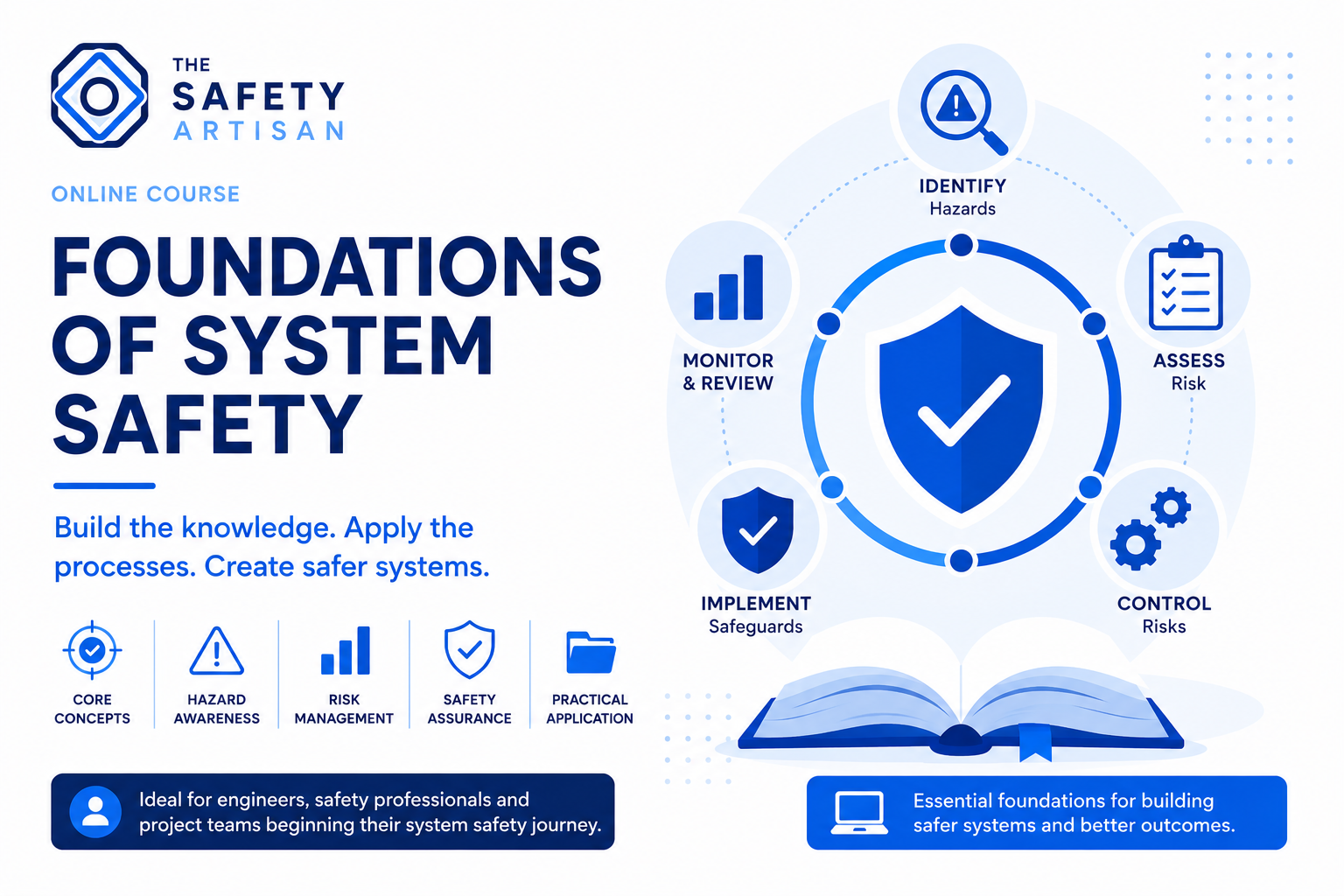
The System Safety Foundations Course teaches the fundamentals of system safety — and how to apply them.
A practical introduction to system safety engineering, hazard identification and safety analysis for engineers, safety practitioners and technical managers.
System safety can seem complicated. Standards, hazard analyses, risk assessments, safety requirements and assurance activities can quickly become a maze of terminology and paperwork.
You’ll learn how system safety works as an engineering discipline, how hazards are identified and analysed. How can structured safety-analysis techniques be applied throughout the system lifecycle?
Start building practical system-safety capability today.
Who is this course for?
This course is designed for professionals who need to understand system safety — whether safety is their primary discipline or an increasingly important part of their engineering role. It is ideal for:
- Systems engineers who need to incorporate safety into their engineering activities
- Safety engineers developing or extending their system-safety skills
- Software and hardware engineers working on safety-critical systems
- Project and engineering managers responsible for technical risk and assurance
- Airworthiness, seaworthiness and certification professionals
- Defence engineers and technical specialists
- Assurance and compliance practitioners
- Engineers moving into a system safety role
- Experienced practitioners who want to refresh their fundamentals
No previous specialist system-safety qualification is required.
What you’ll learn
By the end of this course, you will understand:
1. The foundations of system safety
Understand what system safety is, why it is needed, and how it differs from traditional approaches to safety.
You’ll explore the relationship between:
Hazards → Risks → Safety Requirements → Controls → Verification → Evidence
2. How hazards are identified
Learn how to systematically identify hazards associated with a system, its functions, interfaces, and operating environment.
You’ll be introduced to Preliminary Hazard Identification (PHI) and the principles behind MIL-STD-882E Task 201.
3. How hazards are analysed
Learn how Preliminary Hazard Analysis (PHA) is used to identify hazardous conditions, assess their consequences and develop appropriate controls.
You’ll examine the principles behind MIL-STD-882E Task 202.
4. How safety requirements are developed
Understand how hazards and safety constraints are translated into system requirements.
You’ll be introduced to System Requirements Hazard Analysis (SRHA) and MIL-STD-882E Task 203.
5. How safety-analysis techniques fit together
Gain an overview of the principal techniques used by safety engineers and understand when different techniques may be appropriate.
The course gives you a foundation for progressing into more detailed safety analyses and specialist techniques.
Course curriculum
Module 1 — Introduction to System Safety
Start with the fundamentals.
You’ll explore the purpose of system safety, the role of the safety engineer, and the relationship between systems engineering and safety engineering.
You’ll learn:
- What system safety is
- Why system safety is necessary
- The system-safety lifecycle
- The relationship between safety and systems engineering
- Key safety terminology
- How safety analysis supports engineering decisions
Module 2 — Preliminary Hazard Identification
MIL-STD-882E Task 201
Learn a structured approach to identifying hazards early in the system lifecycle.
You’ll examine:
- What constitutes a hazard
- Sources of hazards
- System functions and hazards
- Interfaces and interactions
- Operating environments
- Preliminary Hazard Identification
- Recording and communicating hazards
Module 3 — Preliminary Hazard Analysis
MIL-STD-882E Task 202
Learn how to take identified hazards and begin analysing their causes, consequences and controls.
You’ll explore:
- Hazard causes
- Hazardous events
- Mishaps and consequences
- Risk assessment
- Existing controls
- Safety requirements
- Risk reduction
- Documenting the analysis
Module 4 — System Requirements Hazard Analysis
MIL-STD-882E Task 203
Learn how safety analysis informs the development and review of system requirements.
You’ll explore:
- Safety-related requirements
- Requirements derived from hazards
- Requirement allocation
- Design constraints
- Interfaces
- Verification considerations
- Maintaining traceability between hazards and requirements
Module 5 — Safety Analysis Techniques
Build your wider safety-analysis toolkit.
You’ll receive an overview of commonly used techniques and learn how they fit into a broader system-safety programme.
This provides a foundation for further study of techniques such as:
- Hazard analysis
- Functional analysis
- Failure analysis
- Causal analysis
- Event-based analysis
- Requirements analysis
- Risk assessment
What makes this course different?
Safety engineering explained by a practitioner
System safety is not just about completing forms or producing a safety report.
It is an engineering discipline concerned with understanding how systems can cause harm — and then using engineering to control that risk.
The Safety Artisan courses are designed around practical experience of applying safety and airworthiness principles to complex, safety-critical systems.
The emphasis is therefore on understanding and application, rather than simply memorising terminology.
Practical, structured and accessible
The course takes you through the system-safety process step by step.
You don’t need to arrive as a system-safety expert.
Instead, you’ll progressively build your understanding:
Understand → Identify → Analyse → Control → Assure
This gives you a foundation that you can apply to real engineering and safety problems.
What you’ll receive
Your enrolment includes:
- ✓ Approximately 4 hours of video instruction
- ✓ 18 lessons
- ✓ Practical guidance on system-safety analysis
- ✓ Introduction to MIL-STD-882E Tasks 201, 202 and 203
- ✓ Supporting presentation material
- ✓ Course transcripts and supporting resources
- ✓ Lifetime access to the online course
- ✓ The ability to learn at your own pace
Is this course right for me?
“I’m an engineer, but I’m new to system safety.”
Yes.
This course provides a structured introduction to the discipline and explains the fundamental concepts you need before progressing to more advanced techniques.
“I’m already a safety engineer.”
The course can provide a useful refresher and help you consolidate your understanding of the relationship between hazard identification, analysis, and safety requirements.
“I don’t work in defence.”
That’s OK.
Although MIL-STD-882E provides an important reference framework for the course, the underlying principles of hazard identification, risk analysis, safety requirements and risk reduction are applicable across many safety-critical industries.
These include:
Aerospace • Defence • Rail • Maritime • Automotive • Nuclear • Industrial Systems
“Do I need to know MIL-STD-882E?”
No.
The course introduces the relevant concepts as you progress.
Your Instructor

Simon Di Nucci: System Safety Consultant | Chartered Engineer | Fellow of Engineers Australia
Simon has more than three decades of experience in airworthiness, system safety and safety-critical engineering.
His experience spans complex systems and major programmes across aerospace, defence, maritime, rail, air traffic management and other safety-critical domains.
He has worked within different regulatory and risk-management frameworks in the UK, US, Europe and Australia.
Simon holds an MSc in Safety Critical Systems Engineering from the University of York and a BEng (Hons) in Aerospace Systems Engineering from the University of Southampton.
His approach is straightforward:
Use engineering discipline to understand risk — and use proportionate controls to manage it.
From theory to practical safety engineering
A system-safety practitioner needs more than definitions.
You need to be able to look at a system and ask:
- What can go wrong?
- How can it happen?
- What happens if it does?
- How much risk does that create?
- What can we do about it?
- How do we know our controls work?
This course introduces the structured engineering processes that help answer those questions.
Build your system-safety capability
Whether you’re moving into system safety, adding safety responsibilities to an engineering role, or refreshing your existing knowledge, Foundations of System Safety gives you a structured starting point.
- Learn the principles.
- Understand the analyses.
- Apply the methods.
- Build your safety-engineering capability.
Foundations of System Safety
$395
18 lessons | Approximately 4 hours of video
Frequently Asked Questions
How long does the course take?
The course contains approximately four hours of video instruction across 18 lessons. You can work through the material at your own pace.
Is this an introductory course?
Yes. It is designed to establish a solid foundation in system safety before progressing to more advanced analysis and assurance activities.
Is the course based on MIL-STD-882E?
MIL-STD-882E is used as an important framework for the hazard-analysis material, particularly Tasks 201, 202, and 203. The underlying system-safety concepts are applicable beyond the standard itself.
Is MIL-STD-882E only relevant to defence?
No. While MIL-STD-882E was developed for defence acquisition, many of its concepts and analytical approaches are also used or adapted in other safety-critical sectors.
Will I learn how to perform a hazard analysis?
The course introduces the principles and processes behind Preliminary Hazard Identification, Preliminary Hazard Analysis and System Requirements Hazard Analysis.
It is intended to give you the foundation needed to undertake more detailed safety-analysis work.
Is this suitable for systems engineers?
Absolutely. Understanding how hazards translate into safety requirements is an important part of systems engineering on safety-critical projects.
Is this suitable for experienced safety engineers?
Yes. It can be used as a refresher or as a structured way to consolidate fundamental concepts.
Do I receive a certificate?
Yes, you get a certificate and a digital badge from Sertifier.
Can I study at my own pace?
Yes. The course is delivered online, allowing you to work through the lessons according to your own schedule.
Ready to build your system-safety skills?
System safety doesn’t have to be mysterious.
Learn the principles, understand the analysis process, and start applying structured safety engineering to your own systems.
Leave a Reply