Blog

  • The 2024 Blog Digest – Q1/Q2

    The 2024 Blog Digest – Q1/Q2

    The 2024 Blog Digest – Q1/Q2 brings you all of The Safety Artisan’s blog posts from the first six months of this year. I hope that you find this a useful resource!

    The 2024 Blog Digest – Q1/Q2: 25 Posts!

    • Sub-System Hazard Analysis with Mil-Std-882E
      In this video lesson, I look at Sub-System Hazard Analysis with Mil-Std-882E (SSHA, which is Task 204). I teach the mechanics of the task, but not just that. I’m using my long experience with this Standard to teach a pragmatic approach to getting the work done. Task 204 is one of three tasks that integrate… Read more: Sub-System Hazard Analysis with Mil-Std-882E
    • Safety Case Lifecycle: How to Develop a Safety Case
      Safety Case Lifecycle: How to Develop a Safety Case is Part 4 of a four-part series on safety cases. In it, we look at timing issues and typical content through the safety case lifecycle. A Comprehensive Guide to Ensuring Project Safety When embarking on any significant project, ensuring safety isn’t just a step in the… Read more: Safety Case Lifecycle: How to Develop a Safety Case
    • System Hazard Analysis with Mil-Std-882E
      In this 45-minute session, I look at System Hazard Analysis with Mil-Std-882E. SHA is Task 205 in the Standard. I explore Task 205’s aim, description, scope, and contracting requirements. I also provide commentary, based on working with this Standard since 1996, which explains SHA. How to use it to complement Sub-System Hazard Analysis (SSHA, Task… Read more: System Hazard Analysis with Mil-Std-882E
    • Principles of Safe Software Course
      The Principles of Safe Software Course – Learn how to develop safe software – and understand what the safety standards are really asking you to do. Software is everywhere. And increasingly, safety depends on it. Modern aircraft, vehicles, ships, railways, industrial systems and other safety-critical systems rely on software to perform functions that can affect… Read more: Principles of Safe Software Course
    • CISSP 2021: What’s New and How to Prepare

      CISSP 2021: What’s New and How to Prepare? Let’s look at the significant changes made to the CISSP Official Exam Outline (the course syllabus). What You Can Learn Who is this Course for? Students wishing to become Certified Information Systems Security Professionals. Are there any Prerequisites? I designed this course to help students prepare for… Read more: CISSP 2021: What’s New and How to Prepare
    • Master the Complete System Safety Assessment Process
      Master the Complete System Safety Assessment Process. Learn how to design, tailor, and execute a comprehensive system safety assessment programme — from Preliminary Hazard Identification through to Environmental Hazard Analysis. Mil-Std-882E Tasks 201–210 · 69 lessons · 10.5 hours of video · Self-paced online training Learn the process. Master the analyses. Build a defensible safety… Read more: Master the Complete System Safety Assessment Process
    • The Safety Artisan’s Resume
      The Safety Artisan’s Resume, or Curriculum Vitae (CV), if you prefer, is quite long. Why should you listen to me? If you want to know how I know what I know, read on… Simon Di Nucci – Principal Safety Consultant BEng, MSc, CPEng, FIE(Aust), NER, Cert CMi, CISSP Key Skills Qualifications MSc in Safety Critical… Read more: The Safety Artisan’s Resume
    • Supporting a Vision Worth Sharing
      At The Safety Artisan, we recently received a Certificate of Appreciation from The Fred Hollows Foundation in recognition of our support. We are genuinely honoured to receive this acknowledgement. More importantly, we are proud to support an organisation whose work has transformed millions of lives around the world. Our Business is Improving Safety Our business… Read more: Supporting a Vision Worth Sharing
    • ISSS Credentialing Initiative: System Safety Professionals

      The ISSS Credentialing Initiative: System Safety Professionals. Where is the Next Generation of System Safety Professionals? We need a Workforce Development Program for Safety-Critical Industries. The International System Safety Society (ISSS) is launching a major credentialing initiative designed to strengthen and expand system safety capability across Canada and the United States. Developed as a three-year… Read more: ISSS Credentialing Initiative: System Safety Professionals
    • Sub-System Hazard Analysis with Mil-Std-882E
      In this video lesson, I look at Sub-System Hazard Analysis with Mil-Std-882E (SSHA, which is Task 204). I teach the mechanics of the task, but not just that. I’m using my long experience with this Standard to teach a pragmatic approach to getting the work done. Task 204 is one of three tasks that integrate… Read more: Sub-System Hazard Analysis with Mil-Std-882E
    • System Hazard Analysis with Mil-Std-882E
      In this 45-minute session, I look at System Hazard Analysis with Mil-Std-882E. SHA is Task 205 in the Standard. I explore Task 205’s aim, description, scope, and contracting requirements. I also provide commentary, based on working with this Standard since 1996, which explains SHA. How to use it to complement Sub-System Hazard Analysis (SSHA, Task… Read more: System Hazard Analysis with Mil-Std-882E
    • Navigating the Safety Case
      Navigating the Safety Case is Part 4 of a four-part series on safety cases. In it, we look at timing issues and typical content through the safety case lifecycle. A Comprehensive Guide to Ensuring Project Safety When embarking on any significant project, ensuring safety isn’t just a step in the process—it’s the foundation of success.… Read more: Navigating the Safety Case
    • The Lifelong Evolution of a Safety Case
      Introduction In The Lifelong Evolution of a Safety Case, we look at how to Review and revise a Safety Case and Re-Issue a Safety Case Report. When it comes to ensuring safety throughout any Product, System, or Service lifecycle, reviewing and revising the Safety Case isn’t just a recommendation—it’s essential. The age or status of… Read more: The Lifelong Evolution of a Safety Case
    • The 2024 Blog Digest – Q3/Q4
      The 2024 Blog Digest – Q3/Q4 brings you all of The Safety Artisan’s blog posts from the first six months of this year. I hope that you find this a useful resource! The 2024 Blog Digest – Q3/Q4: 18 Posts! Meet the Author Learn safety engineering with me, an industry professional with 25 years of… Read more: The 2024 Blog Digest – Q3/Q4
    • Crafting a Safety Case and Safety Case Report – Part 2
      In Crafting a Safety Case and Safety Case Report – Part 2, we move on to review and sign off on the artifacts. Introduction In any high-stakes environment—whether it’s defense, engineering, or aviation—Safety Case Reports play an essential role in validating the safety of a system. A meticulous review and sign-off process ensures that these… Read more: Crafting a Safety Case and Safety Case Report – Part 2
    • Crafting a Safety Case and Safety Case Report
      Crafting a Safety Case and Safety Case Report: A Comprehensive Guide for Project Safety Assurance – PART 1 [Picture by Eric Bruton from Pexels.com] Introduction Building a robust Safety Case and Safety Case Report is essential to ensuring the safety and regulatory compliance of complex systems within the Ministry of Defence (MOD) and similarly regulated… Read more: Crafting a Safety Case and Safety Case Report
    • In-Service Safety Management System
      In-Service Safety Management System: Ensuring Long-Term Safety for Military Equipment Safety is paramount when it comes to military operations, especially for in-service equipment relied upon by personnel daily. This article delves into the intricacies of maintaining an In-Service Safety Management System, offering insight into how safety practices are implemented, monitored, and evolved over time. Introduction:… Read more: In-Service Safety Management System
    • Comprehensive Project Safety Management Plans: A Guide
      Comprehensive Project Safety Management Plans. Safety is a critical element in any large-scale project, especially in the context of defence and complex systems. One essential tool for managing safety is a Safety Management Plan (SMP). In this article, we’ll break down the process and structure of an effective SMP, highlighting its objectives, content, and how… Read more: Comprehensive Project Safety Management Plans: A Guide
    • Guide to Running a Project Safety Committee
      Guide to Running a Project Safety Committee. Okay, so committees are not the sexiest subject, but we need to get stakeholders together to make things happen! Project Safety Committee: Introduction In safety-critical industries such as defense, aerospace, and engineering, maintaining a robust safety management system (SMS) is paramount. A Project Safety Committee (PSC) plays a… Read more: Guide to Running a Project Safety Committee
    • Project Safety Initiation
      In ‘Project Safety Initiation’ we look at what you need to do to get your safety project or program started. Introduction Definitions A stakeholder is anyone who will be affected by the introduction of the system and who needs to be consulted or informed about the development and fielding of the system, and anyone who contributes to… Read more: Project Safety Initiation
    • More Resources for Risk Assessment
      Welcome to Module Five, More Resources for Risk Assessment. We’re on the home straight now! This is the last of the five modules. I will let you know where to get more resources and help on these topics. Course Learning Objectives More Resources for Risk Assessment: Transcript Copyright/Source Statement “First, I want to point out… Read more: More Resources for Risk Assessment
    • Designing Your Risk Assessment Program
      Designing Your Risk Assessment Program. Which Ingredients should we use? In this post, I draw upon my 25+ years in system safety to give you some BOLD advice! I’m going to dare to suggest which analysis tasks are essential to every System Safety Program. I also suggest which tasks are optional depending on the system… Read more: Designing Your Risk Assessment Program
    • Understanding Your Risk Assessment Standard
      When Understanding Your Risk Assessment Standard, we need to know a few things. The standard is the thing that we’re going to use to achieve things – the tool. And that’s important because tools designed to do certain things usually perform well. But they don’t always perform well on other things. So we will ask,… Read more: Understanding Your Risk Assessment Standard
    • Risk Management 101
      Welcome to Risk Management 101, where we’re going to go through these basic concepts of risk management. We’re going to break it down into the constituent parts and then we’re going to build it up again and show you how it’s done. I’ve been involved in risk management, in project risk management, safety risk management,… Read more: Risk Management 101
    • System Safety Risk Analysis
      In this module, System Safety Risk Analysis, we’re going to look at how we deal with the complexity of the real world. We do a formal risk analysis because real-world scenarios are complex. The Analysis helps us to understand what we need to do to keep people safe. Usually, we have some moral and legal obligation to do it as well. We need to do it well to protect people and prevent harm to people.

    There’s More!

    Head over to my Thinkfic Site for courses & webinars. Subscribe for a free course starter pack and regular email support. Leave a comment, below!

    Meet the Author

    Learn safety engineering with me, an industry professional with 25 years of experience, I have:

    •Worked on aircraft, ships, submarines, ATMS, trains, and software;

    •Tiny programs to some of the biggest (Eurofighter, Future Submarine);

    •In the UK and Australia, on US and European programs;

    •Taught safety to hundreds of people in the classroom, and thousands online;

    •Presented on safety topics at several international conferences.

    Hi, everyone, and welcome to The Safety Artisan. I’m Simon, and I just wanted to share with you briefly why I started this enterprise. I’ve had a career in safety, engineering, and safety consulting for over 25 years now. And in that time, I’ve seen customers make one of two mistakes quite often. First of all, I’ve seen customers not do some things that they should have been doing. This was usually because they were just ignorant of what their legal obligations were.

    And I guess that’s a fairly obvious mistake. That’s what you would expect me to say. But more often, I’ve seen customers do too much to try and achieve safety, which is surprising! I’ve seen people waste a lot of time, energy, and money doing things that just didn’t make a difference. Sometimes it actually got in the way of doing good safety work.

    And I think the reasons for those mistakes are, first of all, ignorance.

    Secondly, not knowing precisely what safety is and therefore not being able to work out how to get there. That’s why I started The Safety Artisan. I wanted to equip people with the knowledge of what safety really is and the tools to get there efficiently. To neither do too much nor too little. We want Safety, Just Right.

  • Environmental Hazard Analysis

    Environmental Hazard Analysis

    This is the full-length (one hour) session on Environmental Hazard Analysis (EHA), which is Task 210 in Mil-Std-882E. I explore the aim, task description, and contracting requirements of this Task, but this is only half the video. In the commentary, I then look at environmental requirements in the USA, UK, and Australia, before examining how to apply EHA in detail under the Australian/international regime. This uses my practical experience of applying EHA. 

    You Will Learn to:

    • Conduct EHA according to the standard;
    • Record EHA results correctly;
    • Contract for EHA successfully;
    • Be aware of the regulatory scene in the US, UK, and Australia;
    • Appreciate the complexities of conducting EHA in Australia; and
    • Recognize when your EHA program requires specialist support.
    This is the seven-minute demo of the full-length (one hour) session on Environmental Hazard Analysis.

    Topics: Environmental Hazard Analysis

    • Environmental Hazard Analysis (EHA) Purpose;
    • Task Description (7+ slides);
    • Documentation, HAZMAT & Contracting (2 slides each);
    • Commentary (8 slides); and
    • Conclusion.

    Transcript: Environmental Hazard Analysis

    Introduction

    Hi, everyone, and welcome to the Safety Artisan. Today, we’re going to be talking about Environmental Hazard Analysis – A big topic! And I’m covering this as part of the series on the System Safety Engineering Standard – Mil. Standard 882E. But it doesn’t really matter what standard we are using the topic is still relevant.

    Environmental Hazard Analysis is a big topic because we’ll cover everything, not just hazards. At the end of this session, you should be able to enjoy three benefits. First of all, you should know how to approach Environmental hazard analysis from:

    • The point of view of the requirements,
    • The Hazard Analysis itself (the process), and
    • Some national and international variations in the English-speaking world.

    So, you should know how to do the basics and also to recognize when maybe you need to bring in a specialist.

    But maybe most important of all, number three is you should have the confidence to be able to get started. So I’m hoping that this session is really going to help you get started, know what you can do, and then maybe recognize when you need to bring in some specialist help or go and seek some further information.

    As you’ll see, it’s a big, complex subject. I can get you started today, but that’s all I can do in one session. And in fact, I think that’s all anyone can do in one session. Anyway, let’s get on with it and see what we’ve got.

    Environmental Hazard Analysis, Mil-Std-882E Task 210

    Environmental Hazard Analysis, which is Task 210 under Mil. Standard 882E. So let’s look at what we’re going to talk about today.

    Topics for this Session

    And you’ll see why it’s going to be quite a lengthy session. I think it will last an hour because we’re going to go through the Purpose and Task Description of Environmental Hazard Analysis as set out in the Mil. Standard. And it says seven-plus slides because there are seven mainstream slides plus some illustrations in there as well. Then we’ve got a couple of slides each on Documentation, Hazardous Materials or HAZMAT, and Contracting. Then eight slides of Commentary and this is the major value add because I’ll be talking about applying Environmental Hazard Analysis in a US, UK, and Australian jurisdiction under the different laws, which I have some experience of.

    I worked closely with environmental specialists on the Eurofighter Typhoon project, and I’ve also worked closely with the same specialists on US programs which had been bought by different countries. And then finally, I’ve been closely involved in a major environmental – or safety and environmental – project here in Australia. So I’ve been exposed and learned the hard way about how things work or don’t work here in Australia. So I’ve got some relevant experience to share with you, as well as some learned material to share with you. And then a little Conclusion, because I say this will take us an hour so there’s quite a lot of material to cover. So, let’s get right on with it.

    EHA

    So the purpose of Environmental Hazards Analysis, or EHA, as it says, is to support design development decisions. Now all of the 882 tasks are meant to do this, but actually, the wording in Task 210 is the clearest of all of them. Really makes it explicit what we’re trying to do, which is excellent.

    So we’re going to identify hazards throughout the life cycle – cradle to grave, whatever system it is. We’re going to document and record those hazards and their leading particulars within the Hazard Tracking System or Hazard Log, as we more often call it. We’re going to manage the hazards using the same system safety process in Section Four as we use for safety. This is the process that you will have heard in the other lessons that I’ve given. And very often under 882, Safety and Environmental Hazards are considered together. There are pros and cons with that approach, but nevertheless, a lot of the work is common. We’ll see why later on.

    In this American standard, it says we are to provide specific data to support the National Environmental Policy Act and executive order requirements. So the NEPA is an American piece of legislation and therefore I use this color blue to indicate anything that’s an American-specific requirement. So if you’re not operating in America, you’ll need to find the equivalent to manage to and to comply with. Moving on…

    …see the full transcript here (TBD).

    Links: Environmental Hazard Analysis

    The links mentioned in the video are here:

    You can find a free pdf of the System Safety Engineering Standard, Mil-Std-882E, here.

    Meet the Author

    Learn safety engineering with me, an industry professional with 25 years of experience, I have:

    •Worked on aircraft, ships, submarines, ATMS, trains, and software;

    •Tiny programs to some of the biggest (Eurofighter, Future Submarine);

    •In the UK and Australia, on US and European programs;

    •Taught safety to hundreds of people in the classroom, and thousands online;

    •Presented on safety topics at several international conferences.

  • System of Systems Hazard Analysis

    System of Systems Hazard Analysis

    In this full-length (38-minute) session, The Safety Artisan looks at System of Systems Hazard Analysis, or SoSHA, which is Task 209 in Mil-Std-882E. SoSHA analyses collections of systems, which are often put together to create a new capability, which is enabled by human brokering between the different systems. We explore the aim, description, and contracting requirements of this Task, and an extended example to illustrate SoSHA. (We refer to other lessons for special techniques for Human Factors analysis.)

    This is the seven-minute demo version of the full 38-minute video.

    System of Systems Hazard Analysis: Topics

    • System of Systems (SoS) HA Purpose;
    • Task Description (2 slides);
    • Documentation (2 slides);
    • Contracting (2 slides);
    • Example (7 slides); and
    • Summary.

    Transcript: System of Systems Hazard Analysis

    Introduction

    Hello everyone and welcome to the Safety Artisan. I’m Simon and today we’re going to be talking about System of Systems Hazard Analysis – a bit of a mouthful that. What does it actually mean? Well, we shall see.

    System of Systems Hazard Analysis

    So, for Systems of Systems Hazard Analysis, we’re using task 209 as the description of what to do taken from a military standard, 882E. But to be honest, it doesn’t really matter whether you’re doing a military system or a civil system, whatever it might be – if you’ve got a system of systems, then this will help you to do it.

    Topics for this Session

    So, we look at the purpose of system of systems. By the way, if you’re wondering what that is what I’m talking about is when we take different things that we’ve developed elsewhere, e.g. platforms, electronic systems, whatever it might be, and we put them together. Usually, with humans gluing the system together somewhere, it must be said, to make it all tick and fit together.

    Then we want this collection of systems to do something new, to give us some new capability, which we didn’t have before. So, that’s what I’m talking about when I say system of systems. I’ll show you an example – it’s the best way.

    We’ve got a couple of slides on task description, a couple of slides or documentation, and a couple of slides on contracting. Task 209 has a very short task description, and therefore I’ve decided to go through an example. So, we’ve got seven slides of an example of a system of systems, safety case, and safety case report that I wrote. Hopefully, that will illustrate far better than just reading out the description. And that will also give us some issues that can emerge with systems of systems and I’ll summarize those at the end.

    SOSHA Purpose

    So, let’s get on. I’m going to call it the SOSHA for short; Systems of Systems Hazard Analysis. The purpose of the SOSHA, task 209, is to document or perform and document the analysis of the system of systems and identify unique system of systems hazards. So, things we don’t get from each system in isolation. This task is going to produce special requirements to deal with these hazards, which otherwise would not exist. Until we put the things together and start using them for something new – We’ve not done this before…

    see the full transcript here.

    End: System of Systems Hazard Analysis

    So, that is the end of the presentation and it just remains for me to say thanks very much for watching and listening. It’s been good to spend some time with you and I look forward to talking to you next time about environmental analysis, which is Task 210 in the military standard … until then, goodbye.

    Meet the Author

    Learn safety engineering with me, an industry professional with 25 years of experience, I have:

    •Worked on aircraft, ships, submarines, ATMS, trains, and software;

    •Tiny programs to some of the biggest (Eurofighter, Future Submarine);

    •In the UK and Australia, on US and European programs;

    •Taught safety to hundreds of people in the classroom, and thousands online;

    •Presented on safety topics at several international conferences.

  • Health Hazard Analysis

    Health Hazard Analysis

    In this full-length (55-minute) session, The Safety Artisan looks at Health Hazard Analysis, or HHA, which is Task 207 in Mil-Std-882E. I explore the aim, description, and contracting requirements of this complex Task. It covers: physical, chemical & biological hazards; Hazardous Materials (HAZMAT); ergonomics, aka Human Factors; the Operational Environment; and non/ionizing radiation. I will outline how to implement Task 207 in compliance with Australian WHS. (See also other lessons for specific tools and techniques, such as Human Factors analysis methods.)

    This is the seven-minute-long demo. The full version is a 55-minute-long whopper!

    Health Hazard Analysis: Topics

    • Task 207 Purpose;
    • Task Description;
    • ‘A Health Hazard is…’;
    • ‘HHA Shall provide Information…’;
    • HAZMAT;
    • Ergonomics;
    • Operating Environment;
    • Radiation; and
    • Commentary.

    Health Hazard Analysis: Transcript

    Introduction

    Hello, everyone, and welcome to the Safety Artisan. I’m Simon, your host, and today we are talking about health hazard analysis.

    Task 207: Health Hazard Analysis

    This is Task 207 in the Mil. standard, 882E approach, which is targeted for defense systems, but you will see it used elsewhere. The principles that we’re going to talk about today are widely applicable. So, you could use this standard for other things if you wish.

    Topics for this Session

    We’ve got a big session today so I’m going to plough straight on. We’re going to cover the purpose of the task; and the description; the task helpfully defines what a health hazard is; and says what health hazard analysis, or HHA, shall provide in terms of information. We talk about three specialist subjects – hazardous materials or hazmat, ergonomics, and operating environment. Also, radiation is covered, as another specialist area. Then we’ll have some commentary from myself.

    Now the requirements of the standard of this task are so extensive that for the first time, I won’t be quoting all of them, word for word. I’ve actually had to chop out some material, but I’ll explain that when we come to it. We can work with that but it is quite a demanding task, as we’ll see.

    Task Purpose

    Let’s look at the task purpose. We are to perform and document a health hazard analysis to identify human health hazards and evaluate what it says, materials and processes using materials, etc, that might cause harm to people, and to propose measures to eliminate the hazards or reduce the associated risks. In many respects, it’s a standard 882-type approach. We’re going to do all the usual things. However, as we shall see it, we’re going to do quite a lot more on this one.

    Task Description #1

    So, task description. We need to evaluate the potential effects resulting from exposure to hazards, and this is something I will come back to again and again. It’s very easy dealing in this area, particularly with hazardous materials, to get hung up on every little tiny amount of potentially hazardous material that is in the system or in a particular environment and I’ve seen this done to death so many times. I’ve seen it overdone in the UK when COSHH, a control of substance hazardous to health, came in in the military. We went bonkers about this. We did risk assessments up the yin-yang for stuff that we just did not need to worry about. Stuff that was in every office up and down the land. So, we need to be sensible about doing this, and I’ll keep coming back to that.

    So, we need to do as it says; identification assessment, characterization, control, and communicate assets in the workplace environment. We need to follow a systems approach, considering “What’s the total impact of all these potential stressors on the human operator or maintainer?” Again, I come from a maintenance background. The operator often gets lots of attention because a) because if the operator stuffs up, you very often end up with a very nasty accident where lots of people get hurt. So, that’s a legitimate focus for a human operator of a system.

    But also, a lot of organizations, the executive management tend to be operators because that’s how the organization evolves. So, sometimes you can have an emphasis on operations and maintenance and support, and other things get ignored because they’re not sexy enough to the senior management. That’s a bad reason for not looking at stuff. We need to think about the big picture, not just the people who are in control…

    get the full transcript here.

    End: Health Hazard Analysis

    So, that is the end of the session. Thank you very much for listening. And all that remains for me to say is thanks very much for supporting the work of the Safety Artisan and tuning into this video. And I wish you every success in your work now and in the future. Goodbye.

    Meet the Author

    Learn safety engineering with me, an industry professional with 25 years of experience, I have:

    •Worked on aircraft, ships, submarines, ATMS, trains, and software;

    •Tiny programs to some of the biggest (Eurofighter, Future Submarine);

    •In the UK and Australia, on US and European programs;

    •Taught safety to hundreds of people in the classroom, and thousands online;

    •Presented on safety topics at several international conferences.

  • Preliminary Hazard Identification & Analysis Guide: Free

    Preliminary Hazard Identification & Analysis Guide: Free

    Get the Preliminary Hazard Identification & Analysis Guide for free! It’s a 50-page .pdf download, collated from reliable sources.

    Contents:

    • Introduction …………………………….1
    • Aim …………………………………………1
    • Description ………………………………2
    • Method ……………………………………3
    • Guidance …………………………………4
    • Inspect the Workplace ………………7
    • How to find hazards …………………8
    • Review available information ……8
    • Consult Your Workers ……………..10
    • When to Consult with Workers …10
    • Hazard Checklists ……………………12
    • Functional Safety Analysis ……….16
    • FMEA/FMECA ……………………….21
    • SWIFT …………………………………..28
    • HAZOP ………………………………….42
    Front cover of PHIA Guide
    The Safety Artisan’s PHIA Guide

    Preliminary Hazard Identification & Analysis Guide – Introduction

    Hazard Identification has been defined as: “The process of identifying and listing the hazards and accidents associated with a system.”

    Hazard Analysis has been defined as: “The process of describing in detail the hazards and accidents associated with a system and defining accident sequences.”

    Preliminary Hazard Identification and Analysis (PHIA) is intended to help you determine the scope of the safety activities and requirements. It identifies the main hazards likely to arise from the capability and functionality being provided. It is carried out as early as possible in the project life cycle, providing an important early input to setting Safety requirements and refining the Project Safety Plan.

    PHIA seeks to answer, at an early stage of the project, the question: “What Hazards and Accidents might affect this system and how could they happen?”

    Aim

    The aim of the PHIA is to identify, as early as possible, the main Hazards and Accidents that may arise during the life of the system. It provides input to:

    1. Scoping the subsequent Safety activities required in any Safety Plan. A successful PHIA will help to gauge the proportionate effort that is likely to be required to produce an effective Safety Case, proportionate to risks.
    2. Selecting or eliminating options for subsequent assessment.
    3. Setting the initial Safety requirements and criteria.
    4. Subsequent Hazard Analyses.
    5. Initiate Hazard Log.

    Did You Know?

    You can also get the Guide with the PHIA Courses on Udemy.

    Preliminary Hazard Identification & Analysis Guide: Free

  • Safety and Risk Audit

    Safety and Risk Audit

    So, what I’m talking about today is safety and risk audit, that is about process, Q&A, and some personal experience. Also something called layered process audits, which I ran into while researching this webinar. I thought that sounded interesting – and it is! Those are today’s topics for the webinar.

    Audit Process

    I’m talking about the safety audit process based on the UK Acquisition Safety and Environmental Management System or ASEMs. This was developed by experts for the UK MOD, and I remember it being introduced when I used to work there.

    It’s a very good system, it’s very thorough and complete. (It is effectively copyright-free, so I can share it with you, and you can access, use it, and modify it perfectly legally.)

    First, we should recognize the Project Oriented Safety Management System (POSMS). It is project-oriented. So the idea is we’ve got a program, or a project, where we’re buying something – a piece of equipment or a service. We’re contracting for something. It’s a project with a beginning, a middle, and an end.

    In POSMS, they refer to auditing as a ‘system audit’…

    Personal Experience of Audit

    Now, I’ve mentioned some personal experiences so far. But I’ve got a few specifics that I want to bring to your attention. I’m doing so on the basis of 25 years in the business of being a safety engineer (see ‘Meet the Author‘, below).

    So I will talk very briefly, about safety audit, what is it really? I mean, we talked about process, the mechanics of it, but what are we trying to achieve?

    When and why do we use audits? What practices should we be following? And what should we not be doing? That last one is important because it’s easy to do it wrong. Who can be an auditor?

    Also, there’s a brief word about the three different terms that get commonly confused. There are Independent Safety Auditors, Independent Safety Assessors, and Independent Safety Advisors. They are all ‘ISA’s and that sometimes gets confusing. What are the differences?…

    Get the Webinar

    See the whole webinar at the Safety Engineering Academy. (You can get discounts on membership by subscribing to my free emails.)

    Course Curriculum

    There are LOTS of goodies in this one.

    1. Videos & Slides:
    2. Safety Audit Templates:
      • aap01a-f-01 Audit Schedule
      • aap01a-f-02 Audit Details Team Composition and Competence Record
      • aap01a-g-01 Audit Competency Interim Guidance
      • aap01b-f-01 Audit Plan
      • aap01b-f-02 Audit Proforma
      • aap01c-f-01 Record of Audit Meeting
      • aap01d-f-01 Audit Report Template
      • aap02-f-01 Monitoring Schedule
      • aap02-f-02 Monitoring Data – Assessment Record
      • aap03-f-01 Management Review Form
      • aap04-f-01 Non-Conformance and Corrective Action Form
    3. )

    There are five videos with an hour of content, (51 videos with 8.5 hours of webinar content in total). See it all at The Safety Engineering Academy here. More content is added every month.

    Meet the Author

    Learn safety engineering with me, an industry professional with 25 years of experience, I have:

    •Worked on aircraft, ships, submarines, ATMS, trains, and software;

    •Tiny programs to some of the biggest (Eurofighter, Future Submarine);

    •In the UK and Australia, on US and European programs;

    •Taught safety to hundreds of people in the classroom, and thousands online;

    •Presented on safety topics at several international conferences.

  • Operating & Support Hazard Analysis

    Operating & Support Hazard Analysis

    In this full-length session, I look at Operating & Support Hazard Analysis, or O&SHA, which is Task 206 in Mil-Std-882E. I explore Task 206’s aim, description, scope, and contracting requirements.

    There’s value-adding commentary, which explains O&SHA: how to use it with other tasks; how to apply it effectively on different products; and some of the pitfalls to avoid. This is based on my 25 years in system safety and my background in operations and maintenance.

    I also refer to other lessons for specific tools and techniques, such as Human Factors analysis methods.

    This is the seven-minute-long demo. The full version is about 35 minutes long.

    Operating & Support Hazard Analysis: Topics

    • Task 206 Purpose:
      • To identify and assess hazards introduced by O&S activities and procedures;
      • To evaluate the adequacy of O&S procedures, facilities, processes, and equipment used to mitigate risks associated with identified hazards.
    • Task Description (six slides);
    • Reporting (two slides);
    • Contracting (two slides); and
    • Commentary (four slides).

    Operating & Support Hazard Analysis: Transcript

    Introduction

    Hello everyone and welcome to the Safety Artisan; home of safety engineering training. I’m Simon and today we’re going to be carrying on with our series on Mil. Standard 882E system safety engineering.

    Operating & Support Hazard Analysis

    Today, we’re going to be moving on to the subject of operating and support hazard analysis. This is, as it says, task 206 under the standard. Operating and support hazard analysis, I’ll just call it O&S or OSHA (also O&SHA) for short. Unfortunately, that will confuse people if I call OSHA. Let’s call it O&S.

    Topics for this Session

    The purpose of O&S hazard analysis is to identify and assess hazards introduced by those activities and procedures and to evaluate the adequacy of O&S procedures, processes, equipment, facilities, etc, to mitigate risks that have been already identified. A twofold task but a very big task. And as we’ll see, we’ve got lots of slides today on task description, and reporting, contracting, and commentary. As always, I present the full text as is of the task, which is copyright free, but I’m only going to talk about the things that are important. So, we’re not going to go through every little clause of the standard that would be pointless.

    O&S Hazard Analysis (T206)

    Let’s get started with the purpose. As we’ve already said, it’s to identify and assess those hazards which are introduced by operational and support activities and procedures and evaluate their adequacy. So, we’re looking at operating the system, whatever it may be- And of course, this is a military standard, so we assume a military system, but not all military systems are weapon systems by any means. Not all are physical systems.

    There may be inventory management systems, management information systems, all kinds of stuff. So, does operating those systems and just supporting them, maintaining them are resupplying them, disposing of them, etc – Does that create any hazards or introduce any hazards? And how do we mitigate? That’s the purpose of the task.

    Task Description (T206) #1

    Let’s move on to the task description. Again, we’re assuming a contractor is performing the analysis, but that’s not necessarily the case. For this task, this actually says this typically begins during engineering and manufacturing development, or EMD.  So, we’re assuming an American style lifecycle for a big system and EMD comes after concept and requirements development. So, we are beginning to move into the very expensive stage of development for a system where we begin to commit serious money.

    It’s suggesting that O&SHA can wait until then which is fine in general unless you’ve identified any particularly novel hazards that will need to be dealt with earlier on. As it says, it should build on design hazard analyses, but we’ll also talk about the case later on when there is no design hazard analyses. And the O&SHA shall identify requirements or alternatives or eliminating hazards, mitigating risks, etc. This is one of those tasks where the human is very important – In fact, dominant to be honest. Both as a source of hazards and the potential victim of the associated risks. A lot of human-centric stuff going on here.

    Task Description (T206) #2

    As always, we’re going to think about the system configurations. We’re going to think about what we’re going to do with the system and the environment that we’re going to do it in. So, a familiar triad and I know I keep banging on about this, but this really is fundamental to bounding and therefore evaluating safety. We’ve got to know what the system is, what we’re doing with it, and the environment in which we’re doing it. Let’s move on…

    Click here to see the full transcript.

    End: Operating & Support Hazard Analysis

    So, that is the end of the lesson and it just remains for me to say thank you very much for your time and for listening. And I look forward to seeing you again soon. Cheers.

    Meet the Author

    Learn safety engineering with me, an industry professional with 25 years of experience, I have:

    •Worked on aircraft, ships, submarines, ATMS, trains, and software;

    •Tiny programs to some of the biggest (Eurofighter, Future Submarine);

    •In the UK and Australia, on US and European programs;

    •Taught safety to hundreds of people in the classroom, and thousands online;

    •Presented on safety topics at several international conferences.

  • System Requirements Hazard Analysis

    System Requirements Hazard Analysis

    In this 45-minute session, I’m looking at System Requirements Hazard Analysis, or SRHA, which is Task 203 in the Mil-Std-882E standard. I will explore Task 203’s aim, description, scope, and contracting requirements.  SRHA is an important and complex task, which must be done on several levels to succeed.  This video explains the issues and discusses how to perform SRHA well.

    This is the seven-minute demo video, the full version is 40 minutes’ long.

    Topics: System Requirements Hazard Analysis

    • Task 202 Purpose;
    • Task Description:
      • Determine Requirements;
      • Incorporate Requirements; and
      • Assess the compliance of the System.
    • Contracting;
    • Section 4.2 (of the standard); and
    • Commentary.

    Transcript

    Introduction

    Hello and welcome to the Safety Artisan, where you will find professional, pragmatic and impartial advice on all things system, safety and related.

    System Requirements Hazard Analysis

    Today, we’re talking about system requirements hazard analysis. And this is part of our series on Mil. Standard 882E, and this one is Task 203. And it’s a very widely used system safety engineering standard. Its influence is found in many places, not just in military procurement programs.

    Topics for this Session

    We’re looking at this task, which is very important, possibly the most important task of all, as we’ll see. I’m talking about the purpose of the task, which is word-for-word from the task description itself.

    We’re talking about in the task description, the three aims of this task, which is to determine or work out requirements, incorporate them, and then assess the compliance of the system with those requirements, because, of course, it may not be a simple read-across. We’ve got six slides on that. That’s most of the task.

    Then we’ve just got one slide on contracting, which if you’ve seen any of the others in this series, will seem very familiar. We’ve got a bit of a chat about Section 4.2 from the standard and some commentary, and the reason for that will become clear. Let’s crack on!

    System Requirements Hazard Analysis

    Task 203.1, the purpose of Task 203 is to perform and document a System Requirements Hazard Analysis or SRHA. And as we’ve already said, the purpose of this is to determine the design requirements. We’re going to focus on design rather than buying stuff off the shelf – we’ll talk about the implications of that a little bit later.

    Design requirements to eliminate or reduce hazards and risks, incorporate those requirements, into a says, into the documentation, but what it should say is incorporate risk reduction measures into the system itself and then document it.

    Finally, to assess compliance of the system with these requirements. Then it says the SRHA address addresses all life-cycle phases, so not just meant for you to think about certain phases of the program. What are the requirements through life for the system? And in all modes. Whether it’s in operation, whether it’s in maintenance or refit, whether it’s being repaired or disposed of, whatever it might be.

    Task Description #1

    The first of six slides is the task description. I’m using more than one colour because there’s some quite a lot of important points packed quite tightly together in this description.

    We’re assuming that the contractor performs and documents this SRHA. The customer needs to do a lot of work here before ever gets near a contractor. More on that later. We need to determine system design requirements to eliminate hazards or reduce associated risks.

    Two things here. By identifying applicable policies, regulations, standards, etc. More on that later. And analyzing identified hazards. So, requirements to perform the analysis as well as to simply just state ‘We want a system to do this and not to do that’. So, we need to put some requirements to say ‘Here’s what we want analyzed maybe to what degree? And why.’ is always helpful.

    Task Description #2

    Breaking those breaking those two requirements down.

    Part a. We identify applicable requirements by reviewing our military and industry standards and specs, and historical documentation of systems that are similar or with a system that we’re replacing, perhaps. It’s assumed that the US Department of Defense is the customer, the ultimate customer. So, the ultimate customer’s requirements, including whatever they’ve said about standard ways of mitigating certain common risks.

    The system performance spec, that’s your functional performance spec or whatever you want to call it. Other system design requirements and documents – a bit of a catchall there. And applicable federal, military, state, and local regulations.

    This is a US standard. It’s a federated state, much like Australia and lots of modern states, even the UK. There are variations in law across England, Wales, Scotland and Ireland. They’re not great, but they do exist.

    And in the US and Australia, those differences are greater. And it says applicable executive orders. Executive orders, they’re not law, but they are what the executive arm of the U.S. government has issued, and international agreements. There are a lot of words in there – have a look at the different statements that are in white, blue, and yellow.

    Basically, from international agreements right down to whatever requirements may be applicable, they all need to be looked at and accounted for. So, there’s a huge amount of work there for someone to do. I’ll come back to who that someone should be later.

    End: System Requirements Hazard Analysis

    You can find a free pdf of the System Safety Engineering Standard, Mil-Std-882E, here.

    Meet the Author

    Learn safety engineering with me, an industry professional with 25 years of experience, I have:

    •Worked on aircraft, ships, submarines, ATMS, trains, and software;

    •Tiny programs to some of the biggest (Eurofighter, Future Submarine);

    •In the UK and Australia, on US and European programs;

    •Taught safety to hundreds of people in the classroom, and thousands online;

    •Presented on safety topics at several international conferences.

  • Identify and Analyze Functional Hazards

    Identify and Analyze Functional Hazards

    So, how do we identify and analyze functional hazards? I’ve seen a lot of projects and programs. We’re great at doing the physical hazards, but not so good at the functional hazards.

    Introduction: Identify and Analyze Functional Hazards

    So, when I talk about physical and functional hazards, the physical stuff, I think we’re probably all very familiar with them. They’re all to do with energy and toxicity.

    Physical Hazards

    So with energy, it might be fire, it might be electric shock. Potential energy, the potential energy of someone at height, or something falling. The impact of the kinetic energy. And then of course, in terms of toxicity, we’ve got hazardous chemicals, which we have to deal with. And then we’ve got biological hazards, plus smoke and toxic gasses, often from fires. Or chemical reactions.

    So those are your physical hazards. As I said, we tend to be good at dealing with those. We’re used to dealing with that stuff. And most projects I’ve been on have been pretty good at identifying and analyzing that stuff. Not so for functional hazards.

    Functional Hazards

    I’ve been on lots of projects still today where functional hazards are just ignored completely or they’re only dealt with partially. So let’s explain what I mean about functional hazards. What we’re talking about is where a system is required to do something to perform some function. For example, cars move. They start, they move and they stop, hopefully.

    Loss of Function

    But what happens when those functions go wrong? What happens when we don’t get the function when we need it? The brakes fail on your car, for example. And so that’s a fairly obvious one. When functional hazards are looked at, it’s usually the functional failures that get attention.

    But if that is the obvious failure mode, the less obvious failure modes tend to be more dangerous and there are the two.

    Other Functional Failure Modes

    So what happens if things work when they shouldn’t? What if you’re driving along on a road or the motorway, perhaps at high speed, and your brakes slam on for no apparent reason? Perhaps there is somebody behind you. Do you have a collision or do you lose control on the road and crash?

    What if the function works, but it works incorrectly? For example, you turn the temperature down but instead, it goes up. Or you steer to the left, but instead, your vehicle goes to the right.

    What if a display shows the wrong information? If you’re in a plane, maybe you’ve got an altimeter that tells you how high you are. It would be dangerous if the altimeter told you that you were level or climbing, but you were descending towards the ground. Yeah, we’ve had lots of that kind of accident.

    So there’s an overview of what I mean by physical and functional hazards.

    The Webinar: Identify and Analyze Functional Hazards

    See the whole webinar at the Safety Engineering Academy. (You can get discounts on membership by subscribing to my free emails.)

    Course Curriculum

    1. Introduction
    2. Preliminary Hazard Identification (PHI)
    3. Functional Failure Analysis
    4. Functional Hazard Analysis (FHA)

    There are 11 lessons with two-and-a-half hours of video content, plus other resources. See the Foundations of System Safety here.

    Meet the Author

    Learn safety engineering with me, an industry professional with 25 years of experience, I have:

    •Worked on aircraft, ships, submarines, ATMS, trains, and software;

    •Tiny programs to some of the biggest (Eurofighter, Future Submarine);

    •In the UK and Australia, on US and European programs;

    •Taught safety to hundreds of people in the classroom, and thousands online;

    •Presented on safety topics at several international conferences.

  • Failure Mode Effects Analysis

    Failure Mode Effects Analysis

    TL;DR: This article on Failure Mode and Effects Analysis explains this powerful and commonly-used family of techniques. You can access this webinar (and all the others) here.

    I have used FMEA and related techniques on many programs, and it can produce powerful results quickly and cheaply. Recently, I’ve seen some criticism of FMEA on social media. However, I’m convinced that this is only clickbait. The secret of success is to understand what a technique is good for – and not – and to apply it well. It’s as simple as that!

    This article covers:

    • A description of the technique, including its purpose;
    • When it might be used;
    • Advantages, disadvantages and limitations;
    • Sources of additional information;
    • A simple example of an FMEA/FMECA; and
    • Additional comments.

    I’ve added some ‘top tips’ of my own based on my personal experience in the industry.

    Top Tip

    In this article, I have used material from a UK Ministry of Defence guide, reproduced under the terms of the UK’s Open Government Licence. I have rewritten the very dull source material to make it more readable!

    A Description of the Technique, Including Its Purpose

    Failure modes and effects analysis (FMEA) was one of the first systematic techniques for failure analysis. It was developed in the United States military (Military Procedure MIL-P-1629, titled ‘Procedures for Performing a Failure Modes, Effects and Criticality Analysis’, November 9, 1949) as a reliability evaluation technique to determine the effect of system and equipment failures. Failures were classified according to their impact on mission success and personnel, equipment, and safety. In the 1960s, it was used by the aerospace industry and NASA during the Apollo program. More and more industries – notably the automotive industry – have seen the benefits to be gained by using FMEAs to complement their design processes.

    This qualitative technique helps identify failure potential in a design or process i.e., to foresee failure before it actually happens. This is done by defining the system that is under consideration to ensure system boundaries are established, and then by following a procedure, which helps to identify design features or process operations that could fail. The procedure requires the following essential questions to be asked:

    • How can each component fail?
    • What might cause these modes of failure?
    • What could the effects be if these failures did occur?
    • How serious are these failure modes?
    • How is each failure mode detected?
    • What are the safeguards in place to protect against accidents resulting from the failure mode?

    As always with safety analyses, the more precisely you can answer these questions (above), the better the results you will get.

    Top Tip

    As an aid in structuring the analysis and ensuring a systematic approach, results are recorded in a tabular format. Several different forms are in use, and the form design can be tailor-made to suit the particular requirements of a study. Examples of forms can be found in several standards (links below).

    Make the form support the flow of the process, left-to-right, then top-down!

    Top Tip

    The FMEA analysis can be extended if necessary by characterizing the likelihood, severity, and resulting levels of risk of failures. FMEAs that incorporate this criticality analysis (CA) are known as FMECAs. A FMECA is an analytical quantitative technique that ranks failure modes according to their probability and consequences (i.e., the resulting effect of the failure mode on the system, mission, and personnel). This technique is referred to as a “bottom-up approach” as it starts by identifying the potential failure modes of a component and analyzing their effects on the whole system. It can be quite complex depending on how the user drives the technique.

    We should note that the FMECA does not provide a model by which system reliability can be quantified. Hence, if the objective is to estimate the probability of events, a technique that results in a logic model of the failure mechanisms must be employed, typically a fault tree and/or an event tree.

    Reliability Block Diagrams, or for repairable systems, Markov Chains can also be used.

    Top Tip

    A FMEA or FMECA can be conducted on either a component or a functional level. A functional FMEA/FMECA only covers hardware aspects, but a functional FMEA/FMECA can cover all aspects of a system. For either approach, the general principle remains the same.

    When it Might be Used

    FMEA is applicable for any well-defined system, but is primarily used for reviews of mechanical and electrical systems. It can be used in many situations, for example, to assess the design of a product in terms of what could go wrong in manufacturing and in-service as a result of the weakness in the design. We can also use it to analyze failures in the manufacturing process itself and during service. It is effective for collecting information needed to troubleshoot system problems and improving maintenance and reliability of plant and equipment (defining and optimizing), as it focuses directly and individually on equipment failure modes.

    It’s fair to say that you need a design, on which to perform a FMEA. Pre-design you could use Functional Failure Analysis (FFA) instead.

    Top Tip

    The FMECA technique is best suited for detailed analysis of system hardware, and should preferably be carried out by the designer in parallel with system development. This will not only speed up the analysis itself, but also force the design team to think systematically about the failure characteristics of the system. The primary use of the FMECA is in verifying that single-component failures cannot cause a catastrophic system failure.

    There are a number of areas today in which the use of FMECA has become mandatory to demonstrate system reliability. Examples of such requirements are in the classification of Dynamically Positioned (DP) vessels and in a number of US military applications for which MIL-STD documents apply.

    Advantages, Disadvantages, and Limitations

    Advantages

    • It is widely used and well-understood, and easy to understand and interpret
    • It can be performed by a single analyst or more if required
    • Qualitative data about the causes and effects can be incorporated into the analysis
    • It is systematic and comprehensive, and should identify hazards with an electrical or mechanical basis
    • The level of detail incorporated can be varied to suit the analysis
    • It identifies safety-critical equipment where a single failure would be critical for the system
    • Even though the technique can be quite time-consuming it can lead to a thorough understanding of the system being considered

    Disadvantages

    • The technique adopts a bottom-up approach, and if conducting a component-level FMEA or FMECA, this can be boring and repetitive
    • The benefit gained is dependent upon the experience of the analyst or the group.
    • It requires a hierarchical system drawing as the basis for the analysis, which the analyst usually has to develop before the FMEA process can start
    • It is optimised for mechanical and electrical equipment, and does not apply easily to Human Factor Integration, procedures, or process equipment
    • It is difficult for the technique to cover multiple failures, as equipment failures are generally analysed one by one; therefore, important combinations of equipment failures may be overlooked
    • Most accidents have a significant human or external influence contribution, and these are not a usual failure mode with FMEA
    • More than one FMEA may be required for a system with multiple modes of operation
    • Due to its wide use, there can be a temptation to read across data from ARM or ILS projects where, for example, the fault-tree technique has been used. As a consequence, the safety perspective can be lost as human error has been excluded and the focus has been solely on determining faults and not on more far-reaching safety issues
    • Perhaps the worst drawback of the technique is that all component failures are examined and documented, including those that do not have any significant consequences.
    • For large systems, especially those with a fair degree of redundancy built into them, the amount of unnecessary documentation is a major disadvantage. Hence, the FMECA should primarily be used by designers of reasonably simple systems. It should, however, be noted that the concept of the FMECA form can be quite useful in other contexts, e.g., when reviewing an operation rather than a hardware system. Then the use of a form similar to the FMECA can provide a useful way of documenting the analysis. Suitable columns in the form could, for example, include: operation, deviation, consequence, correcting or reversing action, etc.

    ARM = Availability, Reliability, Maintainability
    ILS = Integrated Logistic Support (or logistics engineering
    )

    Top Tip

    Sources of Additional Information, such as Standards, Textbooks, and Websites

    BS 5760: Part 5 Reliability of Systems, Equipment and Components: Part 5 Guide to Failure Modes, Effects and Criticality Analysis.

    HSE Website – Marine Risk Assessment, Offshore Technology Report 2001/063

    IEC 60812:2018 Failure modes and effects analysis (FMEA and FMECA)

    As always, Understand your Standard (what it was designed to do) to get the best out of it!

    Top Tip

    A Simple Example of an FMEA/FMECA

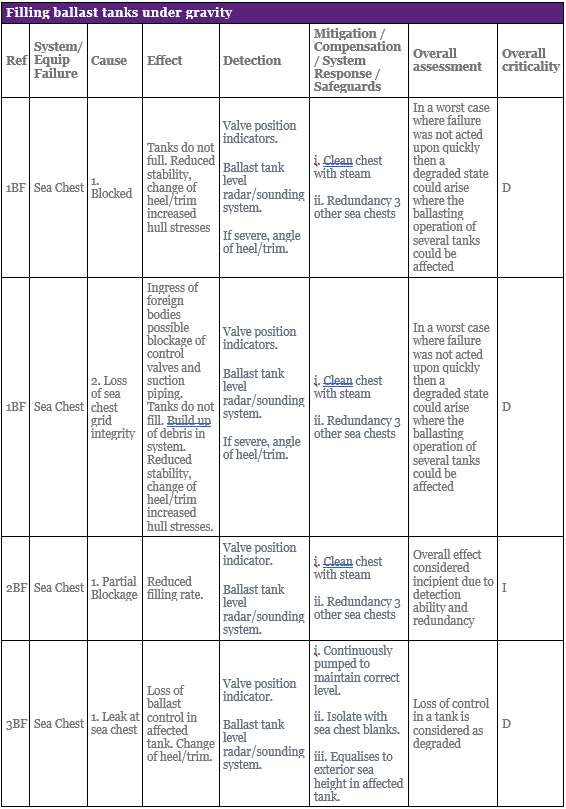
    An example extract from an FMEA of a ballast system is shown below. This can be found in the HSE Marine Risk Assessment Report. The column headings are based on the US Military Standard Mil-Std 1629A, but with modifications to suit the particular application. For example, the failure mode and cause columns are combined. The criticality of each failure is ranked as minor, incipient, degraded, or critical.

    An example of an FMEA Output Table

    To properly understand these results you need to know how a Sea Chest works (see context here). Otherwise the example just shows what kind of output a FMEA can produce.

    Top Tip

    Additional comments

    Failure Modes and Effects and Criticality Analysis (FMECA) is an analytical QRA technique, used by ARM and ILS systems engineers, most commonly and effectively at the late design, test and manufacture stage of a project. It requires the breakdown of the system into individual components and the identification of possible failure modes or malfunctions of each component, (such as too much flow through a valve). Referred to as a bottom-up approach, it starts by identifying the potential failure modes of a component and analyzing their potential effects on the whole system. Numerical levels can be assigned to the likelihood of the failure and the severity or consequence of the failure.

    Note: It is important to recognize that FMEA/FMECA Standards have different approaches to criticality. Failure mode severity classes 1 – 5 for Standards MIL1629A and ARP926A go from Class 1 being the most severe (e.g. loss of life) to Class 5 being less severe (i.e. no effect), whereas BS 5760 deals with criticality in the opposite direction where Class 5 is the most severe.

    Note that FMECA for ARM/ILS looks at availability or mission criticality, not safety criticality.  A FMECA for safety will have a different focus.

    Top Tip

    Software:

    • Isograph;
    • Reliability Work Bench;
    • Reliasoft;
    • Microsoft Excel.

    These are not recommendations!

    FMEA/FMECA tables for complex systems can run to hundreds of pages, so good tool support is essential.

    Top Tip

    Failure Mode Effects Analysis: Have You Used This Technique?

    Back to the Safety Assessment topic page.

    Meet the Author

    Learn safety engineering with me, an industry professional with 25 years of experience. I have:

    •Worked on aircraft, ships, submarines, ATMS, trains, and software;

    •Tiny programs to some of the biggest (Eurofighter, Future Submarine);

    •In the UK and Australia, on US and European programs;

    •Taught safety to hundreds of people in the classroom, and thousands online;

    •Presented on safety topics at several international conferences.