
The ISSS Credentialing Initiative: System Safety Professionals. Where is the Next Generation of System Safety Professionals? We need a Workforce Development Program for Safety-Critical Industries.
The International System Safety Society (ISSS) is launching a major credentialing initiative designed to strengthen and expand system safety capability across Canada and the United States.
Developed as a three-year industry partnership and sponsorship program, the initiative will create a structured pathway for professionals working with complex and safety-critical systems. The program combines modular learning, stackable micro-credentials, and verifiable digital certifications to help organizations build a stronger and more resilient safety workforce.
The initiative is being led by an ISSS sub-committee including Jenn Downing, ISSS Director of Education and Professional Development, and Carol-Ann Haggarty.
Why This Initiative Matters
Organizations operating in safety-critical environments face increasing challenges in recruiting, developing, and retaining personnel with the skills required to manage system safety throughout the lifecycle of complex systems.
Whether in defence, aerospace, transportation, energy, healthcare technology, telecommunications, or critical infrastructure, employers require practitioners who understand:
- Hazard identification and analysis
- Risk assessment and acceptance
- Safety assurance and evidence generation
- Lifecycle safety management
- Safety-informed decision making
The ISSS Credentialing Initiative addresses these challenges by creating a common, industry-recognized framework for developing and validating system safety competencies.
A Three-Year Development and Trial Program
The initiative will be delivered through a structured three-year model.
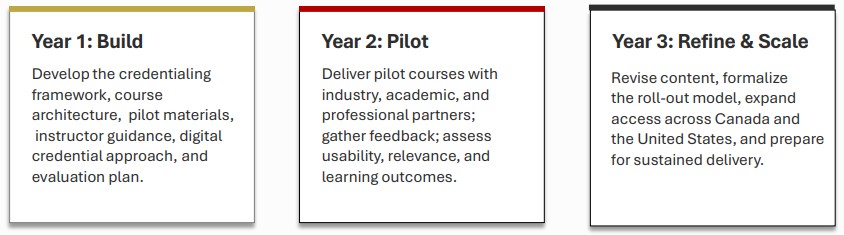
Year 1 – Build
The first year focuses on developing:
- The credentialing framework
- Course architecture and learning pathways
- Pilot training materials
- Instructor guidance
- Digital credentialing mechanisms
- Evaluation and assessment strategies
Year 2 – Pilot
Pilot courses will be delivered with industry, academic, and professional partners. Feedback will be collected to evaluate:
- Learning effectiveness
- Practical relevance
- User experience
- Workforce applicability
Year 3 – Refine and Scale
Following the pilot phase, the program will be refined and prepared for wider deployment across Canada and the United States. The goal is to establish a sustainable and scalable credentialing model that meets long-term workforce needs.
Creating a Workforce Pipeline
The credentialing pathway is designed to support professional development from entry into the workforce through to advanced practice.
The model provides a clear progression:

Students and Early-Career Professionals → ISSS Micro-Credentials → Verified Skills → Industry Deployment → Career Progression
This approach helps organizations identify talent, validate competencies, and accelerate workforce readiness.
Cross-Industry Applicability
A key strength of the program is its portability across industries.
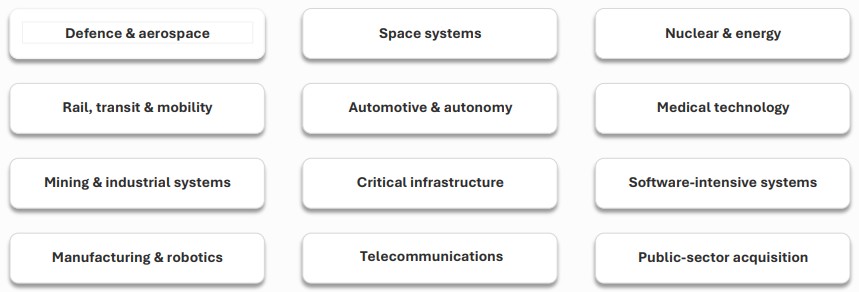
The credentialing model is intended to be standards-aware while remaining industry-neutral, making it applicable to sectors including:
- Defence and aerospace
- Space systems
- Nuclear and energy
- Rail and public transit
- Automotive and autonomous systems
- Medical technology
- Mining and industrial operations
- Critical infrastructure
- Software-intensive systems
- Manufacturing and robotics
- Telecommunications
- Public-sector acquisition
By focusing on disciplined safety thinking, evidence-based assurance, and risk management principles, the framework can support organizations operating under a wide range of regulatory and operational environments.
Benefits for Industry Partners
Industry participation is central to the success of the initiative.
Partner organizations can help ensure that the credentialing framework remains practical, current, and aligned with real workforce requirements. Benefits include:
Improved Workforce Readiness
Employees gain foundational and applied knowledge in system safety principles, reducing training gaps and improving operational effectiveness.
A Common Professional Language
The program promotes alignment across safety, systems engineering, software engineering, quality assurance, human factors, compliance, and program management functions.
Reduced Onboarding Costs
Organizations gain access to personnel with a recognised baseline of knowledge and capability, reducing the need to repeatedly teach foundational concepts internally.
Scalable Capability Development
The modular structure allows organizations to support workforce development at scale while maintaining consistency across teams and locations.
Inclusive Workforce Development
The ISSS Credentialing Initiative is built upon Universal Design for Learning (UDL) principles.
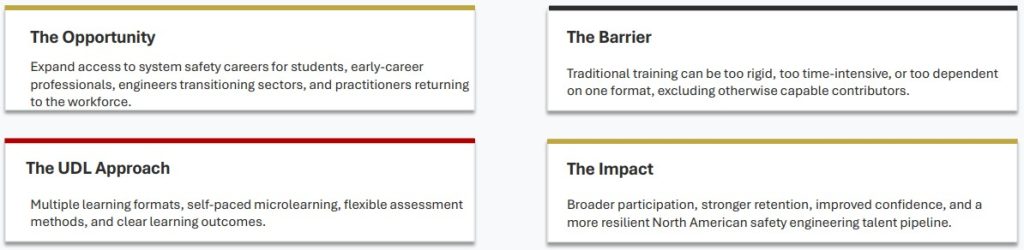
The program seeks to expand access to system safety careers for:
- Students
- Early-career professionals
- Engineers transitioning between industries
- Practitioners returning to the workforce
Learning will be delivered through flexible formats, including self-paced modules, micro-learning approaches, and multiple assessment methods.
This inclusive design helps broaden participation, improve learner confidence, and strengthen the long-term safety engineering talent pipeline across North America.
Opportunities for Sponsorship and Partnership
ISSS is currently seeking organizations willing to support the development and trial period through one or more of the following roles:

Sponsors
Provide financial support for:
- Curriculum development
- Pilot delivery
- Evaluation activities
- Accessible learning design
- Launch preparation
Partners
Support the initiative by:
- Nominating pilot participants
- Reviewing course relevance
- Providing structured feedback
- Validating workforce outcomes
Champions
Help expand awareness by connecting ISSS with:
- Industry networks
- Professional societies
- Academic institutions
- Government stakeholders
- Potential implementation partners
Sponsors may also receive benefits including brand recognition, pilot course access, participation in feedback activities, and discounted access during the formal rollout phase.
The Next Step
The ISSS Credentialing Initiative represents an opportunity to build a sustainable and scalable system safety workforce development framework for North America.
Organizations interested in shaping the future of system safety education and professional development are invited to:
- Become a partner
- Sponsor the initiative
- Nominate pilot participants
- Contribute subject matter expertise
- Support long-term rollout and adoption
By working together, industry, academia, government, and professional societies can help create a stronger pipeline of qualified professionals capable of supporting the increasingly complex and safety-critical systems upon which modern society depends.

Hi, I’m Simon Di Nucci. I am a practicing system safety engineer and have been for the last 30 years. I’ve worked in all kinds of domains: aircraft, ships, submarines, sensors, and command-and-control systems, rail, air traffic management systems, and lots of software safety. So, I’ve done a lot of different things!